pink underwing - Species Profile
Conservation • Description • Habitat • Ecology • Distribution • Taxonomy

Hodges #
8833
Conservation Status
IUCN Red List
not listed
NatureServe
NNR - Unranked
SNR - Unranked
Minnesota
not listed
Description
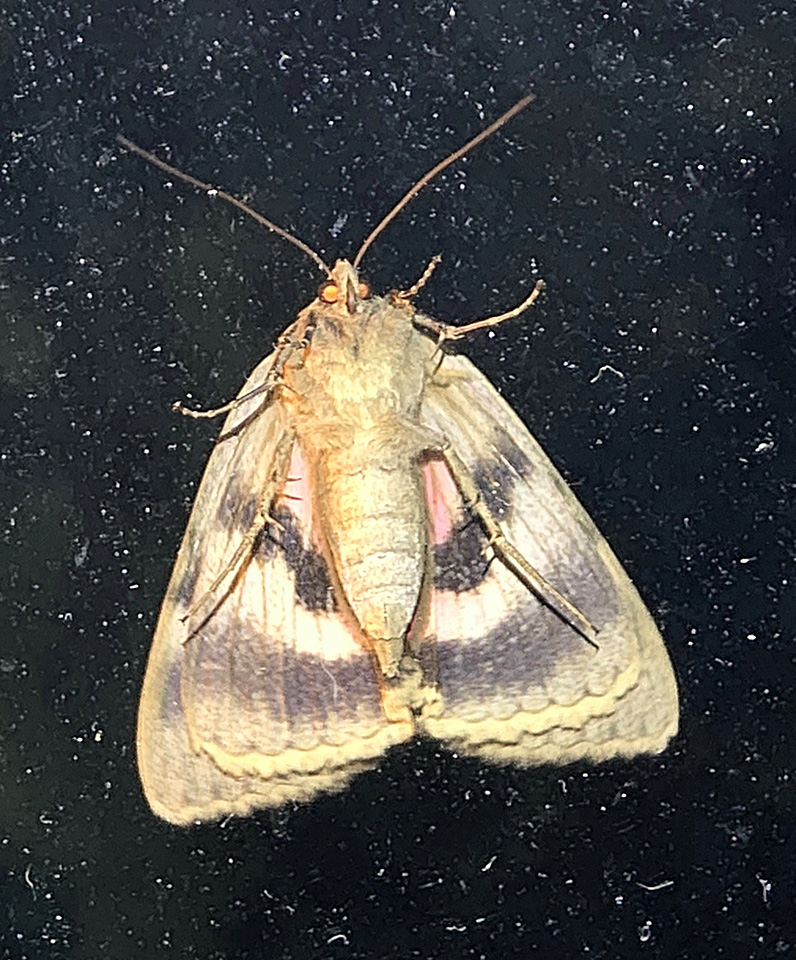
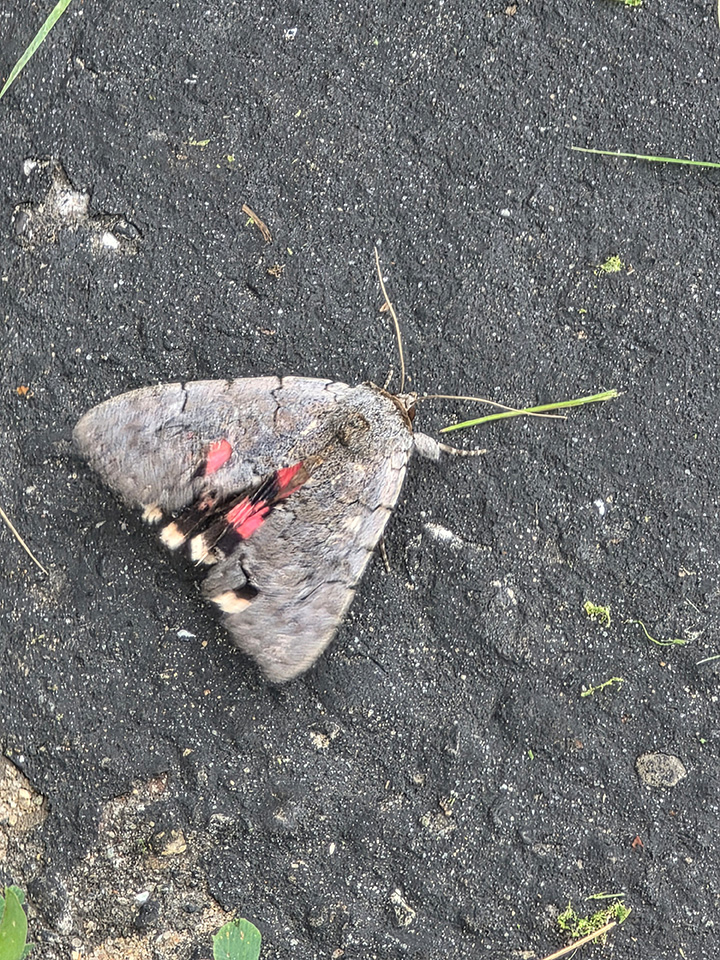
Pink underwing is a medium to large sized, strikingly colored, underwing moth. Adults are 1¼″ to 1½″ in length and have a wingspan of 2⅜″ to 3″.
The forewings are light gray and brownish gray with thin, black, jagged, antemedial and postmedial lines. The kidney-shaped (reniform) spot is slightly paler than the surrounding background color. The hindwings are pink with a black median band, a black terminal band, and a wide, straight, uninterrupted, white fringe.
The antennae are slender and thread-like.
There is a prominent tympanal hearing organ on each side of the thorax.
Size
Wingspan: 2⅜″ to 3″
Total length: 1¼″ to 1½″
Similar Species
Darling underwing (Catocala cara) forewings are darker grayish-brown and violet-brown. The fringe on the hindwing is undulating or checkered.
Once-married underwing (Catocala unijuga) forewing reniform spot is dark and there is a whitish spot in front of it. The subterminal jagged line has a broad, whitish outline in front. The fringe on the hindwing is undulating.
Habitat
Shrubby riverbanks, woodland edges, urban plantings.
Ecology
Season
One generation per year: August to early September.
Behavior
Larvae are solitary feeders.
Adults are active at night. They are attracted to light. When at rest the wings are folded roof-like over the body. When approached or disturbed they spread their forewings revealing the startling color of the hindwings, possibly to scare off or give it time to escape a predator.
Life Cycle
Eggs overwinter.
Larva Food/Hosts
Leaves of poplar (Populus spp.) and willow (Salix spp.).
Adult Food
Distribution

Sources
Biodiversity occurrence data published by: Minnesota Biodiversity Atlas (accessed through the Minnesota Biodiversity Atlas Portal, bellatlas.umn.edu. Accessed 8/25/2026).
Catocala concumbens Walker in Bánki, O., Roskov, Y., Döring, M., Ower, G., Hernández Robles, D. R., Plata Corredor, C. A., Stjernegaard Jeppesen, T., Örn, A., Pape, T., Hobern, D., Garnett, S., Little, H., DeWalt, R. E., Miller, J., Orrell, T., Aalbu, R., Abbott, J., Abreu, C., Acero P, A., et al. (2026). Catalogue of Life (2026-07-17 XR). Catalogue of Life Foundation, Amsterdam, Netherlands. https://doi.org/10.48580/dgykv
Quinn, Edward. M., and Ron Danielson. April 27, 2009. A Survey of Lepidoptera in Three Priority Areas of the Minnesota State Parks System. https://files.dnr.state.mn.us/eco/nongame/projects/consgrant_reports/2009
/2009_quinn_danielson.pdf.
Occurrence
Common
Taxonomy
Order
Lepidoptera (Butterflies and Moths)
Superfamily
Noctuoidea (Owlet Moths and Allies)
Family
Erebidae (Underwing, Tiger, Tussock, and Allied Moths)
Subfamily
Erebinae (Underwings, Zales, and Related Owlets)
Tribe
Catocalini
Genus
Catocala (Underwing Moths)
Subordinate Taxa
Synonyms
Catocala diana
Catocala hillii
Common Names
pink underwing