plains clubtail - Species Profile
Conservation • Description • Habitat • Ecology • Distribution • Taxonomy

Conservation Status
IUCN Red List
not listed
NatureServe
N5 - Secure
SNR - Unranked
Minnesota
not listed
Description
Plains clubtail is a medium-sized to large dragonfly. It occurs in the United States from Ohio west to eastern Idaho, north to Minnesota, and south to Louisiana and New Mexico. It also occurs in southern Winnipeg and Saskatchewan Canada. It is relatively common in Minnesota. It is found at large, moderately flowing rivers and large streams with muddy bottoms and grassy or wooded banks. It is occasionally found at lakes. Adults are active from early April to mid-August. They will eat almost any flying insect. The larvae are aquatic. They eat aquatic insects, freshwater shrimp, small fish, and tadpoles.
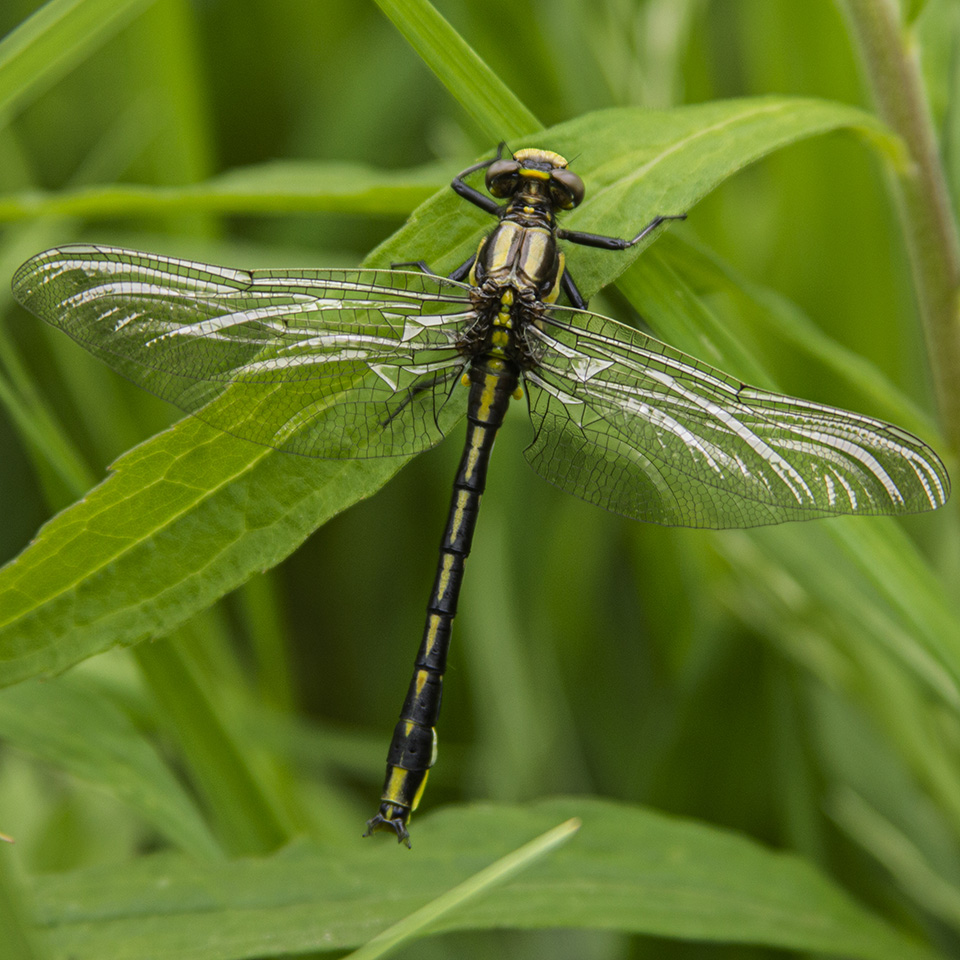
Adults are 2 1⁄16″ to 2⅜″ (52 to 60 mm) in length. The body is stocky, heavily clubbed, and brownish-black with extensive bright yellow markings.
The head is small. The plate on the face (clypeus) is crossed in the middle by a transverse groove called the frontoclypeal suture. There is no black band on the face, but the frontoclypeal suture may appear as a dark hairline. The large compound eyes are turquoise blue and do not meet at the top of the head on either sex. The area behind the compound eyes at the top of the head (occiput) on both sexes is yellow. On the female there is a short, yellow, laterally slanting horn next to each compound eye in front of the occiput.
The thorax is large and black with yellow stripes. On the upper side there is a pair of stripes (dorsal top stripes). Each stripe has an inward, bar-like extension at the top that meets the other stripe, and an outward, hook-like extension at the bottom. On the sides of the thorax there is a thin gray upper stripe in the shoulder area, two widely separated yellow stripes, and a gray stripe between the yellow stripes. The gray stripes are variable. The upper gray stripe varies in length from long and complete, connecting with the dorsal top spot at the bottom, to short and incomplete. The lower gray stripe is variable in width.
On the abdomen there are yellow spots on top of all segments. There is a lance-shaped spot on segments 1 through 7 (S1 to S7), a triangular spot on S8, a rectangular spot on S9, and a small dot on S10. S7, S8, and S9 are expanded into a noticeable, moderate-sized “club”. The sides of S8 and S9 have large yellow spots that reach the edges. On S8 the spot is mostly complete. On S9 the spot is the entire length of the segment. At the tip of segment 10 the male has claspers used to grasp the female during mating. The claspers consist of a pair of upper appendages (cerci) and a single lower appendage (epiproct). The claspers are very widely forked. The epiproct is wider than the cerci when viewed from above, and it extends well beyond the cerci. The female also has cerci on S10, but they are non-functional and tend to break off.
The legs are black. On the female, the third leg segment (femur) often has a yellow stripe. On both sexes, the fourth leg segment (tibia) has a pale yellow stripe near the base.
The wings are clear except for a dark cell (stigma) on the leading edge (costal margin) near the tip. The vein on the costal margin (costa) of each wing is bright yellow.
Size
Total length: 2 1⁄16″ to 2⅜″ (52 to 60 mm)
Similar Species
Pronghorn clubtail (Phanogomphus graslinellus) is very similar but smaller. S9 is all yellow above. S10 has more yellow above. On the male it has a yellow stripe. On the female it is mostly yellow. On the male, the epiproct extends barely beyond the cerci.
Habitat
Large, moderately flowing rivers; large streams with muddy bottoms and grassy or wooded banks;.and occasionally lakes
Ecology
Season
Early April to mid-August
Behavior
When near water, males will perch on the shore, on rocks exposed above water, or lacking these, on overhanging vegetation. When away from water, they will perch on the ground or at the tips of weeds. They make a long, wide, surveying patrol far over water and return to their perch.
Males fly with their club raised. The flight is bouncy.
Life Cycle
Naiad Food
Aquatic insects, freshwater shrimp, small fish, and tadpoles
Adult Food
Flying insects
Distribution

Sources
Biodiversity occurrence data published by: Minnesota Biodiversity Atlas (accessed through the Minnesota Biodiversity Atlas Portal, bellatlas.umn.edu. Accessed 10/21/2022).
Gomphurus externus (Hagen in Selys, 1858) in Bánki, O., Roskov, Y., Döring, M., Ower, G., Hernández Robles, D. R., Plata Corredor, C. A., Stjernegaard Jeppesen, T., Örn, A., Pape, T., Hobern, D., Garnett, S., Little, H., DeWalt, R. E., Miller, J., Orrell, T., Aalbu, R., Abbott, J., Abreu, C., Acero P, A., et al. (2026). Catalogue of Life (2026-05-15 XR). Catalogue of Life Foundation, Amsterdam, Netherlands. https://doi.org/10.48580/dgxsq
Abbott, J.C. 2006-2026. OdonataCentral: An online resource for the distribution and identification of Odonata. Available at https://www.odonatacentral.org/. (Accessed: 10/21/2022).
Haarstad, J. 1997. The dragonflies of selected eastern Minnesota rivers. Report submitted to the Minnesota Department of Natural Resources. Unpaged.
Occurrence
Fairly common
Taxonomy
Order
Odonata (Dragonflies and Damselflies)
Suborder
Superfamily
Gomphoidea
Family
Gomphidae (Clubtails)
Genus
Gomphurus
Genus
This species was formerly classified as Gomphus externus. In an attempt to clarify the relationships of species in the genus Gomphus (Needham, 1947) , five subgenera were proposed. This species was placed in the subgenus Gomphurus. In later years, several other subgenera were defined. Nine of the genera were grouped in what was called the Gomphus complex. A recent phylogenetic analysis (Ware, et al., 2017) raised all nine subgenera in the complex to genus level, and Gomphus externus became Gomphurus externus.
Subordinate Taxa
Synonyms
Gomphus externus
Gomphus consobrinus
Common Names
plains clubtail