Polyphemus moth
(Antheraea polyphemus)
Conservation • Description • Habitat • Ecology • Distribution • Taxonomy

Hodges #
7757
Conservation Status
IUCN Red List
not listed
NatureServe
N5 - Secure
Minnesota
not listed
Description
Polyphemus moth is a common, extra large, giant silkworm moth. With a wingspan of 4″ to 6″ it is one of the two largest moths native to North America. Females are larger than males.
Wing coloration is highly variable. A single batch of eggs reared on the exact same tree will typically yield a mix, with some individuals leaning golden yellow, others warm cinnamon brown, and others a muted grayish tan. Genetic recombination guarantees that color intensity and gray dusting vary from sibling to sibling, giving the overall population a diverse set of camouflage shades to blend into different tree bark and leaf litter.
The uppersides of the wings are various shades of reddish brown, yellowish brown, or cinnamon brown. The median area is dusted with black and the submarginal area is pale. Each wing has a pink, white and black subterminal line and a transparent eyespot in the median area.
The leading edge of the forewing (costal margin) is whitish and dusted with black. The line separating the basal and median areas on the forewing (antemedial line) is pink, white, dark brown, and black. The eyespot is small and oval. It is ringed with a broad yellow line and a thin black line. There is a blue crescent on the inner edge.
The eyespot on the hindwing is similar but larger and more conspicuous. It is in the middle of a large, round to irregular, black patch. A thin pink line separates the black patch from the basal area.
There are no mouth parts and no hearing organs. Males have feather-like antennae with branches on both sides of the central axis. Females have smaller, less bushy antennae.
The caterpillar is bright green, plump, and up to 3″ long. There is usually a steeply oblique yellow line that passes through the breathing holes (spiracles) of abdominal segments 2 through 7 (A2–A7). On A1–A7 there six warts, on thoracic segments 2 and 3 (T2 and T3) there eight warts. There is one wart on each side of the dorsal midline (addorsal), one above the spiracle (supraspiracular), and one below the spiracle (subspiracular). T1 to T3 also have a wart just above each leg-like structure (proleg). The addorsal and supraspiracular warts on the abdomen are flashy silver and red. The subspiracular warts on the abdomen and all of the warts on the thorax are mostly orange and lack silver. Each wart has 2 to 5 minute, white, bristle-like hairs (setae). The prolegs are green. The anal plate is dark and continues as a line across A9. T1 is short and collar-like with a flat, yellow front edge. The head is orangish brown and is partially withdrawn into T1.
Mature caterpillars can be found from late May through November.
Size
Wingspan: 4″ to 6″
Similar Species
Luna moth (Actius luna) caterpillar is similar. A1–A7 have a yellow transverse line near the trailing edge of each segment, not passing through the spiracle.
Habitat
Deciduous hardwood forests, urban areas, suburbs, agricultural fields, orchards, wetlands
Ecology
Season
One brood: Late May to July
Behavior
Adults are attracted to lights.
Life Cycle
Polyphemus moth are short-lived, lasting only 4 to 7 days, since they have no mouth parts and do not feed. In Minnesota there is usually just a single generation per year. Adults emerge in late spring and early summer, May to July, though late-emerging individuals or a partial second brood can occasionally be seen into late August. They find a mate on the night of the same day they emerge from the cocoon. The males use their specialized antennae to detect pheromones released by the females. After breeding, the female lays up to 150 to 200 eggs, singly or in small clusters of 2 to 5 eggs, on either side of the leaves of a host shrub or tree. The eggs are flattened and light brown.
The eggs hatch in about 10 days. The larvae are solitary feeders. They molt 5 times in 5 to 6 weeks before pupating. In late summer or early fall each caterpillar spins a cocoon in which it will spend the winter. Many caterpillars descend to the ground and spin their cocoon in leaf litter. Most others spin their cocoon in a leaf attached to the host plant, which falls to the ground at the end of the season. In the south some cocoons remain attached to the host plant.
Larva Food/Hosts
Leaves of deciduous trees and shrubs; especially members of the birch, rose, and willow families; but also apple, ash, dogwood, elm, hazel, hickory, maple and oak.
Adult Food
Adults do not feed.
Distribution

Sources
Biodiversity occurrence data published by: Minnesota Biodiversity Atlas (accessed through the Minnesota Biodiversity Atlas Portal, bellatlas.umn.edu. Accessed 8/25/2026).
Antheraea (Telea) polyphemus Cramer, 1775 in Bánki, O., Roskov, Y., Döring, M., Ower, G., Hernández Robles, D. R., Plata Corredor, C. A., Stjernegaard Jeppesen, T., Örn, A., Pape, T., Hobern, D., Garnett, S., Little, H., DeWalt, R. E., Miller, J., Orrell, T., Aalbu, R., Abbott, J., Abreu, C., Acero P, A., et al. (2026). Catalogue of Life (2026-07-17 XR). Catalogue of Life Foundation, Amsterdam, Netherlands. https://doi.org/10.48580/dgykv
Quinn, Edward. M., and Ron Danielson. April 27, 2009. A Survey of Lepidoptera in Three Priority Areas of the Minnesota State Parks System. https://files.dnr.state.mn.us/eco/nongame/projects/consgrant_reports/2009
/2009_quinn_danielson.pdf.
Occurrence
Common
Taxonomy
Order
Lepidoptera (Butterflies and Moths)
Superfamily
Bombycoidea (Hawk, Sphinx, Silk, Emperor, and Allied Moths)
Family
Saturniidae (Emperor and Giant Silk Moths)
Subfamily
Tribe
Saturniini
Genus
Antheraea (Tussar Moths)
Subordinate Taxa
Mexican polyphemus moth (Antheraea polyphemus mexicana)
polyphemus moth (Antheraea polyphemus olivacea) 
polyphemus moth (Antheraea polyphemus polyphemus) 
polyphemus moth (Antheraea polyphemus tuxtlasensis)
Synonyms
Antheraea tuxtlasensis
Phalaena fenestra
Phalaena polyphemus
Telea albida
Telea brunnea
Telea flava
Telea fumosus
Telea intermedia
Telea nigra
Telea nigrescens
Telea olivacea
Telea polypheme
Telea polyphemus
Telea vinacea
Telea wilfriedi
Common Names
polyphemus moth
Visitor Photos
This button not working for you?
Simply email us at info@MinnesotaSeasons.com.
Attach one or more photos and, if you like, a caption.
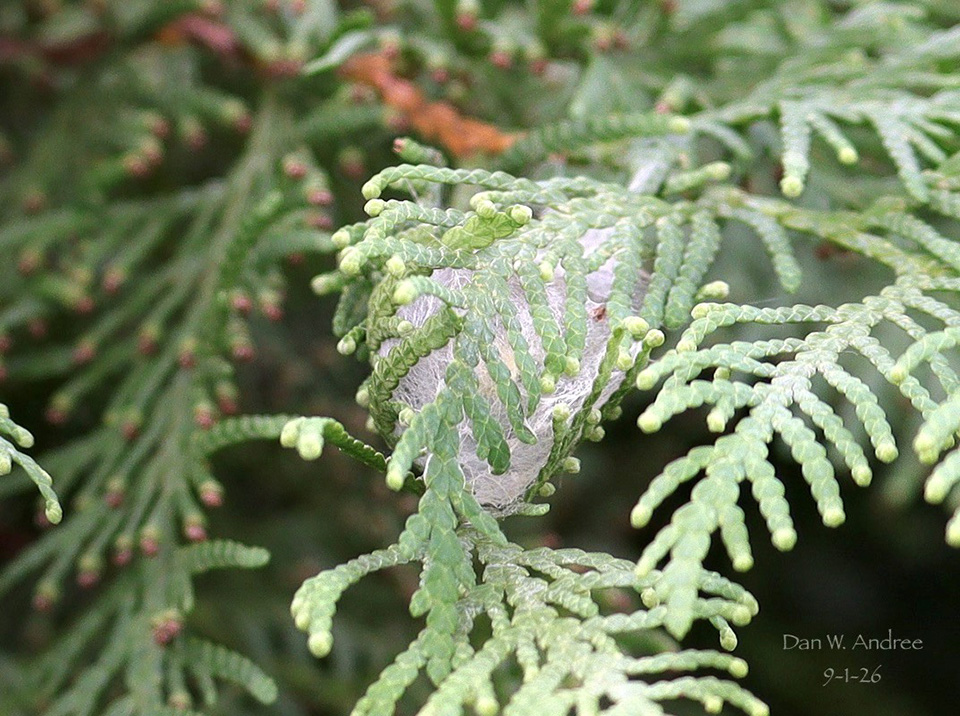
Around 19 days later...
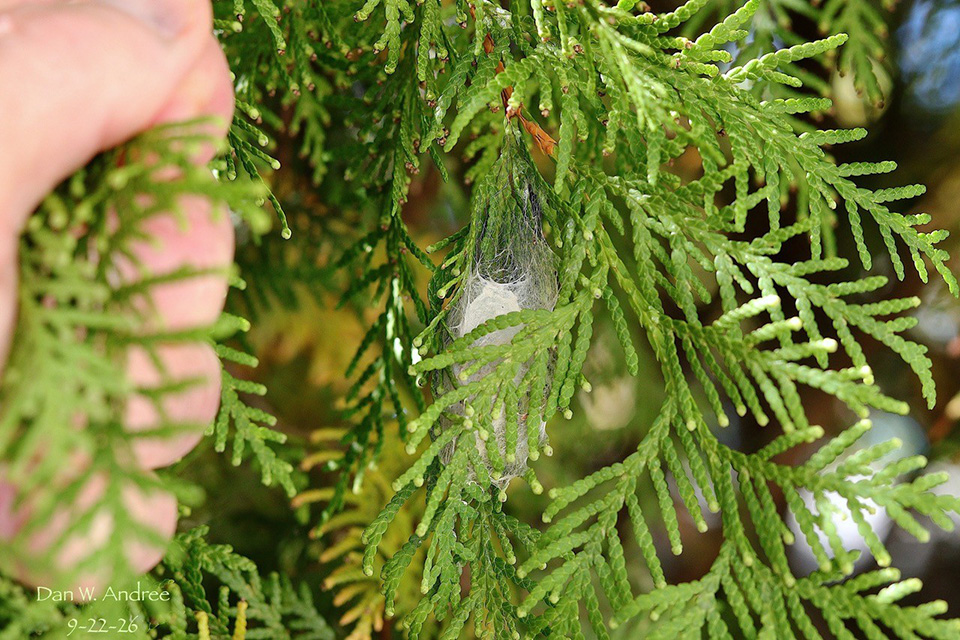
…from the first time I seen this cocoon. This is today. I only could find one but do think at one time there were two. I’ll check it out another day its a big bushy juniper or some sort of arborvitae species that grew maybe 15 ft or so high and about as round. It's shaped like a ball. We had rain on and off in Sept. and grass etc. is green again.
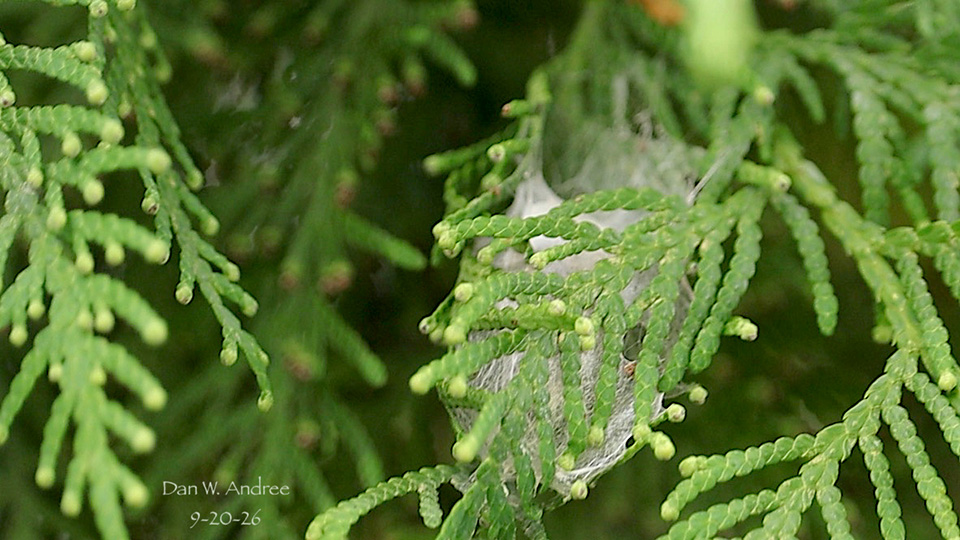
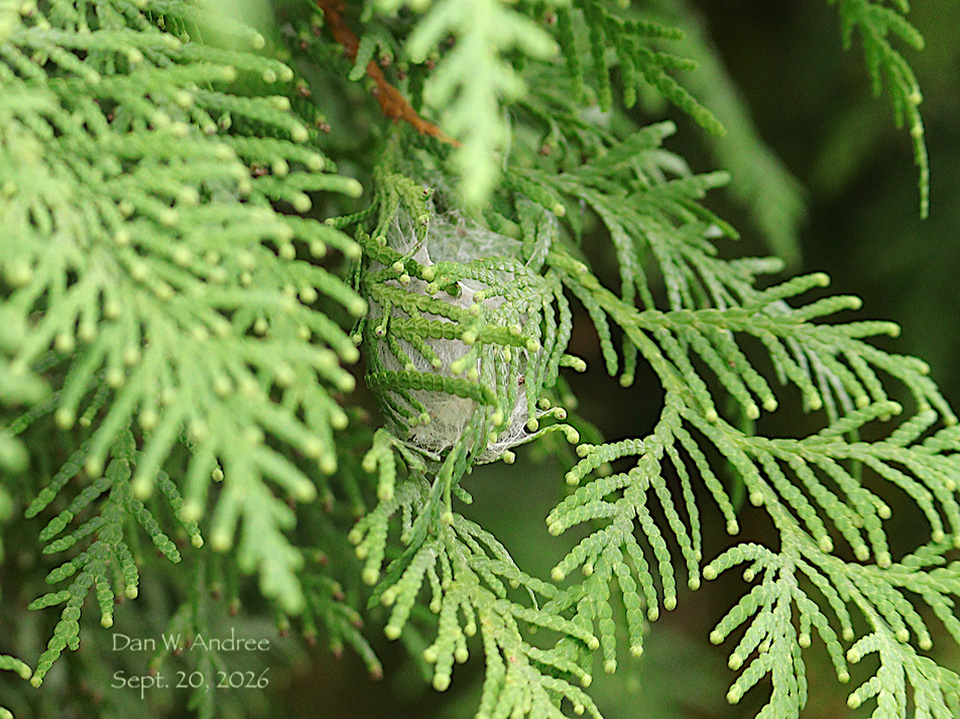
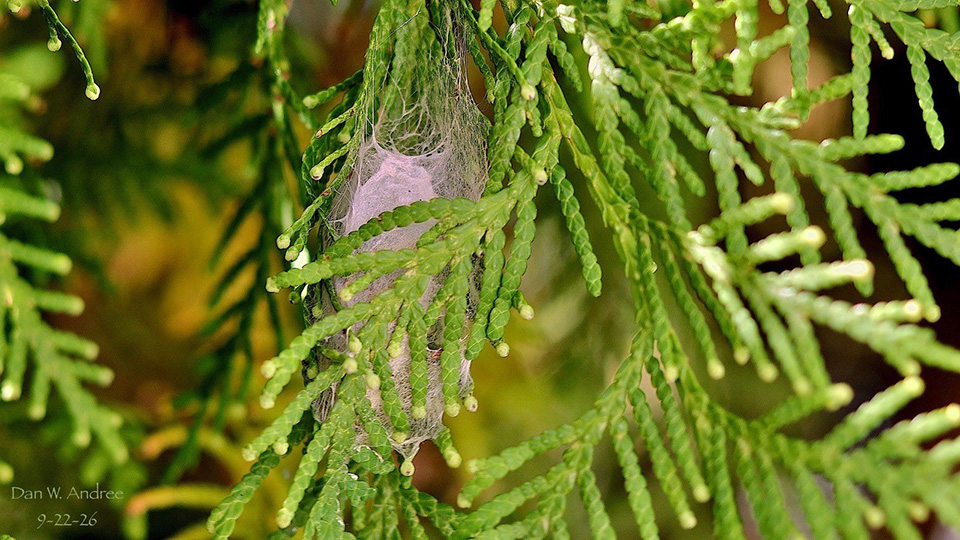
Here is a couple Cocoon images...
Though that lighter area doesn’t look like it, but it is a paper like outer area starting. I pulled the branch down to get a different angle. Not sure if it is a polyphemus moth cocoon since it has been there since beginning of September and hasn’t really changed a whole lot far as darkening or becoming more paper like on the outer area. It is only about 1.5 inches at most.… I will keep an eye on it from time to time to see if it changes in texture, color etc. Nature can be kind of confusing at times, but I find it fun anyway. Gets my brain really thinking and wondering.
Antheraea polyphemus moth...
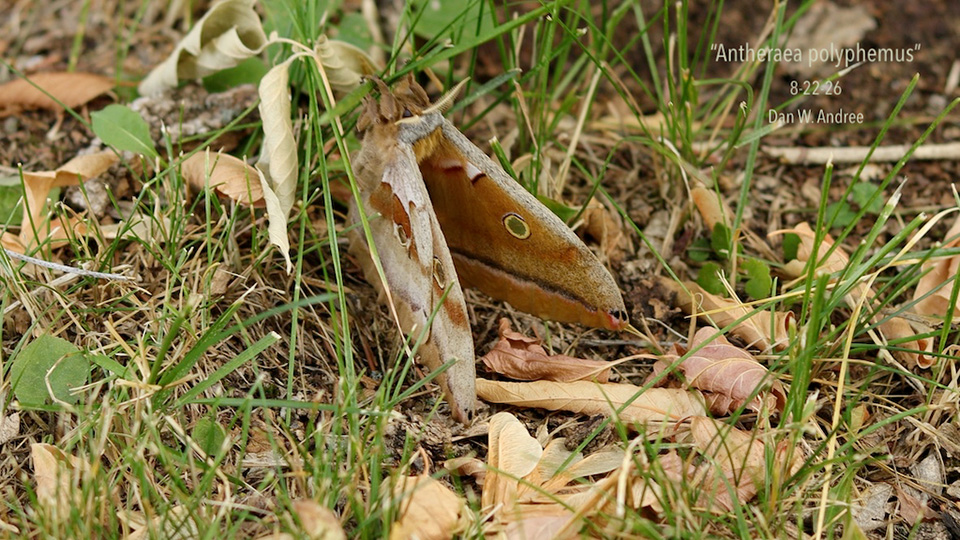
This moth has been hanging around my backyard mainly in my birch tree. I noticed it yesterday which was the 22nd of Aug. 2026. She was hanging in the dense leaf part apparently sleeping. I got my camera out and started trying to film and photograph it though the angle and lighting wasn’t the greatest so decided to quit. I must have spooked it because once I got out from under the branches and turned around and looked back it was gone. So thought it must have flown away. Later I was just out in the backyard and looking around and the same moth was on a boxelder tree trunk though I didn’t notice until it spooked and flew down to the ground as shown in this image. It remained there for a few minutes then awkwardly crawled over grasses and fallen leaves and crawled about five feet up onto the boxelder tree trunk and remained stationary for hours. Finally in the evening I went to check on it and it did decide to crawl up a little higher then flutter its wings and flew off. However today now she is back same moth with same markings etc. and just hanging on the birch tree trunk that I first discovered her the other day. She clings tight to a piece of pealing bark and a breeze sways her in the wind a little but she hangs on. I read females have thinner or not as dense antenna and she has the thinner. I did see a few photos of males and am convinced she is a female.
I know this type of large moth lay eggs in certain trees birch being one mentioned so maybe she is going to or has. I don’t know what time of year etc. they lay eggs etc. But she seems to like my birch tree which is dense in leaves even though been dry at times and hot this summer. I wonder when the caterpillars emerge too.
Anyway I’ve been busy working and my car has been giving me issues all summer so haven’t been out in nature as much as usual. But was fortunate to find this really interesting large moth in the backyard. She will more than likely hang in that spot on the birch tree and has already for a few hours since I first seen her today. Will maybe attempt to see if I can get some imagery if she spreads those wings. Yesterday she was just mainly tight closed wings or loosely but only opened then before she flew off. Got 7 sec. video of it then switched to photos as I wanted to try get a couple good photos as well. Only got 2 before she took off. They are always hard to predict like most things in nature. Catch a person off guard.
Antheraea polyphemus moth...
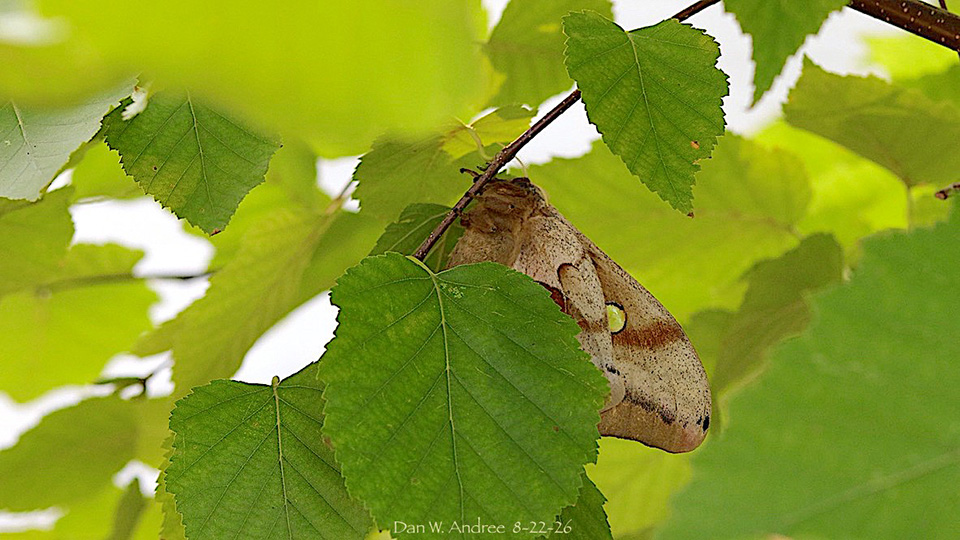
This is how I first seen this moth on my birch tree somewhat concealed. Since they only live 4 days she would have laid eggs during that time wouldn’t she have? If so they would still hatch this summer and the caterpillars then spin a cocoon and emerge in the spring would that be correct?
Just curious and will keep my eyes open to see if I see any caterpillars around the birch trees etc. She seemed to favor the birch tree close to my back porch. The second day which was the 23rd of Aug. 2026 she just remained on the birch tree trunk for hours most of the day until around 6 pm or a little after 6pm. Haven’t seen it since. It could have been in my backyard area its whole life and I just didn’t notice it at first.
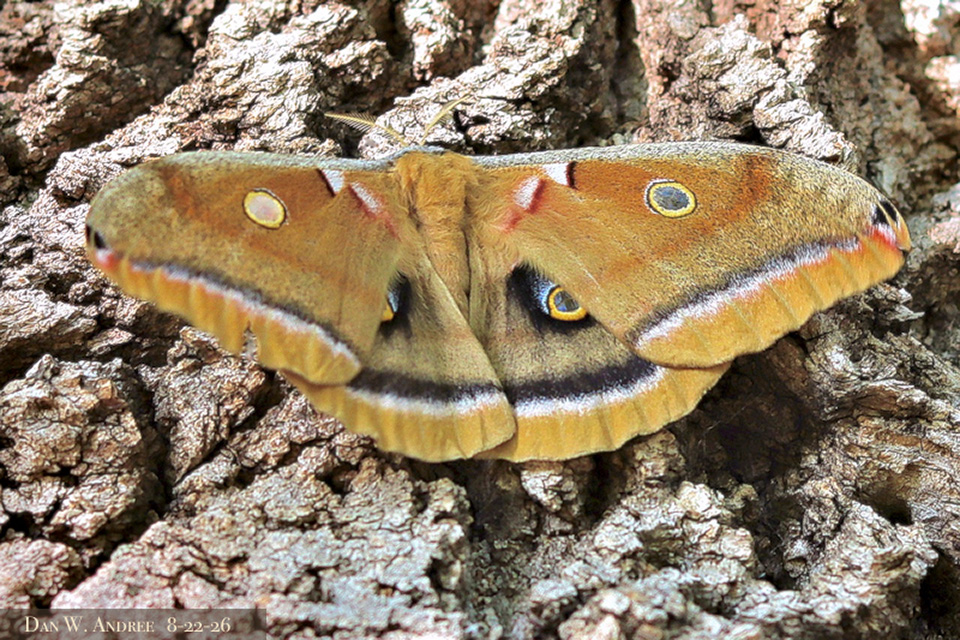
Antheraea polyphemus...
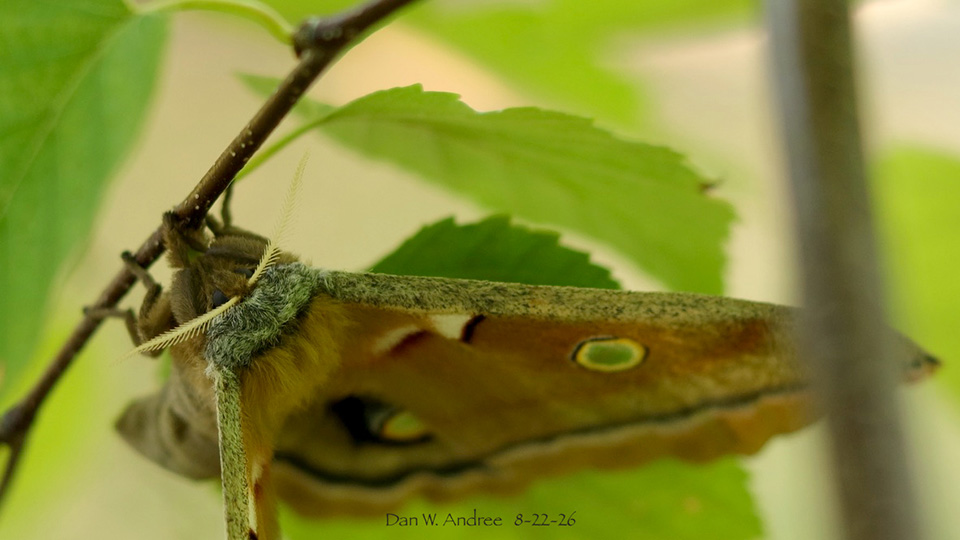
It shivered its wings and flew away. Rarely opened its wings and when it did only for a few seconds or so then took off. When it returned the next day the 23rd it just clung to the birch tree trunk for hours and sometime after 6pm I was going to go out and check on it but it was gone. I got quite a bit of video of it, but only a few seconds with its wings open. It was an interesting moth I had not seen or even knew of this species of moth until this one showed up in my birch tree recently. Neat markings too.
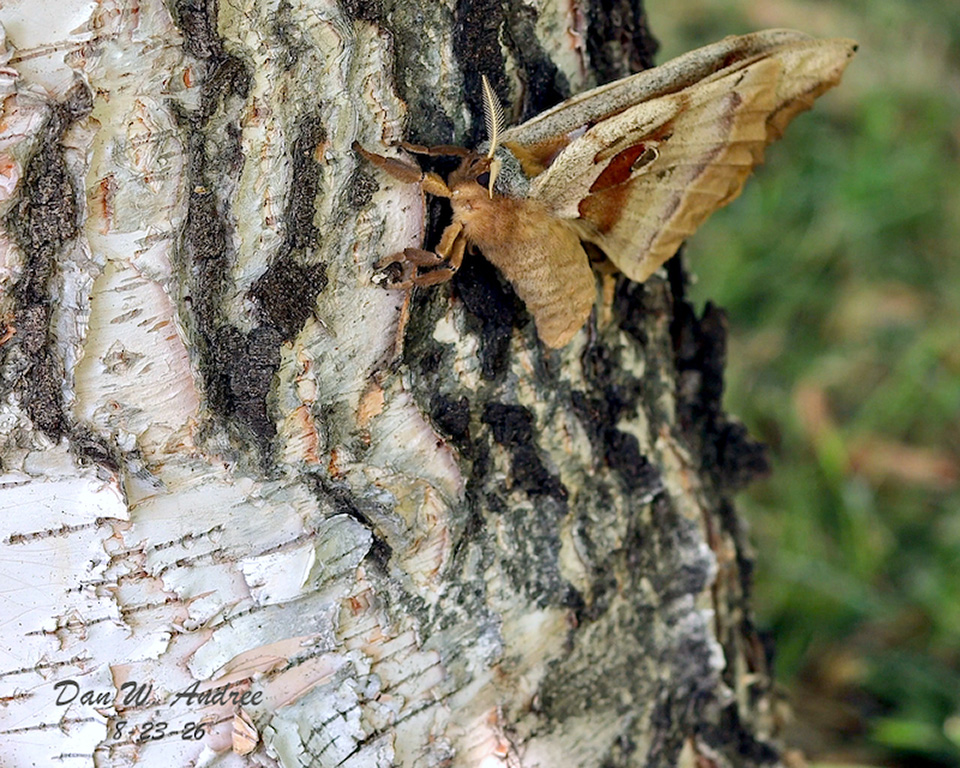
Breezy but hanging on...
Description: A breeze came up and blew her sideways, but she clung to the birch tree. Interesting they have no mouth parts. She stayed clinging to the birch tree all day and left sometime after 6 pm. Similar to the previous day where she just stayed on a boxelder tree for hours until sometime after 6 pm. that day too.
One never knows what may show up in ones backyard area. This big moth was an unexpected and real interesting encounter.
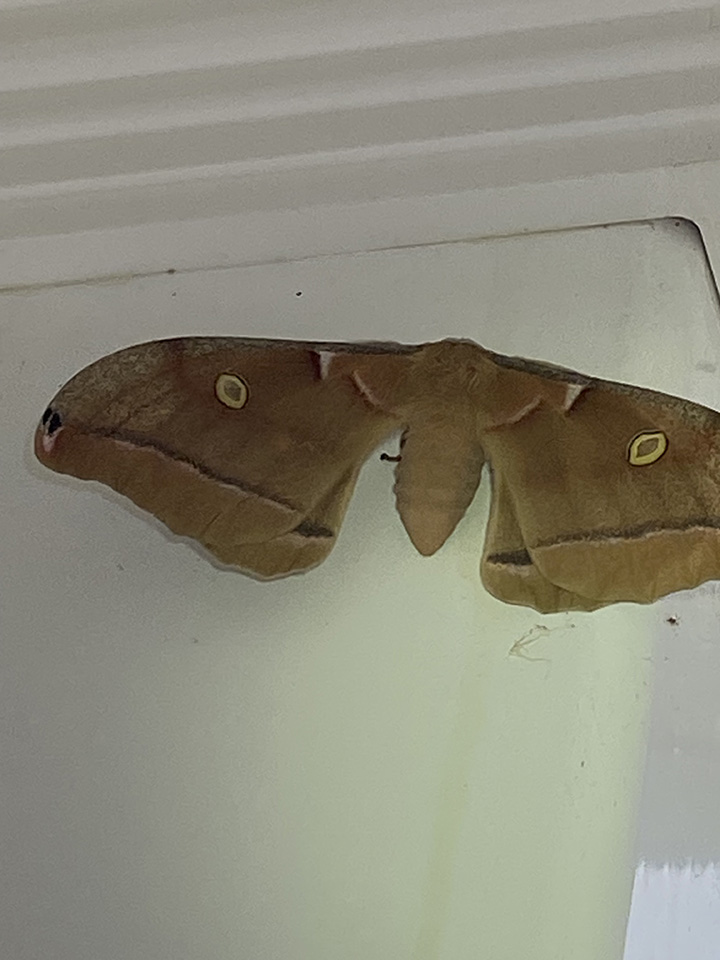
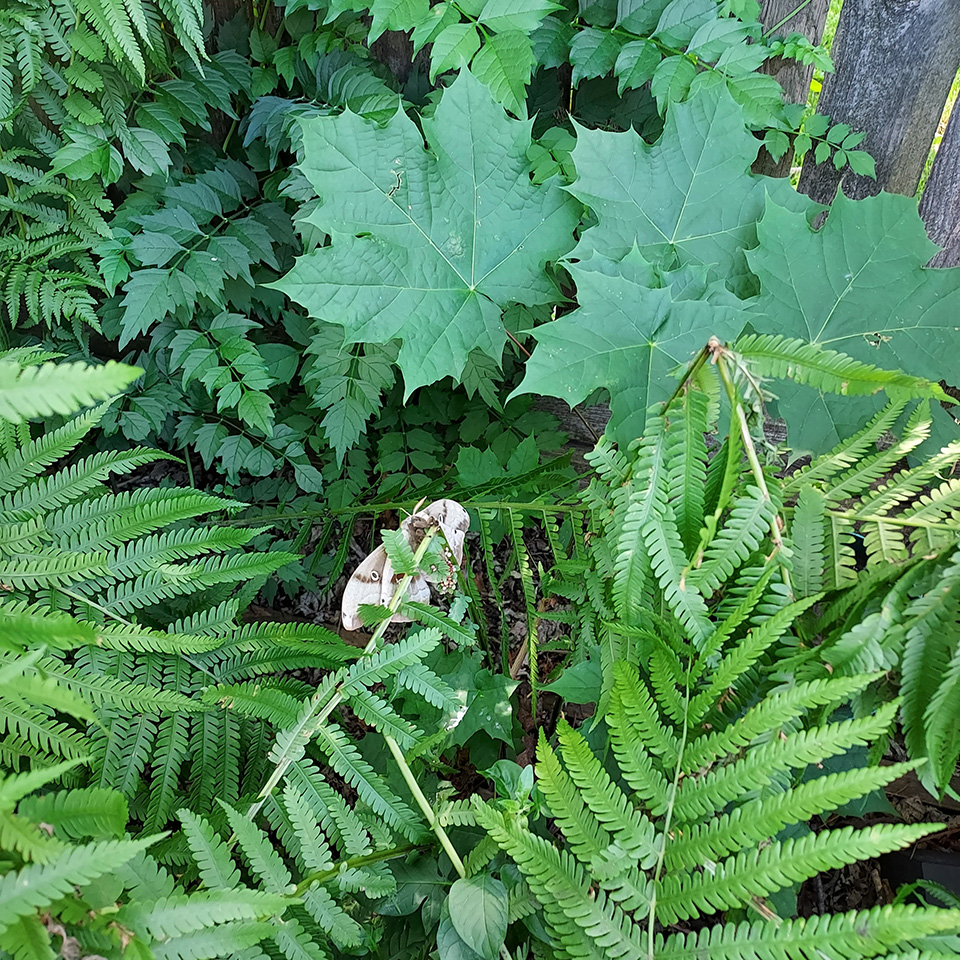


Laid its eggs on an Iris leaf. Photos by me: Matthew Borchert. Have many more on my Facebook page.


Lorem ipsum dolor sit amet, consectetur adipisicing elit. Error accusamus saepe ipsa voluptatum molestias officiis fugiat obcaecati et aliquid nulla eius dolor inventore vel quo nihil repudiandae expedita nesciunt, vitae doloremque, eligendi id minus ratione corporis?


Polyphemus moth?
Is the cocoon for the Polyphemus moth?
I am in South Texas. I keep trying finding these on my peach tree. This is the first year I have seen these.
Note: it has a dried leaf stuck on the hair like fibers?
found outside my job this morning, Over 5 in Long, when trying to relocate it to a tree or something it could not fly it would go up two or three times and then falls flat down. Attaching two photos!

Polyphemus cocoon?
I thought I'd send this your way and see what you thought. I found it among a pile of pinecone scales (squirrels are messy eaters lol) my mom had raked up from under our pine trees. There is a large oak tree just feet away from the pine trees so that's why I'm thinking it's a polyphemus moth cocoon. I'm in Austin, MN - Mower county. It seems early but I'd guess it's ready to overwinter? Let me know what you think. I'm thinking of keeping it in a container in the garage to see what emerges.


I found your website when I was trying to identify this moth on our porch...it’s definitely a Polyphemus moth. Very cool! Just wanted to let you know because we live in Isanti County and I see that you haven’t identified them as being seen here yet. Now you can!


Minnesota Seasons Photos
Slideshows
Polyphemus Moth - Hodges#7757 (Antheraea polyphemus)
Andree Reno Sanborn
Antheraea polyphemus (Polyphemus Moth)
Allen Chartier
Visitor Videos
This button not working for you?
Simply email us at info@MinnesotaSeasons.com.
Attach a video, a YouTube link, or a cloud storage link.
Antheraea polyphemus (Polyphemus Moth)
Jun 28, 2019
Other Videos
Polyphemus Moth (Antheraea polyphemus) Close-up
Carl Barrentine
Giant Green Caterpillar (Antheraea polyphemus) crawling HD
joe pompili
Polyphemus Moth Lifecycle
LOBAM!
Polyphemus Moth (female)
Carol Snow Milne
Visitor Sightings
This button not working for you?
Simply email us at info@MinnesotaSeasons.com.
Be sure to include a location.
Dan W. Andree
9/22/2026

Location: Norman Co. Mn.
Though that lighter area doesn’t look like it, but it is a paper like outer area starting. I pulled the branch down to get a different angle. Not sure if it is a polyphemus moth cocoon since it has been there since beginning of September and hasn’t really changed a whole lot far as darkening or becoming more paper like on the outer area. It is only about 1.5 inches at most.… I will keep an eye on it from time to time to see if it changes in texture, color etc. Nature can be kind of confusing at times, but I find it fun anyway. Gets my brain really thinking and wondering.
Dan W. Andree
9/20/2026

Location: Norman Co. Mn.
Around 19 days later from the first time I seen this cocoon. This is today. I only could find one but do think at one time there were two. I’ll check it out another day its a big bushy juniper or some sort of arborvitae species that grew maybe 15 ft or so high and about as round. It's shaped like a ball. We had rain on and off in Sept. and grass etc. is green again.
Dan W. Andree
9/1/2026

Location: Norman Co. Mn.
Dan W. Andree
8/22/2026

Location: Norman Co. Mn.
This moth has been hanging around my backyard mainly in my birch tree. I noticed it yesterday which was the 22nd of Aug. 2026. She was hanging in the dense leaf part apparently sleeping. I got my camera out and started trying to film and photograph it though the angle and lighting wasn’t the greatest so decided to quit. I must have spooked it because once I got out from under the branches and turned around and looked back it was gone. So thought it must have flown away. Later I was just out in the backyard and looking around and the same moth was on a boxelder tree trunk though I didn’t notice until it spooked and flew down to the ground as shown in this image. It remained there for a few minutes then awkwardly crawled over grasses and fallen leaves and crawled about five feet up onto the boxelder tree trunk and remained stationary for hours. Finally in the evening I went to check on it and it did decide to crawl up a little higher then flutter its wings and flew off. However today now she is back same moth with same markings etc. and just hanging on the birch tree trunk that I first discovered her the other day. She clings tight to a piece of pealing bark and a breeze sways her in the wind a little but she hangs on. I read females have thinner or not as dense antenna and she has the thinner. I did see a few photos of males and am convinced she is a female.
I know this type of large moth lay eggs in certain trees birch being one mentioned so maybe she is going to or has. I don’t know what time of year etc. they lay eggs etc. But she seems to like my birch tree which is dense in leaves even though been dry at times and hot this summer. I wonder when the caterpillars emerge too.
Anyway I’ve been busy working and my car has been giving me issues all summer so haven’t been out in nature as much as usual. But was fortunate to find this really interesting large moth in the backyard. She will more than likely hang in that spot on the birch tree and has already for a few hours since I first seen her today. Will maybe attempt to see if I can get some imagery if she spreads those wings. Yesterday she was just mainly tight closed wings or loosely but only opened then before she flew off. Got 7 sec. video of it then switched to photos as I wanted to try get a couple good photos as well. Only got 2 before she took off. They are always hard to predict like most things in nature. Catch a person off guard.
Dan W. Andree
8/27/2026

This is how I first seen this moth on my birch tree somewhat concealed. Since they only live 4 days she would have laid eggs during that time wouldn’t she have? If so they would still hatch this summer and the caterpillars then spin a cocoon and emerge in the spring would that be correct?
Just curious and will keep my eyes open to see if I see any caterpillars around the birch trees etc. She seemed to favor the birch tree close to my back porch. The second day which was the 23rd of Aug. 2026 she just remained on the birch tree trunk for hours most of the day until around 6 pm or a little after 6pm. Haven’t seen it since. It could have been in my backyard area its whole life and I just didn’t notice it at first.
John Valo
8/27/2026
While late August seems late, it is a race against the clock.
In a warm autumn, there can still be just enough time for those eggs to hatch (about 10–14 days) and for the caterpillars to complete their 5 instars before the first hard freezes in October. However, in northern Minnesota, these late-August broods are right on the edge of the season—if cold weather sets in early or leaves drop quickly, it becomes a high-risk gamble for the offspring to reach the cocoon stage.
A second partial generation that does not reach the cocoon stage is often referred by entomologists to as a phantom generation.
Dan W. Andree
8/27/2026
John Valo
8/27/2026
If a female Polyphemus lays a brood of 150 eggs, her offspring won't all look like exact copies of her or the father. Instead, the brood will express a spectrum of variation. A single batch of eggs reared on the exact same tree will typically yield a mix—some individuals leaning golden-yellow, others warm cinnamon-brown, and others a muted gray-tan. Genetic recombination guarantees that color intensity and gray dusting vary from sibling to sibling, giving the overall population a diverse set of camouflage shades to blend into different tree bark and leaf litter.
Dan W. Andree
8/23/2026

A breeze came up and blew her sideways, but she clung to the birch tree. Interesting they have no mouth parts. She stayed clinging to the birch tree all day and left sometime after 6 pm. Similar to the previous day where she just stayed on a boxelder tree for hours until sometime after 6 pm. that day too.
One never knows what may show up in ones backyard area. This big moth was an unexpected and real interesting encounter.
Mebevc@yahoo.com
7/12/2026

Location: Albemarle, NC
This has been hanging out on my porch pillar for the last 7.5 hours. Very pretty!
Carole Whitlock
7/17/2025

Location: Seaside, Oregon
Sandy S.
6/17/2025

Location: Lake City, MN
Matthew Borchert
5/27/2024
Location: Lac qui Parle County Mn, near Marietta
Laid its eggs on an Iris leaf. Photos by me: Matthew Borchert. Have many more on my Facebook page.
Lab Tech 007
7/12/2023

Location: EMD Electronics, Tamaqua, PA
Moth visits Merck chemical processing plant control room. Cools off on labtop fan
Lyn
6/4/2023
Location: Burnsville, MN
Found in a potted basil plant. Immediately spreads wings wide when disturbed.
Molly and Robert Power
6/29/2022
Location: Albany MN
Rosalinda
5/20/2022
Location: South Texas
Is the cocoon for the Polyphemus moth?
I am in South Texas. I keep trying finding these on my peach tree. This is the first year I have seen these.
Note: it has a dried leaf stuck on the hair like fibers?
John Valo
5/21/2022
Yes, this appears to be a polyphemus moth cocoon.
Shawna Roden
5/1/2022
Location: Davis, OK
found outside my job this morning, Over 5 in Long, when trying to relocate it to a tree or something it could not fly it would go up two or three times and then falls flat down. Attaching two photos!
Kari Miller
8/16/2021
Location: Austin, MN - Mower County
I thought I'd send this your way and see what you thought. I found it among a pile of pinecone scales (squirrels are messy eaters lol) my mom had raked up from under our pine trees. There is a large oak tree just feet away from the pine trees so that's why I'm thinking it's a polyphemus moth cocoon. I'm in Austin, MN - Mower county. It seems early but I'd guess it's ready to overwinter? Let me know what you think. I'm thinking of keeping it in a container in the garage to see what emerges.
John Valo
8/17/2021
It looks just like the images of a polyphemus moth cocoon retrieved by a Google search.
Kevin Steuck
6/14/2021
Location: Long Prairie, Mn
laying on the shop floor for hours till it flew away. Crazy how large they are.
Anoria Zuehlke
6/12/2021
Location: Edina, MN
I believe they are mating...
Mikequan
Garrett
5/23/2020
Location: Minneapolis Minnesota
was sitting on the porch for 2 days
Shay Elam
6/7/2020

Location: New Hope, MN
This thing is giant and incredible!
Colin Warren
6/6/2020

Location: Hennepin (Sibley Park in South Minneapolis)
Mike G
5/24/2020
Location: Woodbury / Afton border
This giant moth was hanging on screen of screen door this morning!
Keith Miller
5/20/2020
Location: Bloomington MN near 494 and France.
They are mating.
Jodi Magnuson
5/16/2020

Location: 55417 Minneapolis, MINNESOTA
Jeff Johnson
7/1/2019
Location: Avon, MN, Stearns County
This is huge!
Molly and Robert Power
6/26/2019
Location: Albany MN
being careful on our bug zapper!
Jim
6/26/2019

Location: Sakahta State Park- LeSeur County
Christine Gerjets
6/26/2019

Location: Glenwood MN, Pope County
Jesse Owens
6/21/2019
Location: Isanti County
I found your website when I was trying to identify this moth on our porch...it’s definitely a Polyphemus moth. Very cool! Just wanted to let you know because we live in Isanti County and I see that you haven’t identified them as being seen here yet. Now you can!
JoSu
6/1/2019

Location: Eagan, Minnesota
S Shroyer
5/30/2014

Location: Saint Paul, MN
Bill Reynolds
1/31/2014

Location: St. Louis Co MN
Minnesota Seasons Sightings