privet leafhopper - Species Profile
Conservation • Description • Habitat • Ecology • Distribution • Taxonomy
Conservation Status
IUCN Red List
not listed
NatureServe
not listed
Minnesota
not listed
Description
Privet leafhopper, also called cherry leafhopper, is an adventive, medium-sized, typical leafhopper. It is native to Europe and has been accidentally introduced into the UK, Australia, and North America. It was first recorded in Connecticut in 1918, and it was often misidentified or described as a synonym. Though common, it is frequently overlooked due to its similarity to several native species and its remarkable mimicry of the leaf buds on its host plants. It is now well established in North America. In the United States it occurs east of the Great Plains, west of the Rocky Mountains, and around major metropolitan areas in between. In southern Canada it occurs in Quebec and Ontario in the east and in British Columbia in the west.
Privet leafhopper is found on a wide range of deciduous trees and shrubs. It is an agricultural pest only in the orchards of sweet cherry (Prunus avium), where it is a vector of X-Disease (aka cherry buckskin). It is often found in urban areas on ornamental fruit trees and shrubs, where it does little damage and goes unnoticed. Adults are active from mid-April through October.
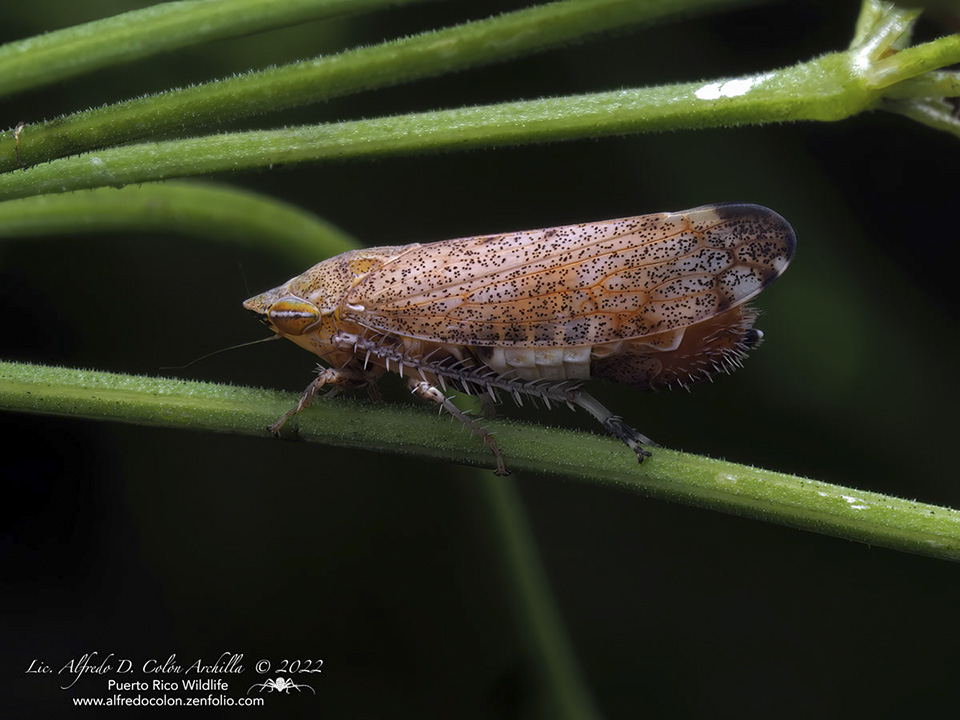
Adults are robust and ¼″ to 5⁄16″ (6.5 to 8.0 mm) in length. They are said to mimic the appearance of leaf buds on the host tree, making them difficult to detect. The upper side is dull yellowish or yellowish brown with minute, round, black dots, and it is sometimes tinged reddish. The underside is black with a broad, highly contrasting, white or yellow band across the abdomen.
The wings (hemelytra) are broad, opaque, and expanded (flared) at the tip.
The top of the head (vertex) is flat and 1.5 to 2 times wider between the eyes than its length in the middle. The front margin of the vertex is sharp, and the vertex is acutely angled with the front of the head and the face. The face is almost as wide as long. It is yellow with two parallel black bands on the upper part of the face (frons) that sometimes fuse together.
Size
Total length: ¼″ to 5⁄16″ (6.5 to 8.0 mm)
Similar Species
Habitat
Ecology
Season
One generation per year: Mid-April through October
Behavior
Life Cycle
Larva Food/Hosts
Adult Food
Distribution
Occurrence
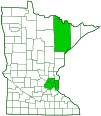
Common
Taxonomy
Order
Hemiptera (True Bugs, Hoppers, Aphids, and Allies)
Suborder
Auchenorrhyncha (True Hoppers)
Infraorder
Cicadomorpha (Spittlebugs, Cicadas, Leafhoppers and Treehoppers)
Superfamily
Membracoidea (Leafhoppers and Treehoppers)
Family
Cicadellidae (Typical Leafhoppers)
Subfamily
Deltocephalinae
Tribe
Fieberiellini
Genus
Fieberiella
Subordinate Taxa
Synonyms
Fieberia florii
Phlepsius atropunctatus
Selenocephalus florii
Common Names
cherry leafhopper
privet leafhopper
