rusty-patched bumble bee - Species Profile
Conservation • Description • Habitat • Ecology • Distribution • Taxonomy

Conservation Status
IUCN Red List
CR - Critically Endangered
NatureServe
NNR - Unranked
SNR - Unranked
Federal
Endangered
Minnesota
not listed
Species in Greatest Conservation Need
Description
Rusty-patched bumble bee is a relatively large colonial bumble bee. It was historically common throughout most of its range, which extended from Maine to Georgia, west to Minnesota, with a few individuals found in North Dakota. Since the 1990s populations have declined severely in 87% of its historical range. It currently occurs in Minnesota, Iowa, Wisconsin, Illinois, and Indiana, and there are a few widely scattered recent records from Ontario, Quebec, Ohio, New York, Massachusetts, Virginia, and West Virginia.
The female (worker) bee is 7⁄16″ to ⅝″ (11 to 16 mm) long. The width of the abdomen is 3⁄16″ to 5⁄16″ (5 to 8 mm).
The hairs on the head are entirely black, including a dense band of hairs on top of the head (vertex) at the rear. The antennae have 12 segments consisting of one basal segment (scape), one small connecting segment (pedicel), and ten more segments (flagellomeres). The scape is long, slightly more than half as long as all of the flagellomeres together. The first flagellomere is slightly longer than the third, and the third is somewhat longer than the second. The tongue is short, shorter than any other bumble bee species.
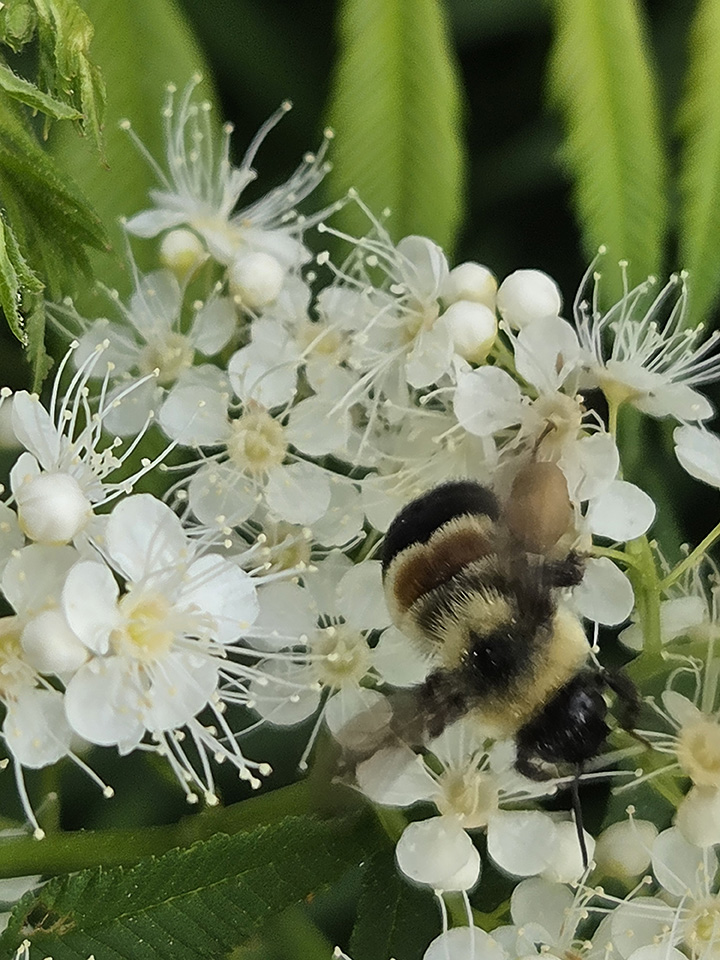
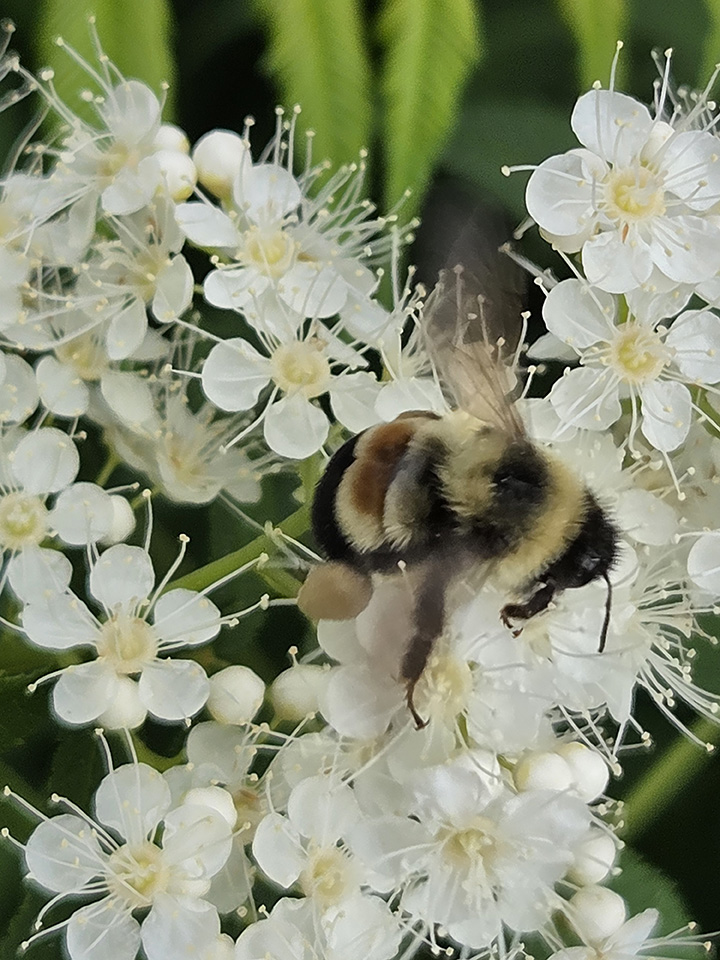
The upper side of the thorax is densely covered with long, mostly yellow hairs. The hairs near the flap-like covering of the wing bases (tegulae) are black intermixed with yellow. Between the wings there is a band of black hairs that extends toward the rear in a V shape.
The abdomen has six segments and is densely covered with relatively long hairs. The hair on the first segment is entirely yellow. On the second segment it is mostly yellow except for a rusty-red patch in the middle. On the remaining segments the hairs are entirely black.
The wings are clear and lightly tinted brown.
The legs are black and are covered with mostly black hairs.
The queen is similar but larger, 13⁄16″ to ⅞″ (21 to 22 mm) in length. The pubescence is shorter and less dense. The thorax has a round, bare, black spot in the middle surrounded with intermixed black and yellow hairs. The second abdominal segment is entirely yellow, with no rusty patch.
The male (drone) is somewhat larger, ½″ to 11⁄16″ (13.0 to 17.5 mm) in length. It is similar to the worker, but the abdomen has 7 segments, and the antennae have 13 segments. The band of hairs on the vertex has a few pale hairs intermixed. The hairs on abdominal segments 1 and 2 are entirely yellow.
Size
Male: ½″ to 11⁄16″ (13.0 to 17.5 mm)
Worker: 7⁄16″ to ⅝″ (11 to 16 mm)
Queen: 13⁄16″ to ⅞″ (21 to 22 mm)
Similar Species
Habitat
Ecology
Season
Mid-May through late October
Behavior
Life Cycle
Rusty-patched bumble bee usually nests in the ground in an abandoned rodent burrow.
Larva Food/Hosts
Adult Food
Distribution

Sources
Biodiversity occurrence data published by: Minnesota Biodiversity Atlas (accessed through the Minnesota Biodiversity Atlas Portal, bellatlas.umn.edu. Accessed 7/9/2026).
Bombus affinis Cresson, 1863 in Bánki, O., Roskov, Y., Döring, M., Ower, G., Hernández Robles, D. R., Plata Corredor, C. A., Stjernegaard Jeppesen, T., Örn, A., Pape, T., Hobern, D., Garnett, S., Little, H., DeWalt, R. E., Miller, J., Orrell, T., Aalbu, R., Abbott, J., Abreu, C., Acero P, A., et al. (2026). Catalogue of Life (2026-06-19 XR). Catalogue of Life Foundation, Amsterdam, Netherlands. https://doi.org/10.48580/dgy8b
Environmental Conservation Online System (ECOS), U.S. Fish and Wildlife Service, Rusty patched bumble bee (Bombus affinis), retrieved 7/9/2026.
The map includes counties in which
- rusty-patched bumble bee is believed to occur but for which there are no records (yellow)
- there are no records after 2005 (light green)
- there are post 2005 records, including citizen science records (dark green)
Occurrence
Taxonomy
Order
Hymenoptera (Ants, Bees, Wasps, and Sawflies)
Suborder
Apocrita (Narrow-waisted Wasps, Ants, and Bees)
Infraorder
Aculeata (Ants, Bees, and Stinging Wasps)
Superfamily
Apoidea (Bees and Apoid Wasps)
Epifamily
Family
Apidae (Honey Bees, Bumble Bees, and Allies)
Subfamily
Apinae (Honey, Bumble, Longhorn, Orchid, and Digger Bees)
Tribe
Bombini
Genus
Subgenus
Bombus
Subfamily
Some authors separate bumble bees and orchid bees into the subfamily Bombinae. NCBI follows this classification. Most authors follow Michener (2007) and include those groups in the subfamily Apinae with the honey bees.
Subordinate Taxa
Synonyms
Bombus affinis novaeangliae
Bremus affinis
Common Names
rusty-patched bumble bee