sword-bearing conehead - Species Profile
Conservation • Description • Habitat • Ecology • Distribution • Taxonomy

Conservation Status
IUCN Red List
not listed
NatureServe
NNR - Unranked
Minnesota
not listed
Description
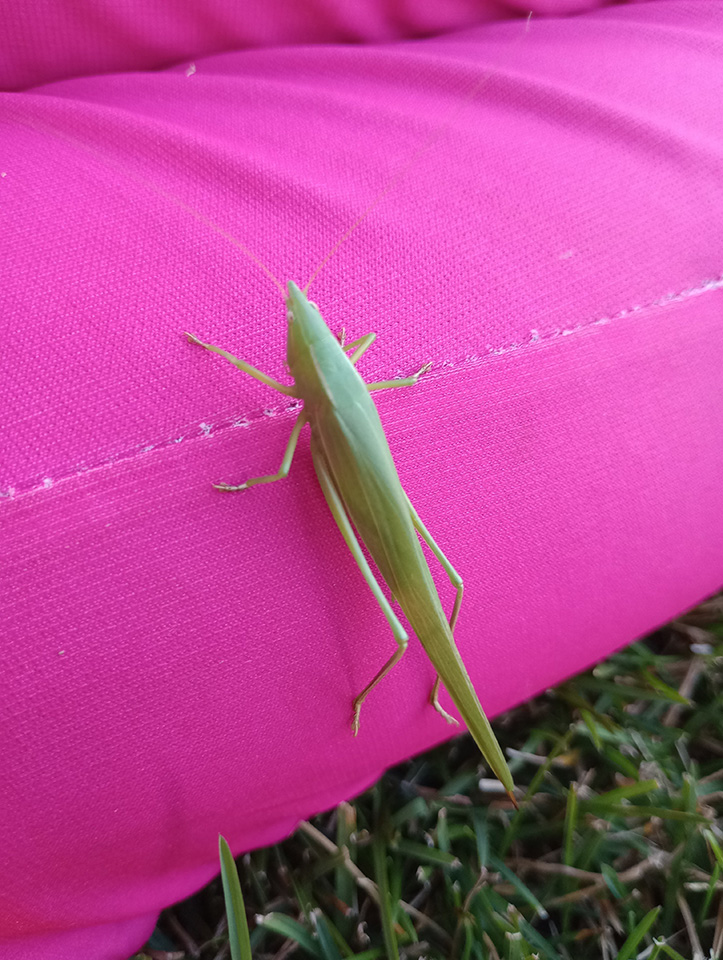
Sword-bearing conehead, also called swordbearer, is a common, large, meadow katydid.
The male is 1¾″ to 2 3 ⁄16″ in length, the female 2 1 ⁄16″ to 2½″. Both males and females have two color phases. On green phase individuals the thorax, abdomen, wings, and femurs are leaf green. There is a narrow yellowish edging on the plate covering the thorax (prothoracic shield) and on the front wing. On brown phase individuals the body is dark tan with black speckling on the wings. The female ovipositor is as long or longer than the body, and is curved, sword-like, which gives this species its common name.
The top of the head extends well beyond the first segment of the antennae, forming the “cone” which gives this tribe its common name. The cone is pinched in at the sides and separated from the head by a gap. It is rounded at the tip and the lower surface is edged with black.
The antennae are long, slender, and hair-like. They are much longer than the body.
The wings are narrow and long, extending beyond the end of the abdomen. They have fewer than 8 longitudinal veins. The front wings slope over the sides of the body, with only a small portion near the base being horizontal. The male has sound-producing organs, a raised hardened vein at the anal edge of the right front wing (scraper) and a toothed vein (file) near the base of the left front wing.
The last segments of the leg (tarsus), corresponding to the foot, has four segments.
Size
Male: 1¾″ to 2 3 ⁄16″
Female: 2 1 ⁄16″ to 2½″
Song
The song of the male is distinctive. It is often compared to the sound of a distant locomotive. It is a continuous series of high-pitched lisps, clearly separated, produced at the rate of 10 per second.
Similar Species
Habitat
Moderately moist grassy areas
Ecology
Season
July to September
Behavior
They are strong fliers. They sometimes come to lights.
By rubbing the file against the scraper the male produces a high-pitched lisping song. At low temperatures nearby males synchronize their lisps.
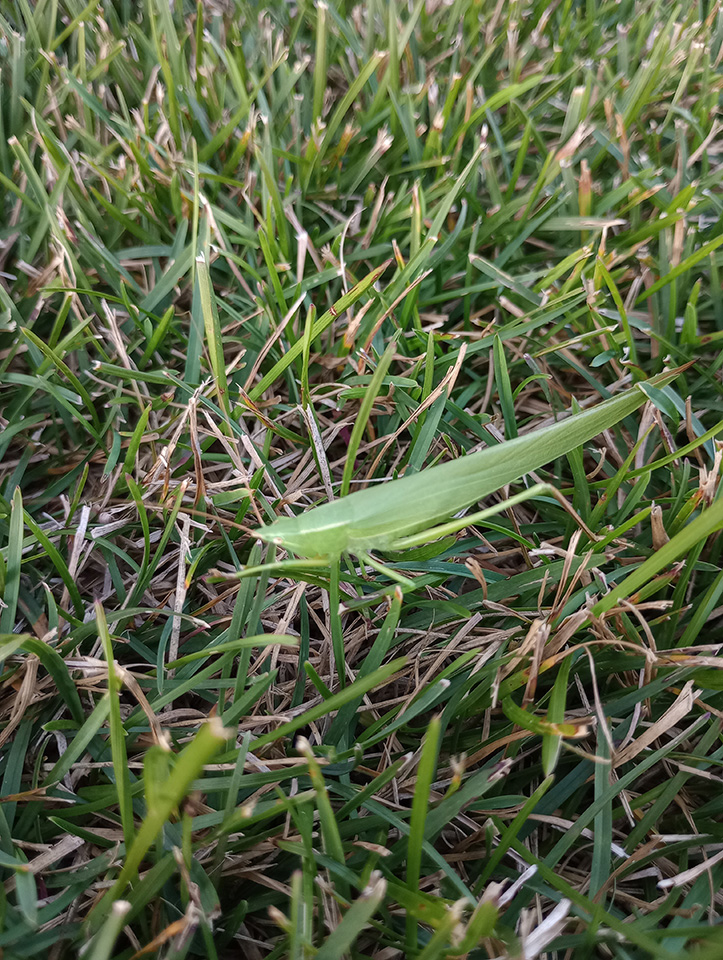
They are often heard at night but seldom seen in daylight. During the day they perch head down on the lower stalk of vegetation with only their wings and hindlegs visible, appearing like a grass blade. At night females can be found near calling males feeding on the seedhead of a grass plant.
Life Cycle
The female uses her long ovipositor to inject eggs into the crown of grass clumps. Most of the eggs overwinter. In the spring the nymphs feed on grass flowers and developing seeds.
Nymph Food
Grass flowers and developing seeds
Adult Food
Seeds of grasses and sometimes sedges.
Distribution

Sources
Neoconocephalus ensiger (Harris, 1841) in Bánki, O., Roskov, Y., Döring, M., Ower, G., Hernández Robles, D. R., Plata Corredor, C. A., Stjernegaard Jeppesen, T., Örn, A., Pape, T., Hobern, D., Garnett, S., Little, H., DeWalt, R. E., Miller, J., Orrell, T., Aalbu, R., Abbott, J., Abreu, C., Acero P, A., et al. (2026). Catalogue of Life (2026-07-17 XR). Catalogue of Life Foundation, Amsterdam, Netherlands. https://doi.org/10.48580/dgykv
Hebard, Morgan. (1932). The Orthoptera of Minnesota. University of Minnesota. Minnesota Agricultural Experiment Station. Retrieved from the University of Minnesota Digital Conservancy, https://hdl.handle.net/11299/204015.
Occurrence
Common
Taxonomy
Order
Orthoptera (Grasshoppers, Crickets, and Katydids)
Suborder
Ensifera (Katydids, Crickets, and Allies)
Infraorder
Tettigoniidea (Katydids, Wētā, and Allies)
Superfamily
Tettigonioidea
Family
Tettigoniidae (Katydids)
Subfamily
Conocephalinae (Coneheads and Meadow Katydids)
Tribe
Copiphorini (Coneheads)
Genus
Neoconocephalus (Common Coneheads)
Subordinate Taxa
Synonyms
Conocephaloides ensiger
Conocephalus attenuatus
Conocephalus ensiger
Common Names
sword-bearing conehead
swordbearer