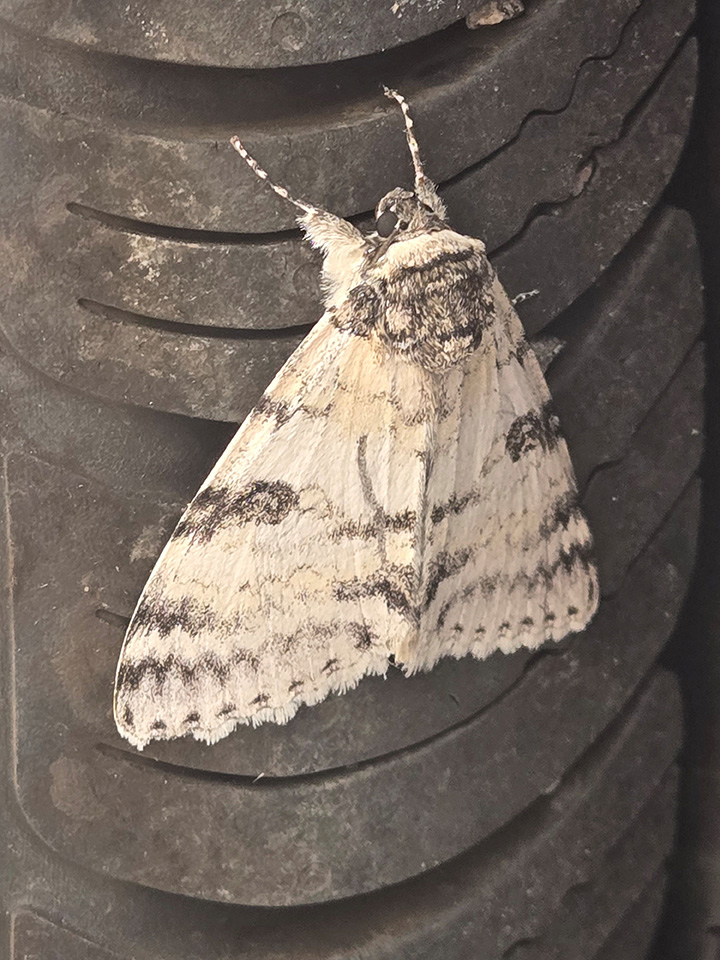
white underwing - Species Profile
Conservation • Description • Habitat • Ecology • Distribution • Taxonomy

Hodges #
8803
Conservation Status
IUCN Red List
not listed
NatureServe
NNR - Unranked
SNR - Unranked
Minnesota
not listed
Description
White underwing is a medium to large sized underwing moth. Adults are 1 7 ⁄16″ to 1⅞″ in length and have a wingspan of 2⅝″ to 3″. Males and females are identical in appearance.
The forewings are white with a dusting of gray and dark gray scales. The amount of dark scaling varies greatly between populations—in some population the forewings are mostly white, in other populations they are mostly dark gray. They are crossed with several jagged, light to dark gray lines, including a broad median line. The median line passes through a kidney-shaped (reniform spot) spot in the lower median area. The reniform spot is dark gray and may have some light spots. The smaller circular spot closer to the inner margin (subreniform spot) is white and outlined with gray. A line nearest to the outer margin (terminal line) consists of row of dark gray spots between the veins. The fringe is light gray. The outer margin of the forewing is scalloped.
The hindwings are black with a broad, curved, white median band, a narrow white stripe near the margin, and a white fringe.
The thorax is dark gray. There is a prominent tympanal hearing organ on each side of the thorax.
The antennae are slender and thread-like.
The caterpillar is whitish and about 3″ in length. There is a dark gray, saddle-like band partially covering the fifth and sixth abdominal segments (A5 and A6). The band extends to the leg-like appendage (proleg) on both segments. The breathing openings (spiracles) are black with a narrow white border. There is a fringe of numerous, long, hair-like growths (setae) near the base (subventral area) of each segment. The head has a dark band across the top and dark mottling near the triangle (frons).
Mature caterpillars are found from late June to early July.
Size
Total length: 1 7 ⁄16″ to 1⅞″
Wingspan: 2⅝″ to 3″
Similar Species
This is the only underwing with a white band on the hindwing.
Habitat
Deciduous forests, especially aspen forests
Ecology
Season
One generation, July to mid-October
Behavior
Adults are nocturnal and are attracted to light.
Life Cycle
The eggs overwinter and hatch in April or May.
Larva Food/Hosts
Mostly quaking aspen (Populus tremuloides), but also willows (Salix spp.) and other cottonwoods and poplars (Populus spp.)
Adult Food
Flower nectar
Distribution

Sources
Catocala relicta Walker in Bánki, O., Roskov, Y., Döring, M., Ower, G., Hernández Robles, D. R., Plata Corredor, C. A., Stjernegaard Jeppesen, T., Örn, A., Pape, T., Hobern, D., Garnett, S., Little, H., DeWalt, R. E., Miller, J., Orrell, T., Aalbu, R., Abbott, J., Abreu, C., Acero P, A., et al. (2026). Catalogue of Life (2026-07-17 XR). Catalogue of Life Foundation, Amsterdam, Netherlands. https://doi.org/10.48580/dgykv
Quinn, Edward. M., and Ron Danielson. April 27, 2009. A Survey of Lepidoptera in Three Priority Areas of the Minnesota State Parks System. https://files.dnr.state.mn.us/eco/nongame/projects/consgrant_reports/2009
/2009_quinn_danielson.pdf.
Occurrence
Common in Minnesota
Taxonomy
Order
Lepidoptera (Butterflies and Moths)
Superfamily
Noctuoidea (Owlet Moths and Allies)
Family
Erebidae (Underwing, Tiger, Tussock, and Allied Moths)
Subfamily
Erebinae (Underwings, Zales, and Related Owlets)
Tribe
Catocalini
Genus
Catocala (Underwing Moths)
Subordinate Taxa
Catocala relicta elda was formerly considered a subspecies, but is now treated as a synonym of Catocala relicta.
Synonyms
Catocala bianca
Catocala clara
Catocala elda
Catocala relicta elda
Catocala fischeri
Catocala phrynia
Common Names
the relict
white underwing