butternut - Species Profile
Conservation • Weed • Wetland • Description • Habitat • Ecology • Use • Distribution • Taxonomy

Conservation Status
IUCN Red List
EN - Endangered
NatureServe
N3 - Vulnerable
S1 - Critically Imperiled
Minnesota
Endangered
Wetland Indicator Status
Midwest
FACU - Facultative upland
Northcentral & Northeast
FACU - Facultative upland
Description
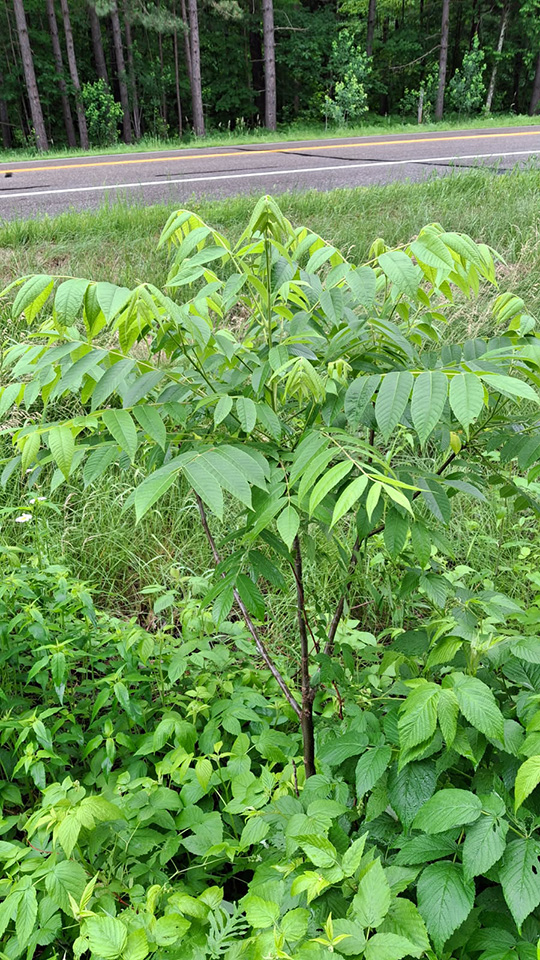
Butternut is a fast-growing deciduous tree rising on a single trunk. On deep soils the root system includes a taproot and deep, widely spreading lateral anchors. In shallow soils there is no taproot. In Minnesota mature trees are usually 40′ to 60′ tall and up to 25″ in diameter at breast height, though large individuals can reach over 80′ in height and 36″ in diameter. It is short-lived due to susceptibility to root diseases, decays, fungal infection, and invasion by wood-boring insects. The greatest recorded age in Minnesota was 221 years, but it usually does not live more than 75 years.
The trunk is slender and often crooked. It is often short and forked or divided into a few large, ascending branches. The crown is broad, open, and rounded on top.
The bark on young trees is light gray and smooth. On mature trees the bark is gray to grayish-brown, moderately thick, with irregular, broad, flat-topped, smooth, interlacing ridges and broad, shallow, dark fissures.
First-year twigs are stout, green to greenish-brown, and hairy, with small, slightly raised, pale, corky bumps (lenticels). Second-year twigs are stout, green to greenish-brown, and hairless. The pith is finely chambered and dark, chocolate brown. Cut through a twig at an angle and check the pith. If it consists of walls with hollow chambers, looking something like a honeycomb, then the tree is either black walnut or butternut. The leaf scars are raised and inversely heart-shaped. The upper margin is flat or almost flat and has a dense ridge of tan, velvety hairs. There are 3 clusters of bundle scars. The appearance is that of a monkey face with a tan eyebrow.
Terminal buds are pale yellow, cone-shaped, flattened, 5 ⁄16″ to ⅝″ long, ⅛″ to 3 ⁄16″ wide, and covered by a few hairy scales. Lateral buds are smaller and are covered with short, soft, matted, woolly, rusty-brown, hairs.
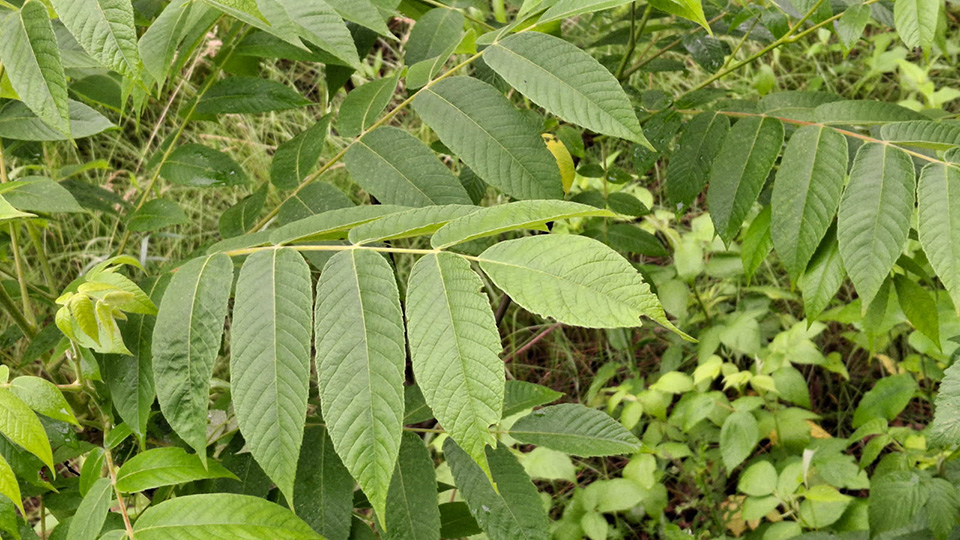
The leaves are deciduous, alternate, 15″ to 24″ long, and pinnately divided into 11 to 17 leaflets. They are on 1 3 ⁄16″ to 3½″ long, hairy leaf stalks. The terminal leaflet is present and well developed.
The leaflets are nearly stalkless, egg-shaped to oblong lance-shaped, 2¾″ to 5″ long, and 1⅛″ to 2⅛″ wide. They taper to a point at the tip with concave sides along the tip and are rounded or nearly squared and asymmetrical at the base. The upper surface is yellowish-green, wrinkled, rough and sparsely to moderately but evenly hairy. The lower surface is paler, grayish-green, and densely soft-hairy. The terminal leaflet is usually present, well developed, and is about the same size as the 2 adjacent lateral leaflets. The margins are finely toothed with sharp, forward pointing teeth. In autumn the leaves turn yellow or brown. The leaflets are flat, they do not droop downward from the central axis (rachis) of the leaf.
Male and female flowers are borne on the same branchlet. They appear early May to early June. The male inflorescence is a slender, 2⅜″ to 4¾″ long catkin drooping from the base of previous-year twigs. The female inflorescence is a cluster of 3 to 7 flowers on a short spike at the tip of current-year twigs. The flowers are pollinated by wind.
The fruit is a nut enclosed in a husk appearing singly or in clusters of 2 to 5. The husk is greenish-bronze, thin, oblong to egg-shaped, 2″ to 3⅛″ long, and 1″ to 1½″ wide. It is obviously longer than wide and somewhat pointed at one end. It is covered with glandular hairs making it sticky to the touch. It ripens in early August to early September and is dispersed by animals. The shell of the nut has irregular, jagged ridges. The seed is sweet-tasting.
Height
40′ to 60′
Record
The champion butternut in Minnesota is on city property near Roseville, in Ramsey County. In 2004 it was measured at 76′ tall and 236″ in circumference (75.1″ in diameter), with a crown spread of 89.5′.
Flower Color
Green
Similar Species
Black walnut (Juglans nigra) has buff pith in the twigs. The terminal buds are shorter, 3 ⁄16″ to 5 ⁄16″ long. The leaves are divided into up to 23, usually 15 to 19, leaflets. The leaflets droop downward from the rachis. The terminal leaflet is either poorly formed or missing. The leaf scar is deeply notched at the top, not almost straight across, and does not have a band of hairs above it. The upper surface of the leaf is either hairless or has hairs only along the midvein. The fruit is nearly spherical and is not sticky to the touch.
Habitat
Streambanks and hillsides in mixed hardwood forests. Shade intolerant.
Ecology
Flowering
Early May to early June
Pests and Diseases
Butternut Canker (Sirococcus clavigignenti-juglandacearum) is a lethal disease affecting butternut trees. There is no known treatment for the disease. Nearly all butternut trees in Minnesota are now either dead or dying.
Use
Distribution

Sources
Biodiversity occurrence data published by: Minnesota Biodiversity Atlas (accessed through the Minnesota Biodiversity Atlas Portal, bellatlas.umn.edu. Accessed 6/21/2026).
Midwest Herbaria Portal. 2026. https://midwestherbaria.org/portal/index.php. Accessed 6/21/2026.
Juglans cinerea L. in Bánki, O., Roskov, Y., Döring, M., Ower, G., Hernández Robles, D. R., Plata Corredor, C. A., Stjernegaard Jeppesen, T., Örn, A., Pape, T., Hobern, D., Garnett, S., Little, H., DeWalt, R. E., Miller, J., Orrell, T., Aalbu, R., Abbott, J., Abreu, C., Acero P, A., et al. (2026). Catalogue of Life (2026-05-15 XR). Catalogue of Life Foundation, Amsterdam, Netherlands. https://doi.org/10.48580/dgxsq
Minnesota Department of Natural Resources, Division of Ecological Resources. 2008. Rare Species Guide: An online encyclopedia of Minnesota’s rare native plants and animals. Minnesota Department of Natural Resources, St. Paul, Minnesota. www.dnr.state.mn.us/rsg/index.html.
Smith, Welby R. 2008. Trees and Shrubs of Minnesota: The Complete Guide to Species Identification. The University of Minnesota Press, Minneapolis, MN.
Nativity
Native
Occurrence
Formerly common but rapidly declining
Taxonomy
Kingdom
Subkingdom
Pteridobiotina
Phylum
Tracheophyta (Vascular Plants)
Class
Order
Fagales (Beeches, Oaks, Walnuts, and Allies)
Family
Juglandaceae (Walnut)
Subfamily
Juglandoideae
Tribe
Juglandeae
Genus
Juglans (Walnuts)
Section
Trachycaryon
Subordinate Taxa
Synonyms
Nux cinerea
Juglans cathartica
Juglans oblonga
Wallia cinerea
Common Names
butternut
white walnut