foxglove beardtongue - Species Profile
Conservation • Wetland • Description • Habitat • Ecology • Use • Distribution • Taxonomy

Conservation Status
IUCN Red List
not listed
NatureServe
NNR - Unranked
SNR - Unranked
Minnesota
not listed
Wetland Indicator Status
Great Plains
FACW - Facultative wetland
Midwest
FAC - Facultative
Northcentral & Northeast
FAC - Facultative
Description
Foxglove beardtongue is a tall, showy, spring wildflower. It occurs in the United States from Maine to Minnesota, south to Texas and North Carolina, and in adjacent Canadian provinces. It is very common in the Midwest and in south-central U.S. It is occasional in Minnesota, where it is at the northwestern extent of its range, and where it may be non-native and naturalized. American botanist F.W. Pennell suggested that its original distribution was confined to to the western and southern portions of its current range. In these areas it is found in upland and bottomland forest openings, savannas, prairies, old fields, roadsides, and railroads. It grows under full or partial sun in moderately moist to dry, loamy soil. It invades new areas by following disturbance corridors, such as roads and railroads.
Foxglove beardtongue is a 10″ to 55″ tall, erect, perennial forb that rises from short, horizontal, underground stems (rhizomes). In the spring one or more stems rise from the center of a radiating cluster (rosette) of basal leaves that have overwintered.
The stems are erect, slender, green to olive-green, and usually tinged with purple at least near the base. They are usually unbranched below the inflorescence and are usually hairless. Sometimes they are moderately to densely covered with minute, nonglandular hairs near the top. They are often somewhat shiny and are never covered with a whitish, waxy bloom (glaucous).
Basal leaves are 1 3⁄16″ to 7⅞″ long and ⅜″ to 2⅜″ wide. The leaf blades are inversely lance-shaped to spatula-shaped; sharply or bluntly pointed or rounded at the tip; and tapered at the base to a winged leaf stalk (petiole). The upper surface is shiny and hairless. The lower surface is usually hairless, sometimes hairy just along the main veins, and sometimes dotted with minute glands. It is not glaucous. The margins may be untoothed or have blunt or sharp teeth.
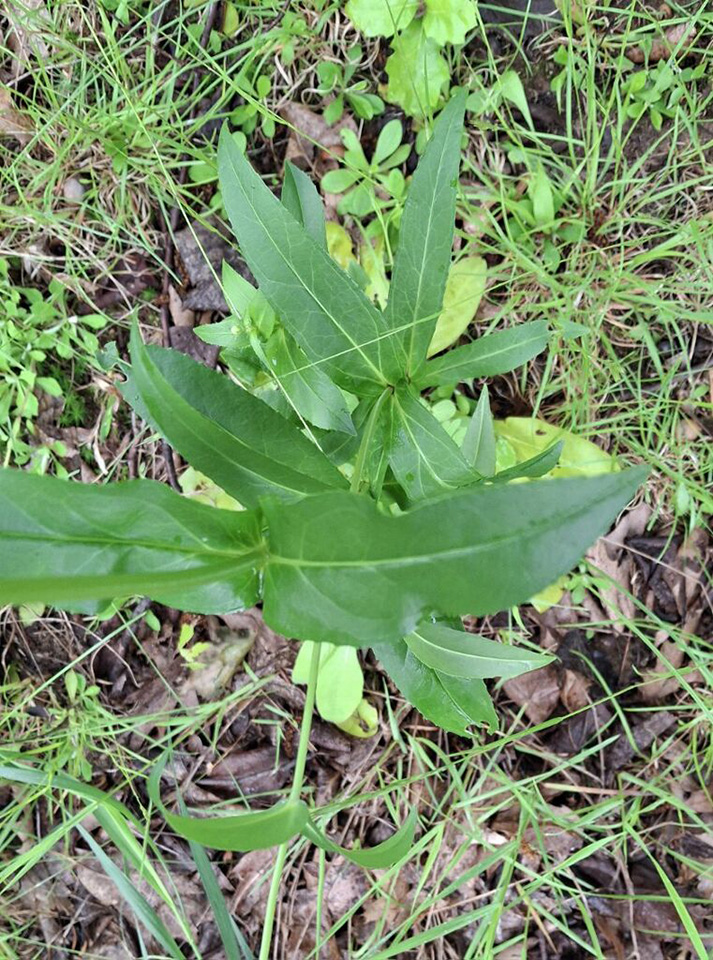
Stem leaves are opposite, 1″ to 6⅜″ long, and ⅜″ to 2″ wide. Lowest leaf blades are narrowly lance-shaped to egg-shaped and stalked, becoming shorter stalked, more sharply pointed, and much smaller as they climb the stem. Middle stem leaves are stalkless with rounded basses, upper stem leaves are clasping with heart-shaped bases. Stem leaves are otherwise similar to basal leaves.
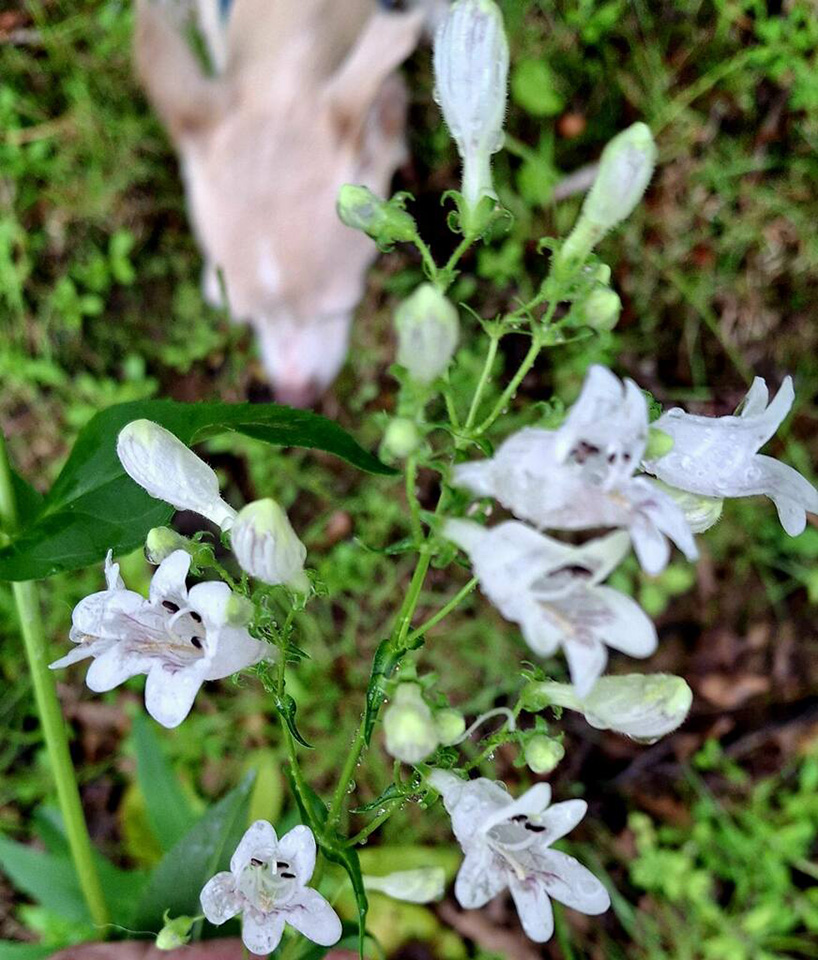
The inflorescence is a 3″ to 13″long, usually pyramid-shaped, sometimes narrow, branched arrangement (panicle) of flowers at the end of the stem. The panicle has 2 to 6 widely-spaced nodes. At each node there is a pair of small modified leaves (bracts) and a pair of inflorescence branches. The bracts are narrowly lance-shaped and somewhat clasp the stem at the base. The branches are 1″ to 3″ long and curved or arched upward. At the end of each main branch there are 3 to several branched clusters of flowers. There are 3 to 18 flowers per main branch.
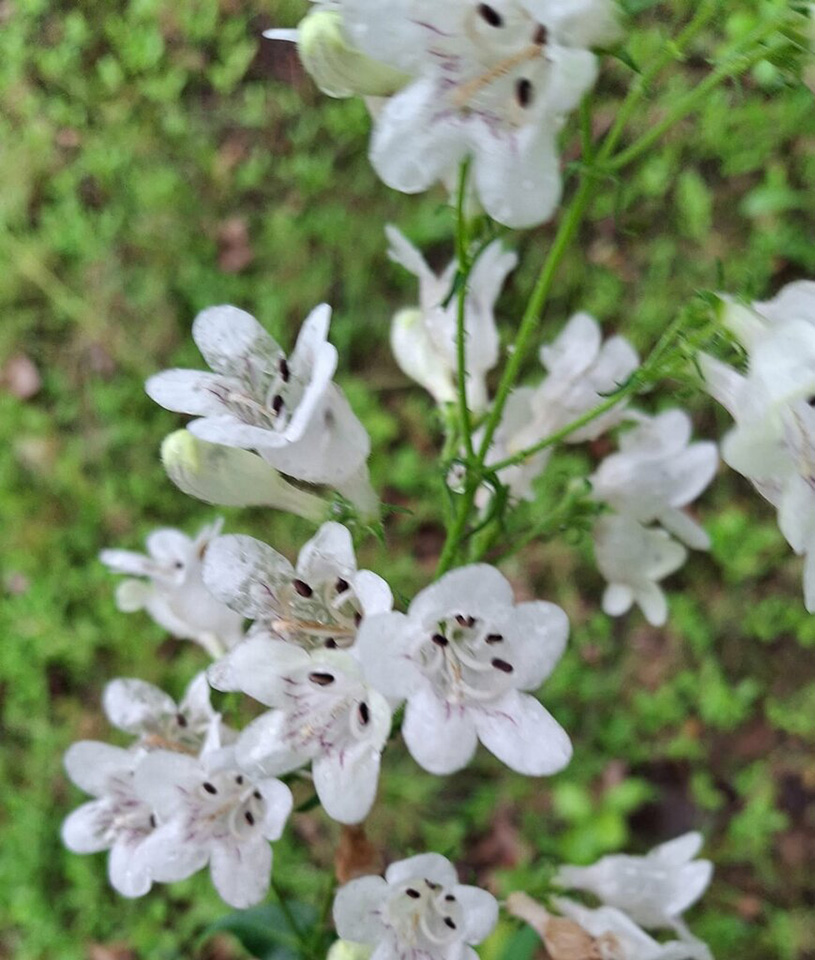
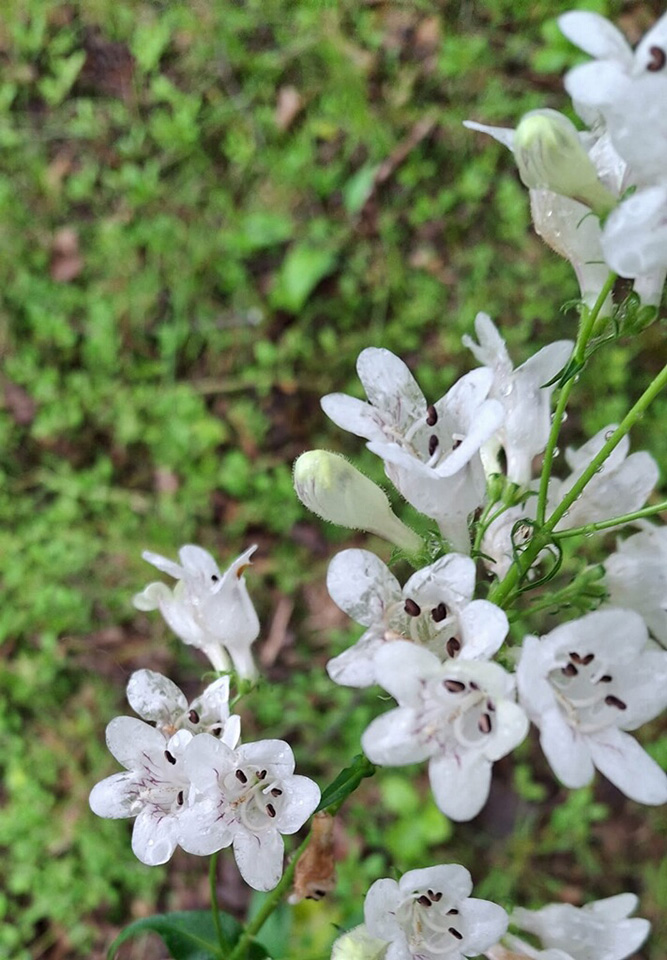
The flowers are ½″ to 1″ long. There are 5 outer floral leaves (sepals), 5 petals, 4 fertile stamens, 1 infertile staminode, and 1 style. The sepals are green, ⅛″ to ¼″ (4 to 8 mm) long, and narrowly egg-shaped to egg-shaped. They are united at the base into a cup-shaped tube (calyx tube), then separated into 5 sharply pointed lobes. The lobes are longer than the tube. The petals (corolla) are ¾″ to 1 3⁄16″ long and white. They are fused at the base into a trumpet-shaped tube with 5 rounded lobes. The tube is much longer than the lobes and is abruptly expanded usually below the midpoint. It is not flattened at the base. There are usually faint purple lines on the lower corolla tube that act as nectar guides. The lobes form 2 distinct lips, a 2-lobed upper lip and a 3-lobed lower lip. The upper lobes are bent backward, the lower lobes are strongly bent downward. The inflorescence branches, bracts, calyces, and outer surface of the corolla are all covered with gland-tipped hairs. The stamens have white, ¾″ long stalks (filaments) and purplish-black anthers. They do not extend beyond the corolla tube. The staminode is strongly flatted at the tip. It has yellow or purple hairs near the base and yellowish-brown hairs near the tip, which is the source of the common name “beardtongue”. The style is white and ¾″ long. The individual flowers are short-lived but the blooming period lasts about 3 weeks from May to late June. They are not fragrant.
The fruit is an egg-shaped, ⅜″ to ⅝″ (10 to 15 mm) long seed capsule with numerous seeds.
Height
10″ to 55″
Flower Color
White
Similar Species
Habitat
Moderately moist to dry. Upland and bottomland forest openings, savannas, prairies, old fields, roadsides, and railroads. Full or partial sun. Loamy soil.
Ecology
Flowering
May to June
Pests and Diseases
Use
Distribution

Sources
Biodiversity occurrence data published by: Minnesota Biodiversity Atlas (accessed through the Minnesota Biodiversity Atlas Portal, bellatlas.umn.edu. Accessed 6/27/2025).
Midwest Herbaria Portal. 2026. https://midwestherbaria.org/portal/index.php. Accessed 6/27/2025.
Penstemon digitalis Nutt. in Bánki, O., Roskov, Y., Döring, M., Ower, G., Hernández Robles, D. R., Plata Corredor, C. A., Stjernegaard Jeppesen, T., Örn, A., Pape, T., Hobern, D., Garnett, S., Little, H., DeWalt, R. E., Miller, J., Orrell, T., Aalbu, R., Abbott, J., Abreu, C., Acero P, A., et al. (2026). Catalogue of Life (2026-05-15 XR). Catalogue of Life Foundation, Amsterdam, Netherlands. https://doi.org/10.48580/dgxsq
Nativity
Native
Occurrence
Occasional
Taxonomy
Kingdom
Subkingdom
Pteridobiotina
Phylum
Tracheophyta (Vascular Plants)
Class
Order
Lamiales (Mints, Plantains, Olives, and Allies)
Family
Plantaginaceae (Plantain)
Tribe
Cheloneae (Penstemon and Allies)
Genus
Penstemon (Beardtongues)
Subgenus
Penstemon
Section
Penstemon
Subordinate Taxa
Synonyms
Chelone digitalis
Penstemon alluviorum
Penstemon laevigatus ssp. alluviorum
Penstemon laevigatus ssp. digitalis
Penstemon laevigatus var. angulatus
Common Names
foxglove beardtongue
foxglove beard-tongue
talus slope penstemon
white beardtongue