pin cherry - Species Profile
Conservation • Wetland • Description • Habitat • Ecology • Use • Distribution • Taxonomy

Conservation Status
IUCN Red List
LC - Least Concern
NatureServe
N5? - Secure
SNR - Unranked
Minnesota
not listed
Wetland Indicator Status
Great Plains
FACU - Facultative upland
Midwest
FACU - Facultative upland
Northcentral & Northeast
FACU - Facultative upland
Description
Pin cherry is common from New England to the upper Midwest and across southern Canada, uncommon and scattered west of the Great Plains. It is common throughout Minnesota except for the southwest quarter.
This is a small, fast-growing, short-lived, deciduous tree. It rises on a single stem from a shallow, spreading root system. Most roots are within 24″ of the soil surface. In other areas it can be from 10′ to 45′ in height and up to 20″ in diameter at breast height. In Minnesota it is usually no more than 25′ tall and 8 ″ in diameter. It reproduces mostly by root sprouts and often forms thickets. In forests, it rarely germinates, and when it does, the saplings rarely survive except in large openings with plentiful moisture and light. Seedlings mostly appear in a forest after heavy cutting, burning, or a blow down. They mature rapidly and live only 20 to 40 years.
The trunk is fairly straight and sometimes leaning. The crown is narrow and rounded at the top. The branches on young trees are ascending. As the tree ages, the branches become nearly horizontal.
The bark on young trees is thin, smooth, shiny, and dark reddish-brown with numerous conspicuous, long, horizontal, pore-like openings (lenticels). The lenticels are widely-spaced, raised, warty, and orange. As the tree ages the bark turns gray. On mature trees the bark is rough and sometimes peels in horizontal strips, and the lenticels are rougher and darker.
The twigs are very slender, hairless, shiny, and red or reddish-brown, with tiny, orange, dot-like lenticels. They are covered with a grayish skin at first but that quickly wears off. They have brown pith and a disagreeable bitter almond taste. The leaf scars are half-round to elliptical. They have 3 bundle scars .
Lateral buds are small, 1 ⁄16″ to ⅛″ long, rounded, and reddish-brown. They diverge slightly from the twig. The terminal bud is similar and appears with a cluster of two or more lateral buds at the end of the twig.
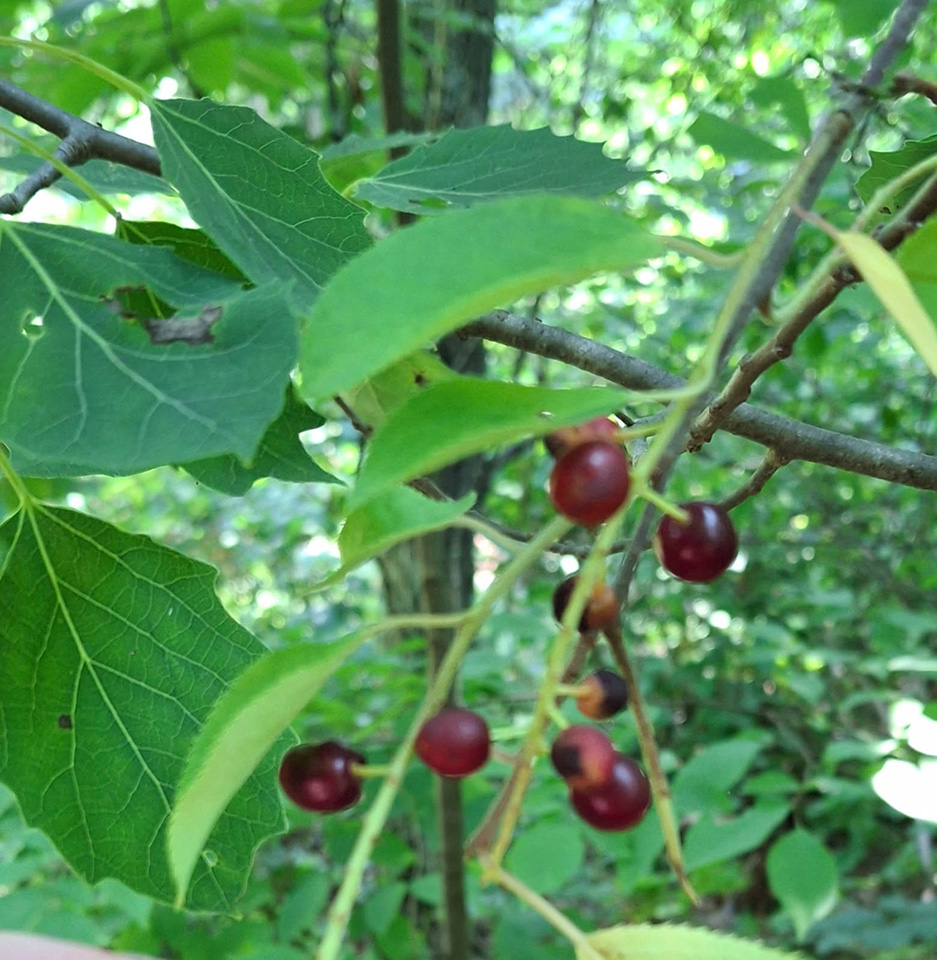
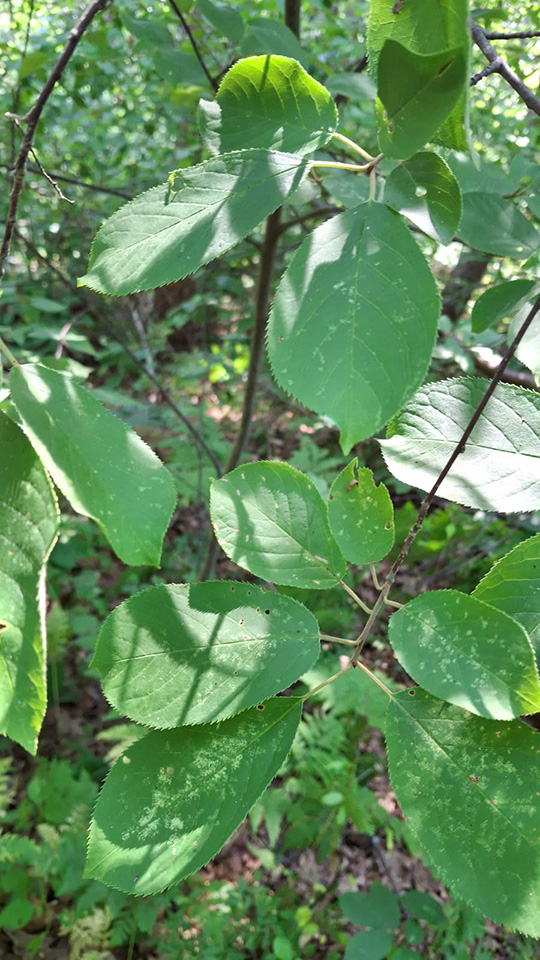
The leaves are deciduous, alternate, and clustered at the ends of the twigs. They are on ⅜″ to ¾″ long, hairless leaf stalks (petioles). The petioles often have one to three, more often two, small, red, wart-like swellings (glands) near the tip where the petiole meets the blade. The leaf blades are lance-shaped, 1¾″ to 4¾″ long, and ⅝″ to 2″ wide, 2 to 3 times longer than wide. They are broadly angled or rounded at the base and taper to a long point at the tip with concave sides along the tip. The upper surface is shiny, hairless and dark yellowish-green. The lower surface is paler and usually hairless, sometimes hairy along the main veins at first, becoming hairless. The margins are finely and irregularly toothed all the way to the base with sharp or rounded, forward pointing teeth. There is a small red or yellow gland at the tip of each tooth near the sinus. In autumn the leaves turn yellow.
The inflorescence is 2 to 5, sometimes 6 or 7, flowers in an stalkless umbrella-shaped (umbel-like) or flat-topped cluster (corymb) at the end of a short, 1 ⁄32″ to 5 ⁄16″long, branch-like base (fascicle). The clusters appear at the ends of current year twigs and at the axils of previous year branchlets. Each flower is on a hairless, ⅜″ to ¾″ long flower stalk (pedicel). Each pedicel is subtended by a minute, modified leaves(bracts). The flowers open in early May to mid-June when the leaves are about half size.
Each flower is about ½″ in diameter. There are 5 sepals, 5 petals, 10 to 30 stamens, and 1 style. The sepals are green, 1 ⁄32″ to ⅛″ long, untoothed, hairless, and bent backward. The petals are white, ⅛″ to ¼″ long, and conspicuously narrowed at the base (clawed). The claw is about 1 ⁄32″ long. The expanded portion of the petal is elliptic, inversely egg-shaped, or almost circular. The stamens have white filaments and yellow anthers.
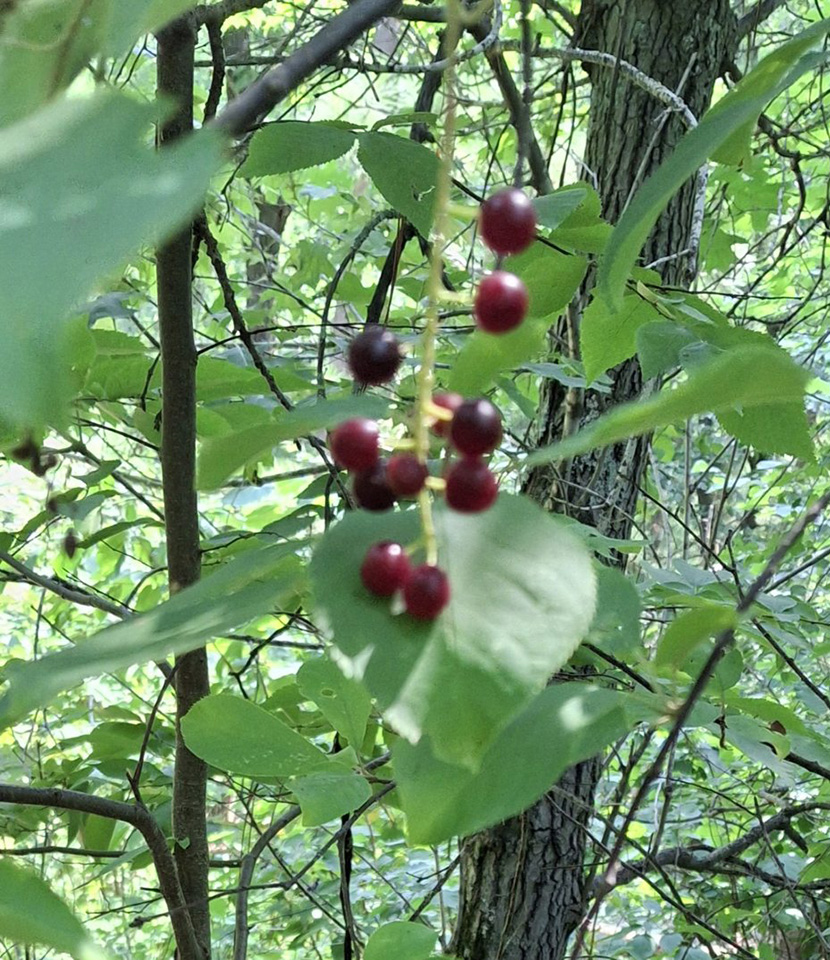
The fruit is a fleshy, one-seeded, spherical or ellipse-shaped, ¼″ to ⅜″ in diameter drupe. It is green at first, turning bright red, shiny, and very sour when it matures in early July to late mid-August. The seed is not flattened.
Height
10″ to 45″
Record
There is no current champion pin cherry tree in Minnesota.
Flower Color
White
Similar Species
American plum (Prunus americana) bark is gray. The branches have stout spines. There are only 2 to 4 flowers or fruits per umbel.
Black cherry (Prunus serotina var. serotina) mature bark is thick, dark, blackish, and scaly. The leaves are dark green above, not yellowish-green. The leaf tip is not a drawn out point. The inflorescence is a 3″ to 6″ long cluster of 20 to 60 flowers.
Habitat
Dry to moderate moisture. Open forests, forest edges and openings, streamsides, roadsides, burned-over and other disturbed areas. Shade intolerant.
Ecology
Flowering
Early May to mid-June
Pests and Diseases
Cherry Leaf Spot (Coccomyces hiemalis)
Use
Distribution

Sources
Biodiversity occurrence data published by: Minnesota Biodiversity Atlas (accessed through the Minnesota Biodiversity Atlas Portal, bellatlas.umn.edu. Accessed 7/28/2026).
Midwest Herbaria Portal. 2026. https://midwestherbaria.org/portal/index.php. Accessed 7/28/2026.
Prunus pensylvanica L.fil. in Bánki, O., Roskov, Y., Döring, M., Ower, G., Hernández Robles, D. R., Plata Corredor, C. A., Stjernegaard Jeppesen, T., Örn, A., Pape, T., Hobern, D., Garnett, S., Little, H., DeWalt, R. E., Miller, J., Orrell, T., Aalbu, R., Abbott, J., Abreu, C., Acero P, A., et al. (2026). Catalogue of Life (2026-07-17 XR). Catalogue of Life Foundation, Amsterdam, Netherlands. https://doi.org/10.48580/dgykv
Smith, Welby R. 2008. Trees and Shrubs of Minnesota: The Complete Guide to Species Identification. The University of Minnesota Press, Minneapolis, MN.
Nativity
Native
Occurrence
Common
Taxonomy
Kingdom
Subkingdom
Pteridobiotina
Phylum
Tracheophyta (Vascular Plants)
Class
Order
Rosales (Roses, Elms, Figs, and Allies)
Family
Rosaceae (Rose)
Subfamily
Amygdaloideae
Tribe
Amygdaleae
Genus
Prunus (Plums, Cherries, and Allies)
Subgenus
Cerasus (True Cherries)
Section
Cerasus
Subordinate Taxa
Some sources, including USDA PLANTS, recognize two varieties based on leaf shape and dentation: the nominate variety, Prunus pensylvanica var. pensylvanica, common in eastern United States and across southern Canada; and P. p. var. saximontana, occurring scattered west of the Great Plains. Flora of North America (FNA) considers the differences to be within normal variation, and does not recognize the varieties. Most sources follow FNA’s example.
Synonyms
Cerasus borealis
Cerasus pensylvanica
Cerasus persicifolia
Padellus pennsylvanica
Padellus pensylvanica
Padus pensylvanica
Prunus borealis
Prunus cerasifolia
Prunus lanceolata
Prunus pennsylvanica
Prunus pensylvanica ssp. pensylvanica
Prunus pensylvanica var. pensylvanica
Prunus persicifolia
Common Names
bird cherry
fire cherry
pin cherry
red cherry