



early horse gentian
(Triosteum aurantiacum var. aurantiacum)
Conservation • Wetland • Description • Habitat • Ecology • Use • Distribution • Taxonomy
Conservation Status |
|
|||||||
| IUCN Red List | not listed |
|||||||
| NatureServe | NNR - Unranked SNR - Unranked |
|||||||
| Minnesota | not listed |
|||||||
Wetland Indicator Status |
||||||||
| Great Plains | FAC - Facultative |
|||||||
| Midwest | FAC - Facultative |
|||||||
| Northcentral & Northeast | FAC - Facultative |
|||||||
Description |
||
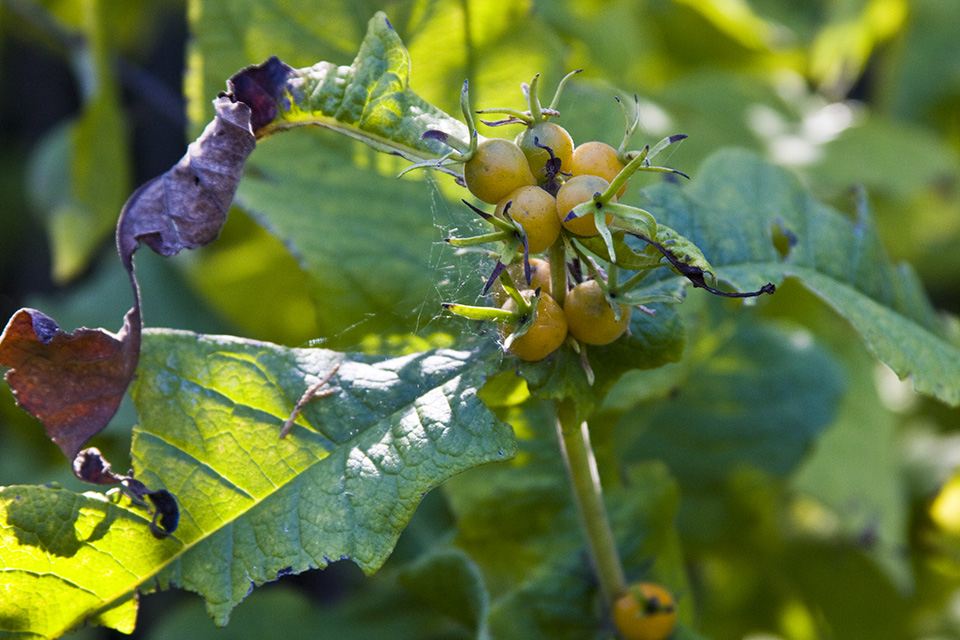
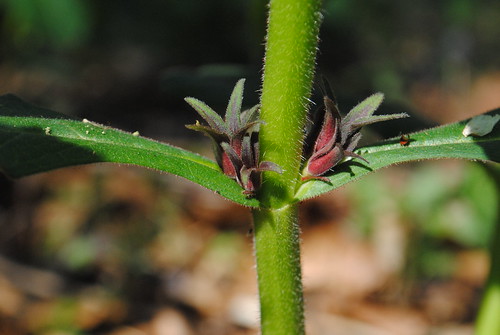
Early horse gentian is a 2′ to 4′ tall, erect, perennial forb rising on 1 or more stems from a taproot. The stems are 2′ to 4′ tall and are covered with short, glandular hairs that are more than 0.5 mm long. Mixed in with the glandular hairs are longer non-glandular hairs. The leaves are opposite, light green, and untoothed. They are attached to the stem without a stalk but are not fused at the base. They are 4″ to 12″ long, 1½ ″ to 6″ wide, and broadly-elliptic. They taper gradually to a pointed tip and taper broadly to the base. They have sparse, glandular hairs on the upper surface, and dense, soft hairs on the lower surface. The inflorescence is a tight cluster of 1 to 4 (usually 3 to 4) flowers in the upper leaf axils. At the base of the flower are 5 linear, erect sepals. They are uniformly hairy on the back and along the margins, and sometimes also have glandular hairs. The flowers are ⅓″ to ⅔″ long with 5 maroon, reddish-purple to brown, or yellowish-green petals. The petals are fused into a tubular or bell-shaped floral tube along most of their length. The tube is swollen on one side at the base. The lobes of the tube are unequal in length. The style is shorter than and does not protrude from the floral tube. The fruit is berry-like, dull orange-yellow, and hairy. Each fruit contains 3 oblong stones. |
||
Height |
||
2′ to 4′ |
||
Flower Color |
||
Maroon, reddish-purple to brown, or yellowish-green |
||
Similar Species |
||
Late horse gentian (Triosteum perfoliatum) stems are covered with short hairs that are less than 0.5 mm long. At least 3 of the pairs of lower and middle leaves are fused at the base, appearing to be pierced by the stem. The style is longer than and protrudes from the floral tube. |
||
Habitat |
||
Dry. Woods, thickets. |
||
Ecology |
||
Flowering |
||
May to June |
||
Pests and Diseases |
||
|
||
Use |
||
|
||
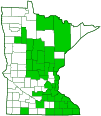
Distribution |
||||
|
Sources |
|||
| 4/13/2023 | ||||
Nativity |
||||
Native |
||||
Occurrence |
||||
|
||||
Taxonomy |
|||
| Kingdom | Plantae (Plants) | ||
| Subkingdom | Pteridobiotina | ||
| Phylum | Tracheophyta (Vascular Plants) | ||
| Class | Magnoliopsida (Dicots) | ||
| Subclass | Caryophyllidae | ||
Order |
Dipsacales (honeysuckles, moschatels, and allies) | ||
Family |
Caprifoliaceae (honeysuckle) | ||
| Subfamily | Caprifolioideae | ||
Genus |
Triosteum (horse gentians) | ||
| Species | Triosteum aurantiacum (orange-fruited horse gentian) | ||
Subordinate Taxa |
|||
There are three varieties of early horse gentian. Only var. aurantiacum occurs in Minnesota. |
|||
Synonyms |
|||
Triosteum perfoliatum var. aurantiacum |
|||
Common Names |
|||
coffee tinker’s-weed early horse gentian orangefruit horse-gentian orange-fruited horse gentian |
|||
Glossary
Axil
The upper angle where the leaf stalk meets the stem.
Glandular hairs
Hairs spread over aerial vegetation that secrete essential oils. The oils act to protect against herbivores and pathogens or, when on a flower part, attract pollinators. The hairs have a sticky or oily feel.
Linear
Long, straight, and narrow, with more or less parallel sides, like a blade of grass.
Visitor Photos |
|||||
Share your photo of this plant. |
|||||
| This button not working for you? Simply email us at info@MinnesotaSeasons.com. Attach one or more photos and, if you like, a caption. |
|||||
Greg Watson |
|||||
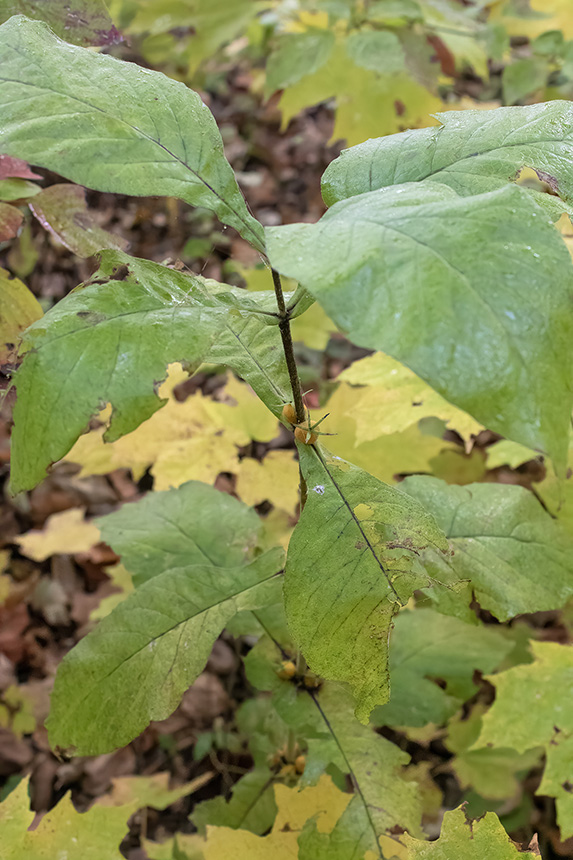
early horse gentian I was hiking out in the Reno Recreational Area near Reno, MN and came across this Early Horse Gentian. Not a plant that I commonly see while hiking. |
 |
||||
MinnesotaSeasons.com Photos |
|||||
Plant |
|||||
 |
|||||
Infructescence |
|||||
 |
|||||

Slideshows |
||
| Triosteum Zi W |
||
|
||
Visitor Videos |
|||
Share your video of this plant. |
|||
| This button not working for you? Simply email us at info@MinnesotaSeasons.com. Attach a video, a YouTube link, or a cloud storage link. |
|||
Other Videos |
|||

Visitor Sightings |
|||||
Report a sighting of this plant. |
|||||
| This button not working for you? Simply email us at info@MinnesotaSeasons.com. Be sure to include a location. |
|||||
| Greg Watson 10/17/2023 |
Location: Reno North Recreational Area I was hiking out in the Reno Recreational Area near Reno, MN and came across this Early Horse Gentian. Not a plant that I commonly see while hiking. |
 |
|||
MinnesotaSeasons.com Sightings |
|||||
Created 1/3/2012
Last Updated: