Common Fieldcap - Species Profile
Conservation • Description • Habitat • Ecology • Distribution • Taxonomy
Conservation Status
IUCN Red List
not listed
NatureServe
NNR - Unranked
Minnesota
not listed
Description
Common Fieldcap is a small to medium-sized, grass loving, gilled mushroom. It is common and very widespread, occurring worldwide on every continent except Antarctica. It occurs throughout the United States, southern Canada, and Mexico. It appears to be common in Minnesota but see the note in Distribution below.
Common Fieldcap is found in summer and fall, alone or in groups but not clustered (gregarious), in open grassy areas including meadows and lawns, and in gardens, disturbed areas, and cultivated areas. It grows usually on the ground, occasionally on manure, compost, and woodchips. It obtains its nutrients from decayed organic matter (saprobic).
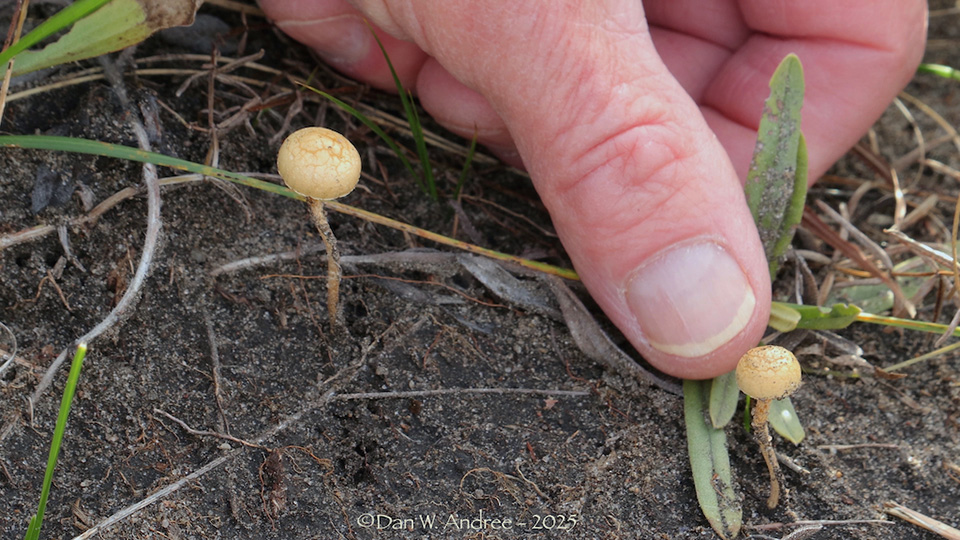
When it first appears, the cap is hemispherical to convex and medium yellowish brown (dark honey colored). The margin is slightly curved inward, and there is often a thin strip of white tissue, remnants of the partial veil, clinging to it. The surface is sometimes sticky. As it ages, it spreads out and the color fades. The mature cap is ⅜″ to 1 3⁄16″ (1 to 3 cm) in diameter, broadly convex to nearly flat, and pale brownish yellow. Most or all of the veil remnants on the margin have fallen away. The surface is bald and smooth, and it is slightly tacky when moist. With age, it often develops fissuring that appears as dark, irregular lines across the cap.
The gills are moderately broad and closely spaced. They are broadly attached to the stalk (adnate) at first, often pulling away as the cap ages. They are pale yellow at first, becoming dark brown as the spores mature. There are frequent secondary, short gills between the main gills.
The stalk is ¾″ to 3⅛″ (2 to 8 cm) long, and 1⁄16″ to ⅛″ (2 to 4 mm) thick. It is more or less equal from top to bottom, and it is sometimes twisted. It is pale or yellowish brown, and often lighter above and darker below.
The flesh is thin and whitish, and it does not change color when sliced. It is edible but should be avoided due to its similarity in appearance to other poisonous little brown mushrooms (“LBMs”).
The spore print is brown.
Similar Species
Habitat and Hosts
Open grassy areas: meadows lawns, gardens, disturbed areas, and cultivated areas
Ecology
Season
Summer and fall
Distribution

Sources
Biodiversity occurrence data published by: Minnesota Biodiversity Atlas (accessed through the Minnesota Biodiversity Atlas Portal, bellatlas.umn.edu. Accessed 3/11/2026).
Agrocybe pediades (Fr.) Fayod in GBIF Secretariat (2023). GBIF Backbone Taxonomy. Checklist dataset https://doi.org/10.15468/39omei accessed via GBIF.org. Accessed 3/11/2026.
Mycology Collections Portal (MyCoPortal) https://www.mycoportal.org/portal/collections/index.php). Accessed 3/11/2026.
The light green counties on the map represent unverified observations on iNaturalist.org. This undoubtedly reflects the difficulty in distinguishing between Agrocybe pediades and many similar little brown mushrooms (“LBMs”).
Occurrence
Common
Taxonomy
Kingdom
Fungi (Fungi)
Subkingdom
Dikarya
Phylum
Basidiomycota (Basidiomycete Fungi)
Subphylum
Agaricomycotina (Higher Basidiomycetes)
Class
Agaricomycetes (Mushrooms, Bracket Fungi, Puffballs, and Allies)
Subclass
Agaricomycetidae
Order
Agaricales (Common Gilled Mushrooms and Allies)
Suborder
Agaricineae
Family
Hymenogastraceae
Genus
Agrocybe
Family
The family placement of Agrocybe pediades is currently debated, reflecting the transition from traditional to molecular classification. It was long placed in the family Strophariaceae based on morphological similarities like its spore color and growth habit. However, extensive DNA sequencing (phylogenetics) has shown that the genus Agrocybe is more accurately placed in the family Hymenogastraceae.
Subordinate Taxa
Synonyms
Agaricus arenicola
Agaricus pediades
Agaricus pumilus subsp. semiorbicularis
Agaricus pumilus var. semiorbicularis
Agaricus semiorbicularis
Agaricus temulentus
Agrocybe arenaria
Agrocybe arenicola
Agrocybe pediades subsp. pediades
Agrocybe pediades var. bispora
Agrocybe pediades var. cinctula
Agrocybe semiorbicularis
Agrocybe subpediades
Agrocybe temulenta
Derminus pediades
Derminus semiorbicularis
Hylophila semiorbicularis
Hylophila temulenta
Naucoria arenaria
Naucoria arenicola
Naucoria pediades
Naucoria pediades var. brasiliensis
Naucoria pediades var. obscuripes
Naucoria semiorbicularis
Naucoria semiorbicularis var. lacunosa
Naucoria semiorbicularis var. pediades
Naucoria semiorbicularis var. robusta
Naucoria subpediades
Naucoria temulenta
Nolanea pediades
Pseudodeconica semiorbicularis
Simocybe pediades
Simocybe semiorbicularis
Common Names
Common Agrocybe
Common Fieldcap
Early Agrocybe
Hemispheric Fieldcap
Plains Agrocybe
Roundtop Earthscale
Spring Agrocybe
