Deceiver - Species Profile
Conservation • Description • Habitat • Ecology • Distribution • Taxonomy

Conservation Status
IUCN Red List
not listed
NatureServe
NNR - Unranked
Minnesota
not listed
Description
Deceiver is a very common, often abundant, small, edible, gilled mushroom. It occurs worldwide but is most common in Europe and North America. In the United States it occurs east of the Great Plains and west of the Rocky Mountains, and there is a disjunct population in the Denver, Colorado area. It is common in Minnesota. It is found from late spring through fall; alone, scattered, in groups, or occasionally clustered; often in woodlands but in a very wide variety of habitats. It grows on the ground in dirt or duff under or near hardwoods or conifers. Mushroomers sometimes consider it a “weed” mushroom due to its ubiquity, abundance, and “lackluster” appearance. One of its common names is Lackluster Laccaria.
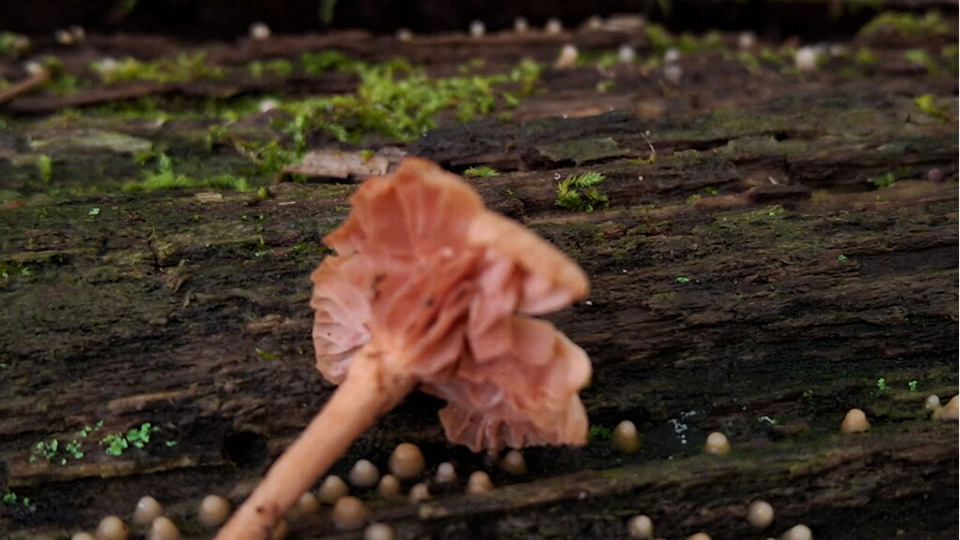
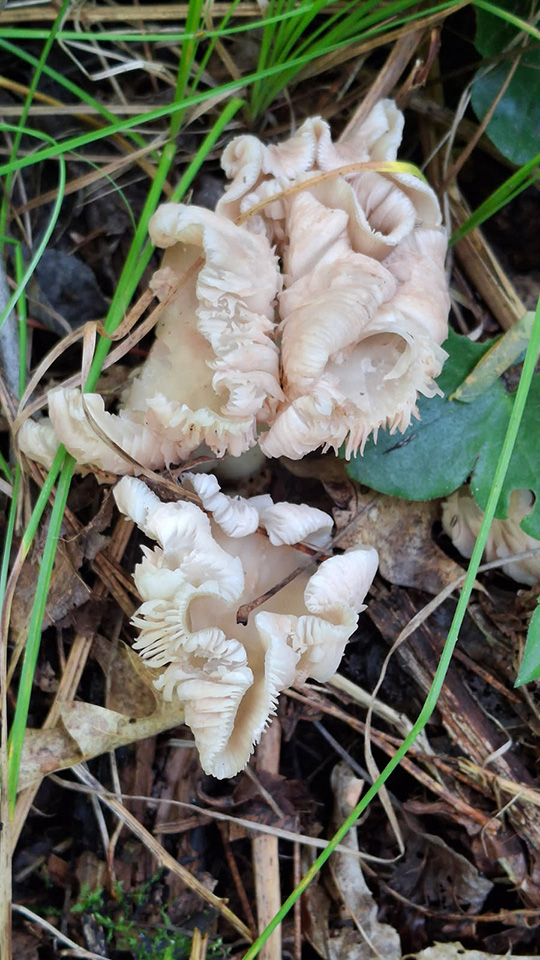
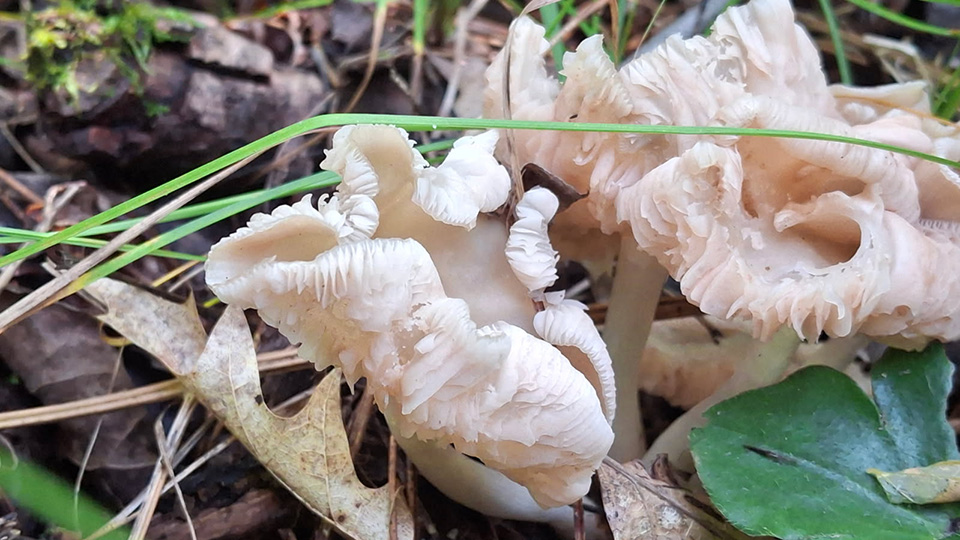
When it first appears, the cap is convex. The upper surface may be bald or be moderately covered with fine hairs or minute scales. The color is highly variable. It may be shades of brown, orangish-brown, reddish-brown, pinkish-brown, or salmon-colored. The tissue is dark and more or less transparent when moist, becoming paler and opaque as it dries out (hygrophanous). The margins are curved inward. As it ages, the cap spreads out and the color fades. The mature cap is usually ⅝″ to 2″ (1.5 to 5 cm) in diameter but it may be larger or smaller. It is often depressed in the middle. The color is buff when dry, becoming darker when moist. The margins are curved downward and may be smooth, lined, or grooved. On older caps the margins are sometimes uplifted, sometimes wavy, and often eroded or lobed. Like the genus, this species is called “Deceiver” due to its tendency to fade and become difficult to identify.
The gills are thick, well-spaced, and somewhat waxy. They are usually broadly attached (adnate), sometimes slightly running down the stalk (decurrent), sometimes abruptly narrowed where they attach to the stalk (notched). They are pale pink to flesh-colored or reddish-tan when young, becoming dusted white as the spores mature.
The stalk is tough, flexible, often twisted, usually slender, ¾″ to 4″ (2 to 10 cm) long, and ⅛″ to ⅜″ (3 to 10 mm) thick. It is more or less the same thickness from top to bottom. It is colored like the cap and usually covered with fine hair-like fibers (fibrillose). There are sometimes downy white fibers, part of the mycelium, at the base. As it ages the stem becomes hollow.
The flesh is thin and the color of the cap but paler. The cap is edible, but care should be taken as it looks like many other mushrooms. The stems are tough and are not considered edible.
The spore print is white.
Similar Species
Habitat and Hosts
A wide variety of habitats. Hardwoods and conifers.
Ecology
Season
Late spring through fall
Distribution

Sources
Biodiversity occurrence data published by: Minnesota Biodiversity Atlas (accessed through the Minnesota Biodiversity Atlas Portal, bellatlas.umn.edu. Accessed 4/30/2025).
Laccaria laccata (Scop.) Cooke in Bánki, O., Roskov, Y., Döring, M., Ower, G., Hernández Robles, D. R., Plata Corredor, C. A., Stjernegaard Jeppesen, T., Örn, A., Pape, T., Hobern, D., Garnett, S., Little, H., DeWalt, R. E., Miller, J., Orrell, T., Aalbu, R., Abbott, J., Abreu, C., Acero P, A., et al. (2026). Catalogue of Life (2026-08-26 XR). Catalogue of Life Foundation, Amsterdam, Netherlands. https://doi.org/10.48580/dgyy9
Mycology Collections Portal (MyCoPortal) https://www.mycoportal.org/portal/collections/index.php). Accessed 4/30/2025.
Occurrence
Very common, often abundant
Taxonomy
Kingdom
Fungi (Fungi)
Subkingdom
Dikarya
Phylum
Basidiomycota (Basidiomycete Fungi)
Subphylum
Agaricomycotina (Higher Basidiomycetes)
Class
Agaricomycetes (Mushrooms, Bracket Fungi, Puffballs, and Allies)
Subclass
Agaricomycetidae
Order
Agaricales (Common Gilled Mushrooms and Allies)
Suborder
Agaricineae
Family
Hydnangiaceae
Genus
Laccaria (Deceivers)
Family
The genus Laccaria was formerly placed in the family Tricholomataceae, a waste-basket family containing a large number of genera that do not fit into another family or have not (yet) been separated into a distinct family. Some authors placed it into a separate family, Hydnangiaceae, based on its unique spore type. Subsequent DNA studies support this separation.
Subordinate Taxa
Deceiver (Laccaria laccata var. laccata) 

Deceiver (Laccaria laccata var. pallidifolia)
Synonyms
Agaricus laccatus
Camarophyllus laccatus
Clitocybe laccata
Collybia laccata
Omphalia laccata
Russuliopsis laccata
Common Names
Deceiver
Lackluster Laccaria