Leathery-veiled Bolete
(Paragyrodon sphaerosporus)
Conservation • Description • Habitat • Ecology • Distribution • Taxonomy

Conservation Status
IUCN Red List
not listed
NatureServe
not listed
Minnesota
not listed
Description
Leathery-veiled Bolete is a large, conspicuous, easily identified mushroom. It occurs in the United States in the Upper Midwest in Michigan, Wisconsin, Minnesota, Iowa, and northern Illinois. It also occurs in Canada in southern Manitoba. It is relatively common in Minnesota. There are just a handful of isolated records outside this range in Kansas, Colorado, Utah, Montana, and Saskatchewan. It was originally described in 1885 from a specimen in New York.
Leathery-veiled Bolete is found in summer and fall in deciduous forests and on lawns. It grows on the ground under hardwood trees, mostly white oak, but in Colorado it has been found under Gambel oak. It fruits mostly in areas where the forest has been cleared and only the shade trees remain. It has a mutually beneficial relationship (mycorrhizal) with the tiny rootlets of trees, absorbing sugars and amino acids while helping the tree absorb water.
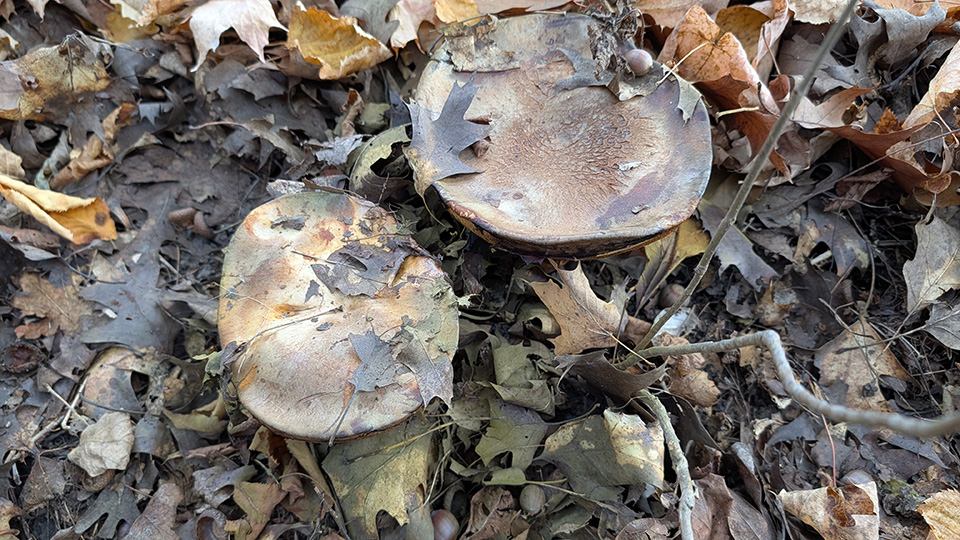
When it first appears, the stalk and cap are completely enveloped in a thick, tough, leathery, firmly attached, protective covering (partial veil). This is the feature that gives the mushroom its common name. The veil soon ruptures, becomes gelatinous, and disintegrates, but it leaves a ring of tissue that sheathes the base of the stalk, and sometimes it leaves tissue remnants on the margin of the cap.
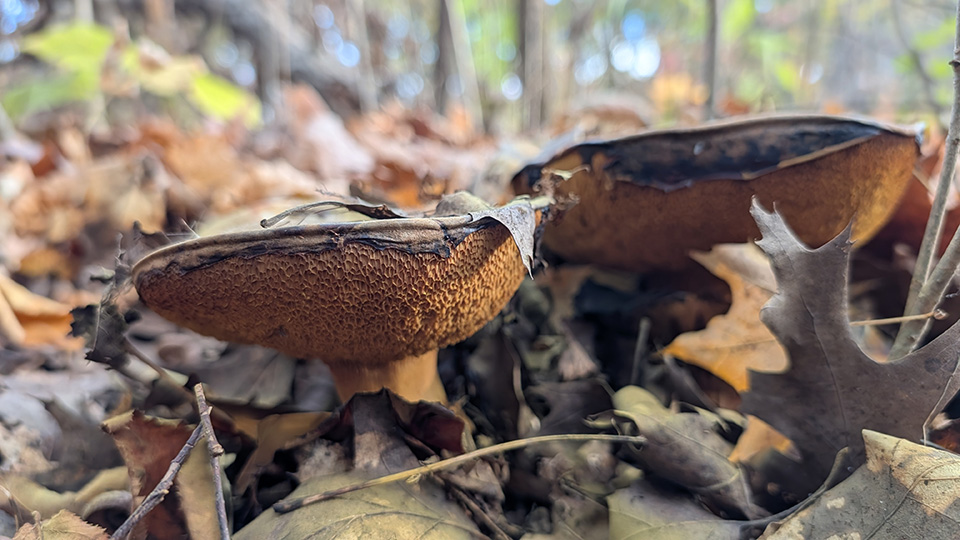
The cap is yellowish and convex when young. As it ages it broadens and darkens. Mature caps are brown, 1½″ to 8″ (4 to 20 cm) in diameter, and broadly convex or flat. The surface is smooth and is sticky in dry conditions but slimy when moist. It bruises dark brown.
The stalk is white to yellowish, 1½″ to 4″ (4 to 10 cm) long, and ⅜″ to 1¼″ (1 to 3 cm) thick, more or less the same thickness from top to bottom. It is smooth near the top. It bruises brown.
The pore surface is yellow when young, becoming brown as the spores mature. It is attached to the stem and sometimes runs down the stem. When bruised it quickly turns dark brown. There is about 1 pore per 1⁄32″ (1 mm). The pore tubes are angular and about ⅜″ (1 cm) deep.
The flesh is white to yellowish. It turns brown when sliced. Edibility is unknown.
The spore print is dark olive yellow to yellowish-brown.
Similar Species
Habitat and Hosts
Deciduous forests, lawns
Ecology
Season
Summer and fall
Distribution

Sources
Biodiversity occurrence data published by: Minnesota Biodiversity Atlas (accessed through the Minnesota Biodiversity Atlas Portal, bellatlas.umn.edu. Accessed 10/14/2026).
Paragyrodon sphaerosporus (Peck) Singer in Bánki, O., Roskov, Y., Döring, M., Ower, G., Hernández Robles, D. R., Plata Corredor, C. A., Stjernegaard Jeppesen, T., Örn, A., Pape, T., Hobern, D., Garnett, S., Little, H., DeWalt, R. E., Miller, J., Orrell, T., Aalbu, R., Abbott, J., Abreu, C., Acero P, A., et al. (2026). Catalogue of Life (2026-08-26 XR). Catalogue of Life Foundation, Amsterdam, Netherlands. https://doi.org/10.48580/dgyy9
Mycology Collections Portal (MyCoPortal) https://www.mycoportal.org/portal/collections/index.php). Accessed 10/14/2026.
Occurrence
Relatively common in Minnesota
Taxonomy
Kingdom
Fungi (Fungi)
Subkingdom
Dikarya
Phylum
Basidiomycota (Basidiomycete Fungi)
Subphylum
Agaricomycotina (Higher Basidiomycetes)
Class
Agaricomycetes (Mushrooms, Bracket Fungi, Puffballs, and Allies)
Subclass
Agaricomycetidae
Order
Boletales (Boletes and Allies)
Suborder
Boletineae
Family
Paxillaceae
Genus
Paragyrodon
Subordinate Taxa
Synonyms
Boletus sphaerosporus
Gyrodon sphaerosporus
Ixocomus sphaerosporus
Suillus sphaerosporus
Common Names
Leathery-veiled Bolete
Visitor Photos
This button not working for you?
Simply email us at info@MinnesotaSeasons.com.
Attach one or more photos and, if you like, a caption.


Minnesota Seasons Photos
Slideshows
Visitor Videos
This button not working for you?
Simply email us at info@MinnesotaSeasons.com.
Attach a video, a YouTube link, or a cloud storage link.
Other Videos
Visitor Sightings
This button not working for you?
Simply email us at info@MinnesotaSeasons.com.
Be sure to include a location.
Travis Saladino
10/13/2026

Location: Nerstrand Big Woods State Park
Paul
8/28/2023
Location: St. Cloud, MN (Benton County)
Minnesota Seasons Sightings