Northern Tooth

(Climacodon septentrionalis)

Information

Northern Tooth - Species Profile

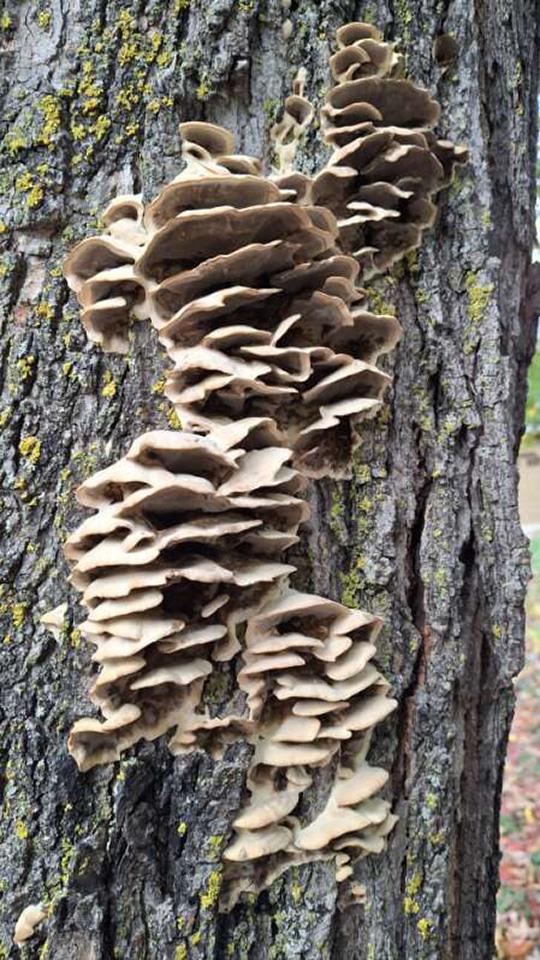
Northern Tooth - Featured photo
Photo by Jeff Lindbom

Conservation Status

IUCN Red List

not listed

NatureServe

not listed

Minnesota

not listed

Description

Northern Tooth is a widespread and fairly common tooth fungus. It is not poisonous but is not edible due to a bitter taste and a tough texture.

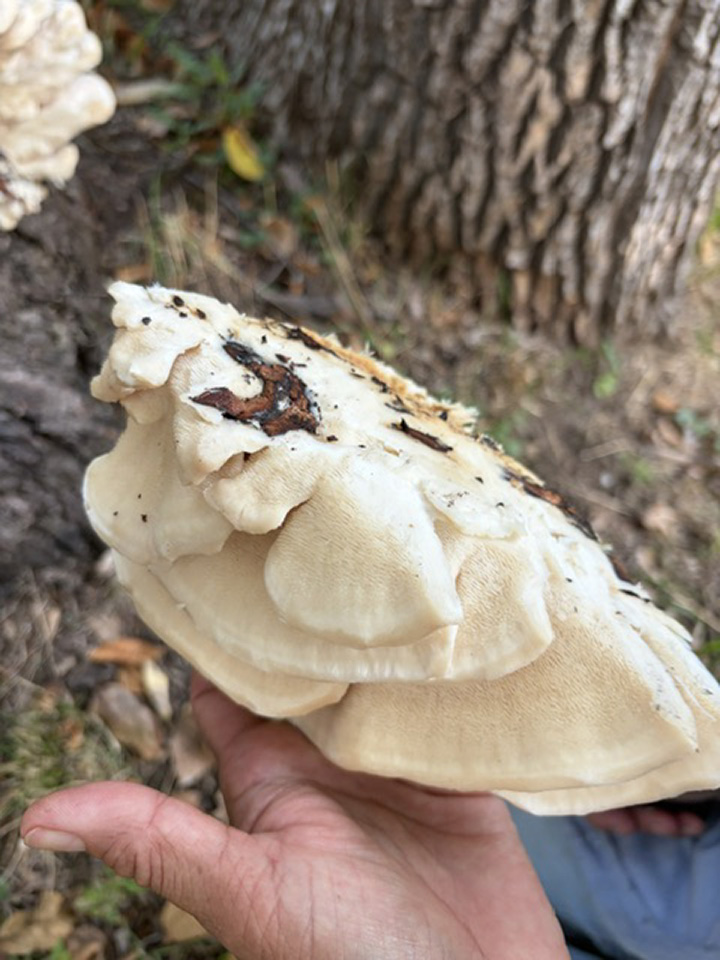
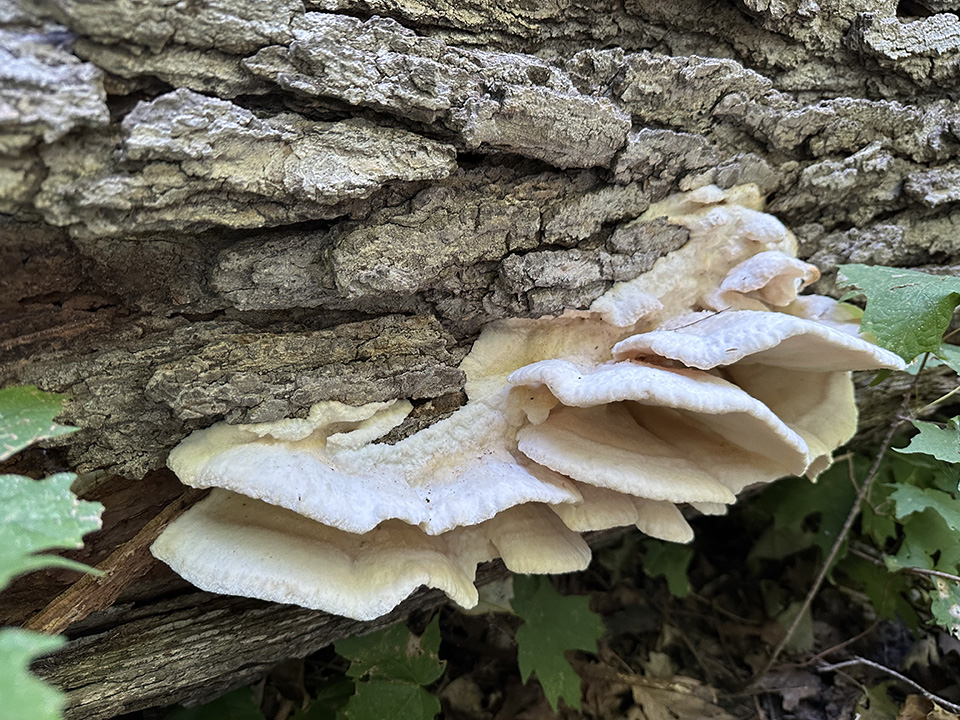
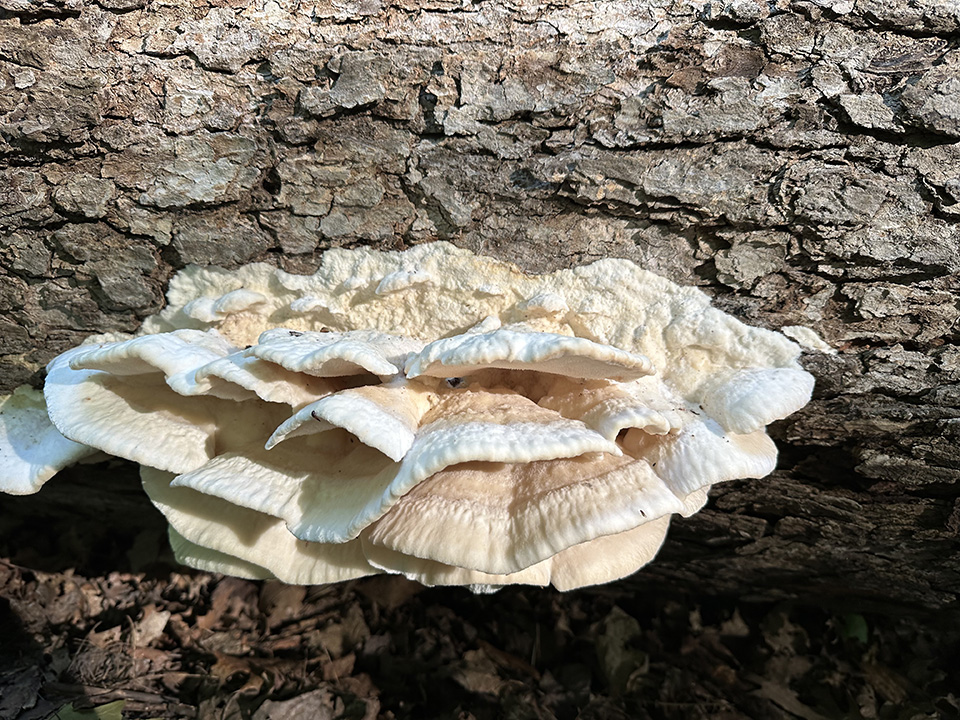
The fruiting body is annual and often massive, up to 20 tall and 10 wide. It consists of tight, overlapping layers of shelf-like caps joined at the base by a whitish plate. It lives high on the trunks if living hardwood trees (parasitic), especially sugar maple, but also other maples, green ash, and beech. It is sometimes found on recently dead trees and stumps but is rarely found on fallen logs. It enters the tree through a wound and causes heartwood rot. It has a sour smell when it is fresh, an unpleasant, rancid odor as it dries.

There is no stem.

The brackets (caps) are fan-shaped; convex, flat, or slightly depressed; 4 to 6 across; 1 to 4¾ deep; and ¾ to 2 thick at the base, becoming thinner toward the margin. They are cream-colored to chamois yellow when fresh, turning brownish when dry. The upper surface is dry and rough to the touch and may be densely hairy. It has very faint concentric zones. The margin is sharp and becomes rolled inward when dry.

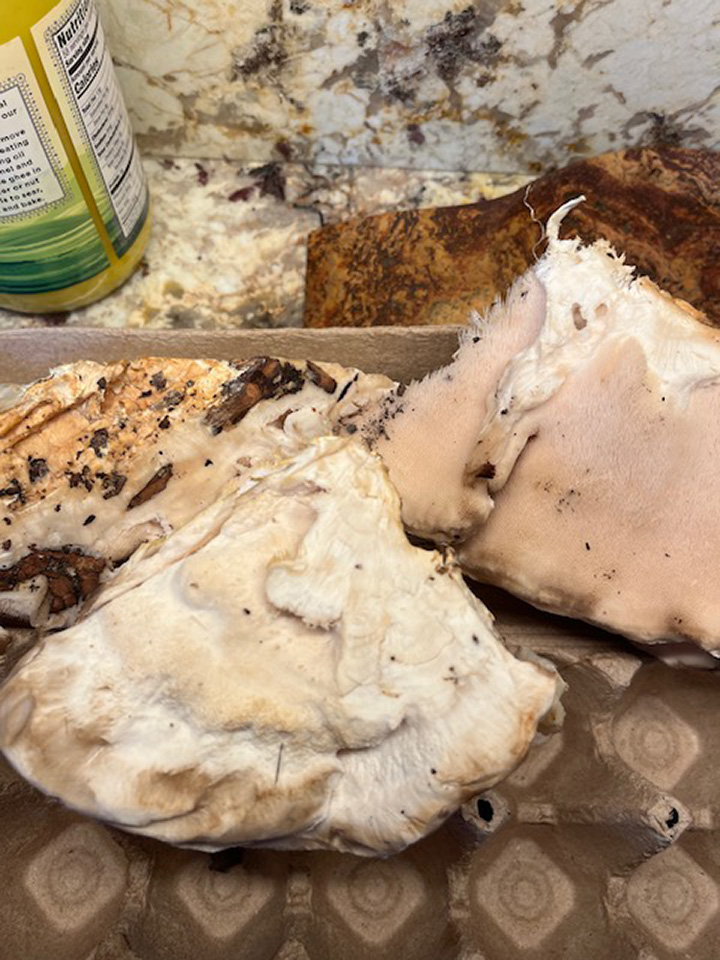
The pore surface on the underside of the bracket consists of numerous, tightly packed, downward-pointing spines. The spines are cylinder-shaped, up to ½ long, and sharply pointed. They are tapered from the base to the tip, so that spores falling straight down will not be obstructed by the surface of the tooth further down. They are creamy yellow when fresh, becoming brownish and fragile when dry. The spore print is white.

The flesh is white and tough.

Similar Species


Habitat and Hosts

Living hardwoods, especially sugar maple, but also other maples

Ecology

Season

July to October

Distribution

Distribution Map
8/22/2026

Sources

24, 30, 77, 83.

Biodiversity occurrence data published by: Minnesota Biodiversity Atlas (accessed through the Minnesota Biodiversity Atlas Portal, bellatlas.umn.edu. Accessed 8/22/2026).

Climacodon septentrionalis (Fr.) P. Karst. in Bánki, O., Roskov, Y., Döring, M., Ower, G., Hernández Robles, D. R., Plata Corredor, C. A., Stjernegaard Jeppesen, T., Örn, A., Pape, T., Hobern, D., Garnett, S., Little, H., DeWalt, R. E., Miller, J., Orrell, T., Aalbu, R., Abbott, J., Abreu, C., Acero P, A., et al. (2026). Catalogue of Life (2026-07-17 XR). Catalogue of Life Foundation, Amsterdam, Netherlands. https://doi.org/10.48580/dgykv

Mycology Collections Portal (MyCoPortal) https://www.mycoportal.org/portal/collections/index.php). Accessed 8/22/2026.

Occurrence

Widespread and fairly common in northeastern United States

Taxonomy

Kingdom

Fungi (Fungi)

Subkingdom

Dikarya

Phylum

Basidiomycota (Basidiomycete Fungi)

Subphylum

Agaricomycotina (Higher Basidiomycetes)

Class

Agaricomycetes (Mushrooms, Bracket Fungi, Puffballs, and Allies)

Subclass

Incertae sedis

Order

Polyporales (Shelf Fungi)

Family

Meruliaceae

Genus

Climacodon

Non-taxonomic group

Tooth fungi do not form a single taxonomic group. They are characterized by having a spore-producing surface with spines, or “teeth”, instead of pores or tubes.

Subordinate Taxa


Synonyms

Climacodon septentrionale

Creolophus septentrionalis

Dryodon septentrionalis

Hericium septentrionale

Hydnum septentrionale

Hydnum septentrionale f. ramicola

Hydnum septentrionale var. hortense

Hydnum septentrionale var. septentrionale

Pleurodon septentrionalis

Steccherinum septentrionale

Common Names

Northern Tooth

Northern Tooth Fungus
Photos

Visitor Photos

Share your photo of this fungus.

This button not working for you?
Simply email us at info@MinnesotaSeasons.com.
Attach one or more photos and, if you like, a caption.

Marcy Grams

N. Tooth

Northern Tooth 11
Northern Tooth 12
Northern Tooth 13

Bobbi Johnson

Northern Tooth 08
Around the garden...

LSegar

Northern Tooth 06
At base of maple tree

Kirk Nelson

Northern Tooth 04
Growing on a silver maple
Northern Tooth 05
Same specimen, two months later

Bill Reynolds

Northern Tooth 01
Parasitic; in dense overlapping clusters on trunks of living deciduous trees, particularly maple and beech

Minnesota Seasons Photos

Slideshows

Slideshows

Videos

Visitor Videos

Share your video of this fungus.

This button not working for you?
Simply email us at info@MinnesotaSeasons.com.
Attach a video, a YouTube link, or a cloud storage link.

Other Videos

Northern Tooth Mushroom - Climacodon Septentrionalis
Mariana Roberts

About

Published on Aug 3, 2013

Northern Tooth (Climacodon Septentrionalis)

More Information: http://www.mushroomexpert.com/climacodon_septentrionalis.html

Identification: Overlapping yellowish-white annual shelves with toothed undersides found on living hardwoods, especially maples.

Season of fruiting: Late summer-fall

Ecosystem function: Spongy heart rot

Fungal Note: This fungus fruits only occasionally on individual trees, and its teeth can reach 10-15 mm in length.

Sightings

Visitor Sightings

Report a sighting of this fungus.

This button not working for you?
Simply email us at info@MinnesotaSeasons.com.
Be sure to include a location.

Marcy Grams
9/3/2026

Northern Tooth

Location: Sherburne County

Amy Stifter
8/22/2026

Northern Tooth

Location: Wolsfeld Woods SNA

Bobbi Johnson
9/9/2024

Northern Tooth

Location: Silver Bay, MN

Around the garden...

LSegar
8/27/2018

Northern Tooth

Location: Excelsior, MN

At base of maple tree

Kirk Nelson
10/16/2016

Northern Tooth

Location: Lebanon Hills Regional Park

Same specimen, two months later

Kirk Nelson
8/21/2016

Northern Tooth

Location: Lebanon Hills Regional Park

Growing on a silver maple

Jeff Lindbom
9/1/2014

Northern Tooth

Location: Marinette County, Wisconsin

Bill Reynolds
10/2/2005

Northern Tooth

Location: growing on the side of a Maple in Cook Co Mn

Parasitic; in dense overlapping clusters on trunks of living deciduous trees, particularly maple and beech

Minnesota Seasons Sightings