Snow Morel - Species Profile
Conservation • Description • Habitat • Ecology • Distribution • Taxonomy

Conservation Status
IUCN Red List
not listed
NatureServe
not listed
Minnesota
not listed
Description
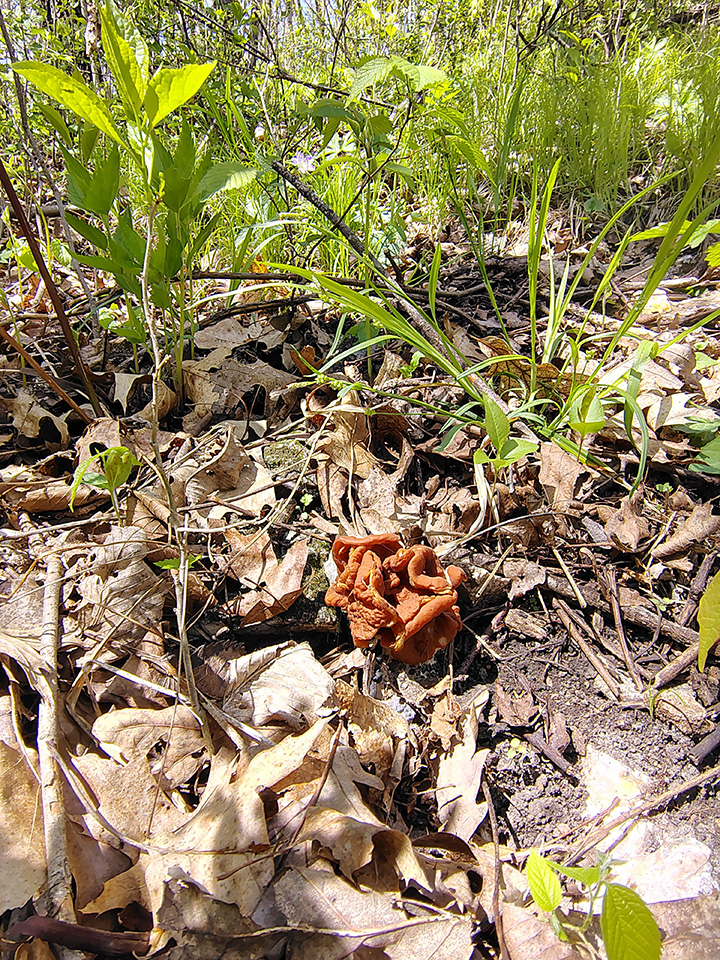
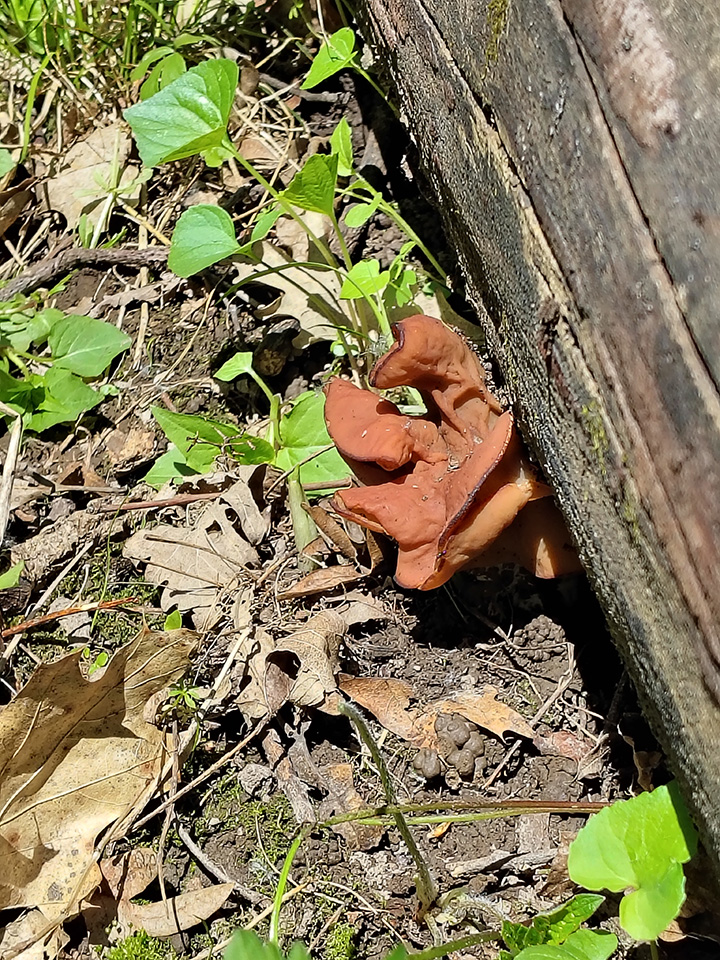
Snow Morel is an early forest mushroom. It occurs in eastern North America. It is found in the spring and early summer alone, scattered, or in groups, on the ground or on rotten wood, under coniferous or hardwood trees, often poking through leaf litter. It is saprobic, obtaining nutrients from rotting wood, and might also be mycorrhizal, having a mutually beneficial relationship with the tiny rootlets of trees. It may exhibit both traits at different parts of its life cycle.
Snow Morel is called a “Snow False Morel” due to its similarity in appearance and seasonality to true morels (Morchella spp.).
The cap is usually 1¼″ to 4″ wide and 1¼″ to 2⅜″ high, but may be much larger. It is hollow, strongly and deeply wrinkled, highly convoluted, and brain-like. It is often squarish and blocky, and is usually compact, without strongly projecting lobes. The upper surface is dull, yellowish-brown or tan when young, becoming darker brown or reddish-brown with age. The margin of the cap is attached directly to the stalk but it is often ingrown at that point and may appear unattached.
The stalk is massive, ¾″ to 4″ tall and wide, about as wide as the cap. It is pale tan or whitish, hairless, and sometimes ribbed or longitudinally wavy or folded. It is often mostly or completely hidden by the closely appressed cap.
The flesh is brittle, thin, whitish, and chambered. It is edible if sautéed but not edible when raw. Some authors suggest that it be avoided due to its similarity in appearance to the poisonous False Morel (Gyromitra esculenta).
Similar Species
False Morel (Gyromitra esculenta) is more erect. The stalk is much narrower than the cap and the cap is less convoluted, looking more like a brain and less like a crumpled cloth. The color is typically much darker, often a deep chocolate or reddish-black.
Habitat and Hosts
Forests
Hardwood trees
Ecology
Season
Spring and early summer
Distribution

Sources
Biodiversity occurrence data published by: Minnesota Biodiversity Atlas (accessed through the Minnesota Biodiversity Atlas Portal, bellatlas.umn.edu. Accessed 5/2/2026).
Gyromitra korfii (Raitv.) Harmaja in GBIF Secretariat (2023). GBIF Backbone Taxonomy. Checklist dataset https://doi.org/10.15468/39omei accessed via GBIF.org. Accessed 5/2/2026.
Mycology Collections Portal (MyCoPortal) https://www.mycoportal.org/portal/collections/index.php). Accessed 5/2/2026.
Occurrence
Taxonomy
Kingdom
Fungi (Fungi)
Subkingdom
Dikarya
Phylum
Ascomycota (Sac Fungi)
Subphylum
Pezizomycotina
Class
Pezizomycetes
Subclass
Pezizomycetidae
Order
Pezizales
Family
Discinaceae
Tribe
Discineae
Genus
Maublancomyces
Species
This species was formerly merged with the European Gyromitra gigas, a name still prevalent in older literature. However, that merge is now widely rejected by North American specialists. The eastern North American “Snow Morel” found in hardwood forests, like those in Minnesota, is now specifically recognized as Maublancomyces korfii, distinct from the western North American species found in coniferous forests Maublancomyces montanus.
Subordinate Taxa
Synonyms
Discina korfii
Gyromitra korfii
Common Names
Snow Morel
Snow False Morel