Wrinkled Cortinarius - Species Profile
Conservation • Description • Habitat • Ecology • Distribution • Taxonomy
Conservation Status
IUCN Red List
LC - Least Concern
NatureServe
NNR - Unranked
Minnesota
not listed
Description
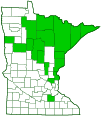
Wrinkled Cortinarius, formerly called Gypsy Mushroom, is a common, late season, medium-sized, gilled mushroom. It occurs in northern regions around the world. In the United States it occurs in the east from Maine to northern Georgia, west to Michigan and Minnesota, and in the west from Washington State to northern California, east to western Montana. It occurs across southern Canada.
Cortinarius caperatus was formerly known as the Gypsy mushroom, a common name that has been updated to reflect modern sensitivities. The shift, spearheaded by the American Ornithological Society and mirrored by various mycological groups, began around 2020. While print and many online sources still use the traditional name, modern databases like iNaturalist, NatureServe, and Wikipedia have transitioned to Wrinkled Cortinarius or Wrinkled Cort, a name that more accurately reflects its scientific epithet caperatus, which is Latin for “wrinkled,” “shriveled,” or “furrowed.”
Wrinkled Cortinarius is found in late summer and fall, in coniferous and mixed woodlands, sometimes alone but more often scattered or in groups but not clustered (gregarious). It grows on the ground under coniferous and deciduous trees and under shrubs in the Heath Family (Family Ericaceae). It obtains its nutrients from the rootlets of living trees and shrubs (mycorrhizal).
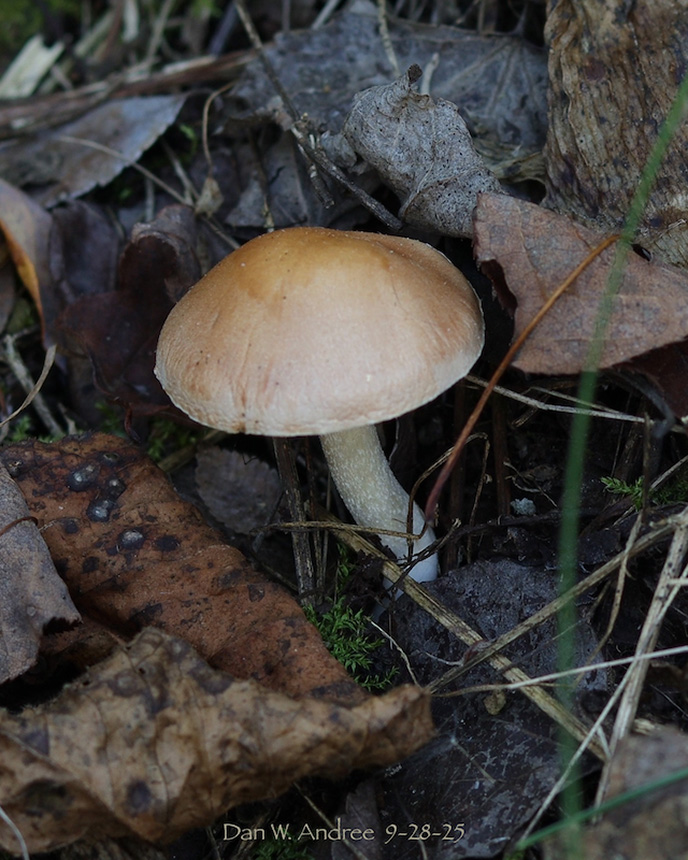
When it first appears, the cap is hemispherical or oval, convex, and pale yellowish. The surface is coated, especially in the center, with a thin, Kleenex-like layer of silky, white or gray, hair-like fibers (fibrils), remnants of the universal veil. As it ages, the cap broadens, the color darkens, and the coating thins or wears away, often becoming less distinct or persisting only as faint patches near the center. The mature cap is 1½″ to 4¾″ (4 to 12 cm) in diameter, broadly convex, bell-shaped, or nearly flat, and yellowish brown, tan, or orangish brown, often paler at the margin. There is sometimes a low, broad knob in the middle (umbonate). The surface is dry and is usually wrinkled radially. This is the feature that gives the mushroom its species epithet and its new common name.
The gills are covered with a membranous partial veil at first. They are closely spaced to crowded, and they are attached to the stalk broadly (adnate), narrowly (adnexed), or with a distinct notch at the stem. They are pale at first, soon turning brown or cinnamon brown as the spores mature. The gill faces are sometimes mottled or banded with transverse darker and lighter zones.
The stalk is 2″ to 4¾″ (5 to 12 cm) long, and ⅜″ to ¾″ (1 to 2 cm) thick, the same thickness from top to bottom or slightly swollen at the bottom. It is solid, firm, and whitish or pale tan. There is a thick, white, membranous ring near the middle that is easily removed. The stalk is usually shaggy or slightly roughened above the ring. At the base there is sometimes an obscure, cup-like covering.
The flesh is thick, whitish, and firm. It does not change color when sliced. It is edible and considered choice.
The spore print is rusty brown.
Similar Species
Habitat and Hosts
Mixed and deciduous woodlands
Deciduous and coniferous trees and shrubs in the Heath Family (Family Ericaceae)
Ecology
Season
Late summer and fall
Distribution
Sources
Biodiversity occurrence data published by: Minnesota Biodiversity Atlas (accessed through the Minnesota Biodiversity Atlas Portal, bellatlas.umn.edu. Accessed 3/14/2026).
Cortinarius caperatus (Pers.) Fr. in GBIF Secretariat (2023). GBIF Backbone Taxonomy. Checklist dataset https://doi.org/10.15468/39omei accessed via GBIF.org. Accessed 3/14/2026.
Mycology Collections Portal (MyCoPortal) https://www.mycoportal.org/portal/collections/index.php). Accessed 3/14/2026.
Occurrence
Common
Taxonomy
Kingdom
Fungi (Fungi)
Subkingdom
Dikarya
Phylum
Basidiomycota (Basidiomycete Fungi)
Subphylum
Agaricomycotina (Higher Basidiomycetes)
Class
Agaricomycetes (Mushrooms, Bracket Fungi, Puffballs, and Allies)
Subclass
Agaricomycetidae
Order
Agaricales (Common Gilled Mushrooms and Allies)
Family
Cortinariaceae
Genus
Cortinarius (Webcaps)
Subgenus
Paramyxacium
Section
Rozites
Subordinate Taxa
Synonyms
Agaricus caperatus
Dryophila caperata
Hylophila caperata
Lepiota caperata
Pholiota caperata
Rozites caperata
Rozites caperatus
Togaria caperata
Common Names
Gypsy Mushroom
Wrinkled Cort
Wrinkled Cortinaria
Wrinkled Cortinarius
