


Wrinkled Peach
(Rhodotus reticeps)
Conservation • Description • Habitat • Ecology • Distribution • Taxonomy

Conservation Status
IUCN Red List
not listed
NatureServe
not listed
Minnesota
not listed
Description |
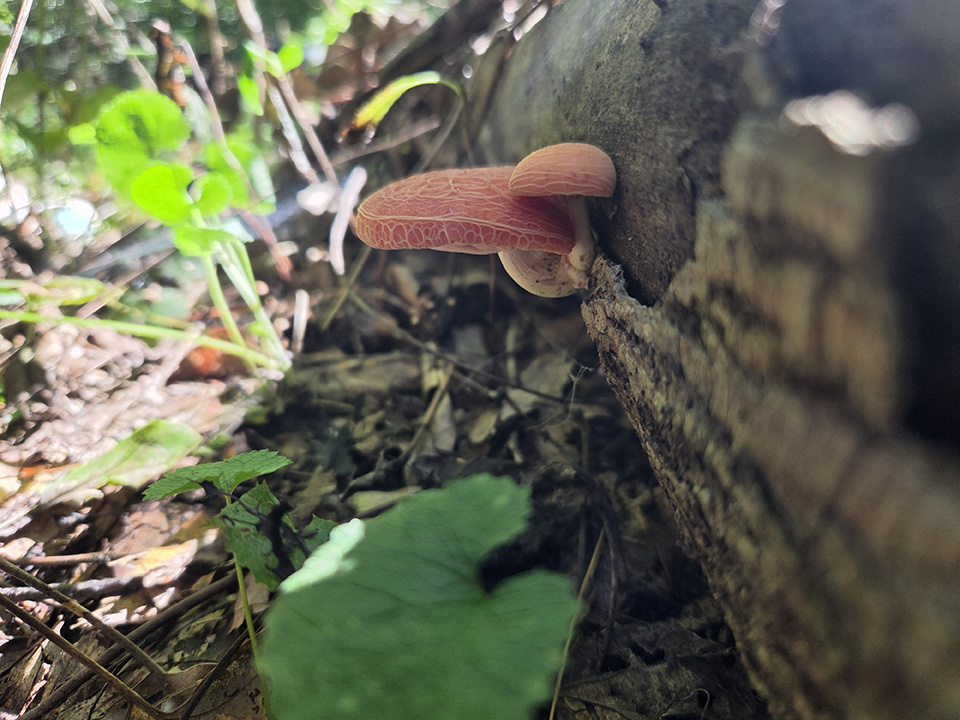
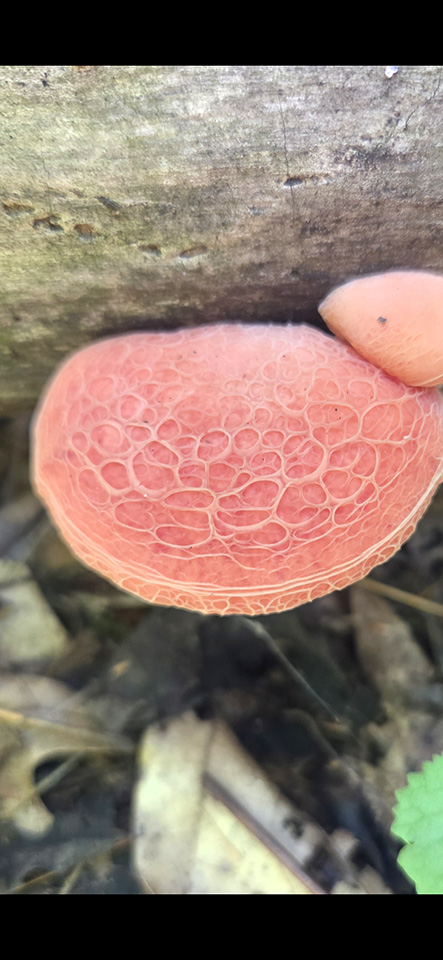
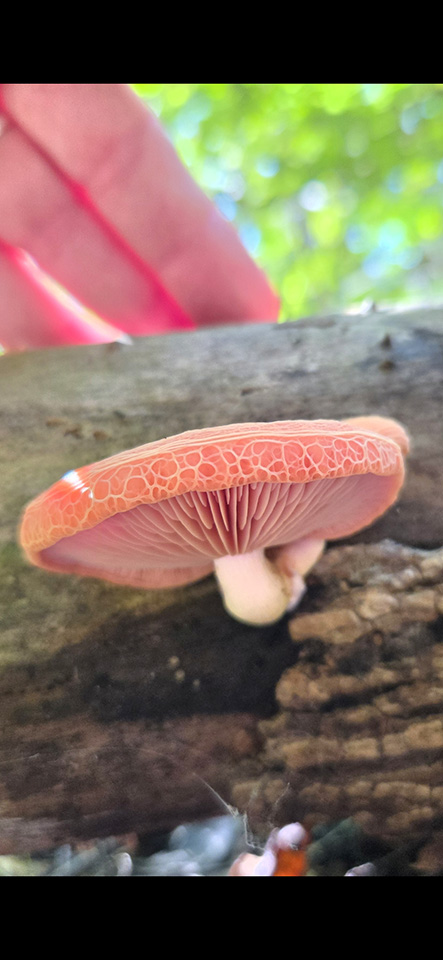
Wrinkled Peach is a small to medium-sized, easily recognized but infrequently found gill mushroom. It is found scattered or in small groups on fallen, rotting hardwoods, especially on elm but occasionally also on basswood and maple. It is saprobic, getting its nutrients from well-decayed wood. The stalk (stipe) is 1¼″to 2¾″ long, ⅜″ to ⅝″ in diameter, solid, tough, dry, and slightly hairy. It is white to pinkish, the color determined by the amount and color of light it receives. It is often curved due to its appearance on the side of a fallen log. It is attached to the bottom of the cap centrally, slightly off-center, or almost laterally. It sometimes exudes red or orange sap. There are no remnants of a universal veil clinging to the stalk. The cap is ¾″ to 4″ in diameter, thick, and tough. It is pink and convex at first. As it ages it flattens out and becomes salmon, peach-colored, pink, or red. Like the stipe, the color is determined by the amount and color of light it receives. The margin is curved under. The skin in the upper surface (pellicle) is gelatinous and sometimes slimy to the touch. It is usually, but not always, conspicuously wrinkled with a network of whitish, cross-linked ridges. The presence of wrinkles is indicative of alternating wet and dry conditions. In an always wet environment, the surface will be smooth, puffy, and gelatinous. The pellicle peels off easily and completely. The flesh is pinkish, firm, and rubbery. It is considered inedible due to its bitter taste, but at least one source (Roger’s Mushrooms) lists the taste as mild. The gills are thick, closely spaced, and broadly attached to the stipe. They are similar in color to, but slightly paler than, the cap. The spore print is pinkish. |
Similar Species |
No similar species. The lightly-colored netted surface, when present, is distinctive. |
Habitat and Hosts |
Dead deciduous wood, especially maple and elm |
Ecology |
Season |
June through September |
Distribution

Sources
Biodiversity occurrence data published by: Minnesota Biodiversity Atlas (accessed through the Minnesota Biodiversity Atlas Portal, bellatlas.umn.edu. Accessed 10/6/2026).
Rhodotus palmatus (Bull.) Maire in Bánki, O., Roskov, Y., Döring, M., Ower, G., Hernández Robles, D. R., Plata Corredor, C. A., Stjernegaard Jeppesen, T., Örn, A., Pape, T., Hobern, D., Garnett, S., Little, H., DeWalt, R. E., Miller, J., Orrell, T., Aalbu, R., Abbott, J., Abreu, C., Acero P, A., et al. (2026). Catalogue of Life (2026-08-26 XR). Catalogue of Life Foundation, Amsterdam, Netherlands. https://doi.org/10.48580/dgyy9
Mycology Collections Portal (MyCoPortal) https://www.mycoportal.org/portal/collections/index.php). Accessed 10/6/2026.
Occurrence
Infrequent
Taxonomy
Kingdom
Fungi (Fungi)
Subkingdom
Dikarya
Phylum
Basidiomycota (Basidiomycete Fungi)
Subphylum
Agaricomycotina (Higher Basidiomycetes)
Class
Agaricomycetes (Mushrooms, Bracket Fungi, Puffballs, and Allies)
Subclass
Agaricomycetidae
Order
Agaricales (Common Gilled Mushrooms and Allies)
Suborder
Marasmiineae
Family
Physalacriaceae
Genus
Rhodotus
Taxonomic Status & Future Revision
This species was long cataloged in North American field guides and regional databases as Rhodotus palmatus (or R. palmatus var. subpalmatus). Recent genetic analysis of Midwestern North American collections of Rhodotus showed that they are phylogenetically divergent from the European species. The resulting publication (Birkebak et al., 2026) formally recombined Montagne’s original species epithet (reticeps) under Rhodotus as Rhodotus reticeps to represent the distinct North American taxon.
Subordinate Taxa
Synonyms
Agaricus palmatus
Agaricus palmatus var. palmatus
Agaricus palmatus var. sessilis
Agaricus phlebophorus var. reticulatus
Agaricus subpalmatus
Crepidotus palmatus
Dendrosarcus subpalmatus
Entoloma cookei
Gyrophila palmata
Pleuropus palmatus
Pleurotus palmatus
Pleurotus subpalmatus
Rhodotus palmatus
Rhodotus palmatus var. subpalmatus
Rhodotus subpalmatus
Common Names
The new combination Rhodotus reticeps has no widely established common name at this time. In the interim, the traditional vernacular Wrinkled Peach is retained here.
Glossary
Pellicle
A thin, outer, gelatinous membrane on the surface of the cap of a mushroom.
Saprobic
A term often used for saprotrophic fungi. Referring to fungi that obtain their nutrients from decayed organic matter.
Stipe
A supporting stalk-like structure lacking vascular tissue: in fungi, the stalk supporting the mushroom cap; in ferns, the stalk connecting the blade to the rhizome; in flowering plants, the stalk connecting the flower’s ovary to the receptacle; in orchids; the band connecting the pollina with the viscidium.
Universal veil
An egg-like structure that envelopes all or most of a developing gill mushroom. Remnants of the universal veil sometimes visible on a mature mushroom are patchy warts on the cap, a ring on the stalk, and a volva at the base of the stalk.
Increasing
Before the middle of the twentieth century this mushroom was rare in North America. With the advance of Dutch elm disease, the number of dead elms has greatly increased, as has the population of this mushroom.
Visitor Photos
This button not working for you?
Simply email us at info@MinnesotaSeasons.com.
Attach one or more photos and, if you like, a caption.
 |
 |
on decaying stump |
 |
 |
|
 |
 |
|
Minnesota Seasons Photos
 |
 |
|
 |
|

Slideshows
Rhodotus palmatus - fungi kingdom
Nineli Lishina
Visitor Videos
This button not working for you?
Simply email us at info@MinnesotaSeasons.com.
Attach a video, a YouTube link, or a cloud storage link.
Other Videos
2010 Rhodotus Palmatus Madrid AMTA
Miguel Rodriguez
Rhodotus Palmatus
László Kaposvári

Visitor Sightings
This button not working for you?
Simply email us at info@MinnesotaSeasons.com.
Be sure to include a location.
Renee M
10/5/2026

Mason County, Illinois
Katey
9/7/2025
Location: Buffalo, MN

DBaloi
9/5/2021
Location: Walker, West Virginia
on decaying stump
Stephanie Keeler
9/5/2021
Location: Eden Prairie, MN
rachelplaetz
6/2/2018
Location: Beaver Falls Township
Jacquelin Boekhoff
9/6/2017
Location: Rum River Central Regional Park
Minnesota Seasons Sightings