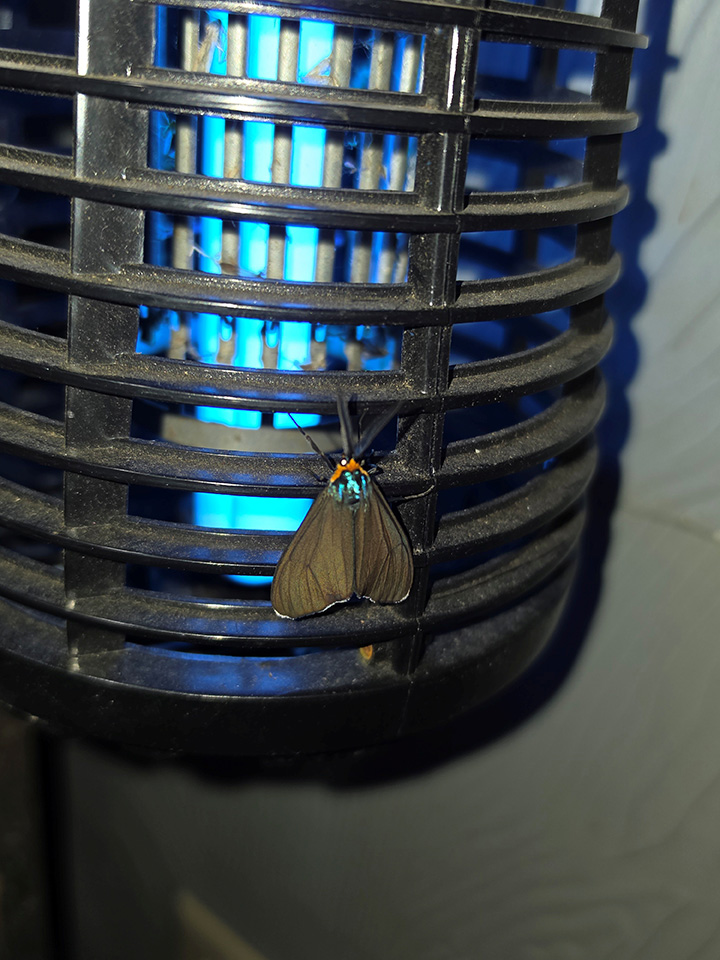
Virginia ctenucha - Species Profile
Conservation • Description • Habitat • Ecology • Distribution • Taxonomy

Hodges #
8262
Conservation Status
IUCN Red List
not listed
NatureServe
NNR - Unranked
Minnesota
not listed
Description
Virginia ctenucha is a colorful, medium-sized moth. It is the largest wasp moth in North America. The adult is 15 ⁄16″ to 1 1 ⁄16″ long and has a wingspan of 1 9 ⁄16″ to 2″.
The abdomen is metallic blue. The thorax is black and metallic blue. There are yellowish-orange scales on the sides of the first section of the thorax (prothorax) forming a collar. The collar does not extend across the upper (dorsal) surface of the prothorax.
The forewings are dark grayish-brown with a metallic blue sheen at the base. The leading edge of the forewing (costa) is dark grayish-brown.
The hindwings, not visible when perched, are smaller and black. Both wings have a short fringe that is at least partially white.
The head is yellowish-orange. The antennae are feather-like with branches only on one side of most segments.
The caterpillar is ⅝″ to 1 9 ⁄16″ long. The thorax and abdomen are nearly black. There is a broken, cream-colored subdorsal stripe and a broken, white, subspiracular stripe. On later instars the body is mostly hidden beneath dense tufts of long, stiff hairs (seta). Middle instar caterpillars lack these long white seta. There is a center (middorsal) row of black tufts flanked by rows of white, blond, or yellow tufts. The black tufts may be obscured by the longer flanking tufts. The head is orange to red except for a black triangular area between the eyes (frons). The abdominal leg-like structures (prolegs) are reddish. Mature caterpillars are found in May to early June and again in the fall.
Size
Wingspan: 1 9 ⁄16″ to 2″
Total length: 15 ⁄16″to 1 1 ⁄16″
Similar Species
Yellow-collared scape moth (Cisseps fulvicollis) is smaller and has much narrower wings. The discal area of the hindwing is translucent. The basal half of the costa is yellow. The thorax is black. The yellowish-orange collar extends evenly across the nape of the neck.
Habitat
Moist, open, grassy fields and meadows.
Ecology
Season
One generation: Mid-June to late July
Behavior
Adults fly primarily during the day, but are also attracted to light at night.
Life Cycle
Caterpillars overwinter beneath leaf litter or matted grass.
Larva Food/Hosts
Mostly grasses, but also sedges and irises.
Adult Food
Flower nectar
Defense Adaptations
This and other Ctenuchid moths have three adaptations that help to protect them from predators; aposematism, sound production, and pyrrolizidine alkaloid sequestration.
Aposematism: The metallic blue color of the thorax and abdomen mimics wasps which may be noxious to predators.
Sound production: A specialized (tymbal), corrugated region on the third section of the thorax (metathorax) produces ultrasonic sounds which interfere with (“jam”) the sonar of moth-eating bats.
Pyrrolizidine alkaloid sequestration: Caterpillars acquire and retain naturally produced toxic chemicals (pyrrolizidine alkaloids) from the plants they eat.
Distribution

Sources
7, 21, 24, 27, 30, 75, 82, 83.
Biodiversity occurrence data published by: Minnesota Biodiversity Atlas (accessed through the Minnesota Biodiversity Atlas Portal, bellatlas.umn.edu. Accessed 6/17/2025).
Ctenucha virginica Esper, 1794 in GBIF Secretariat (2023). GBIF Backbone Taxonomy. Checklist dataset https://doi.org/10.15468/39omei accessed via GBIF.org. Accessed 6/17/2025.
Quinn, Edward. M., and Ron Danielson. April 27, 2009. A Survey of Lepidoptera in Three Priority Areas of the Minnesota State Parks System. https://files.dnr.state.mn.us/eco/nongame/projects/consgrant_reports/2009
/2009_quinn_danielson.pdf.
Occurrence
Widespread and common
Taxonomy
Order
Lepidoptera (Butterflies and Moths)
Superfamily
Noctuoidea (Owlet Moths and Allies)
Family
Erebidae (Underwing, Tiger, Tussock, and Allied Moths)
Subfamily
Arctiinae (Tiger Moths and Allies)
Tribe
Arctiini (Tiger Moths)
Subtribe
Ctenuchina (Handmaidens)
Genus
Ctenucha
Family
In 2011 the family Arctiidae (tiger moths and lichen moths) was transferred to the family Erebidae mostly intact but demoted to a subfamily. The former subfamilies are now tribes, the former tribes now subtribes.
Subordinate Taxa
Synonyms
Ctenucha latreilliana
Common Names
Virginia ctenucha
Virginia ctenucha moth