blackberry looper - Species Profile
Conservation • Description • Habitat • Ecology • Distribution • Taxonomy

Hodges #
7071
Conservation Status
IUCN Red List
not listed
NatureServe
NNR - Unranked
Minnesota
not listed
Description
Blackberry looper is a small, widespread, and very common emerald moth. It occurs in the United States east of the Rocky Mountains, in adjacent Canadian provinces, and in Mexico. It is very common in Minnesota. It is found in woodlands, fields, and other open areas. There are two generations each year. Adults fly from May to September and mature caterpillars are found from May through fall.
Adult blackberry looper moths have a wingspan of 9 ⁄16″ to ⅞″ (14 to 23 mm). There is a wide longitudinal stripe on the upper (dorsal) side of the thorax extending to the tip of the abdomen. The wings are relatively large and grayish-green with creamy white lines and with minute, creamy white speckling that gives them a grainy appearance. The forewing has wide antemedial (AM) and postmedial (PM) lines, a wide band on the leading (costal) margin, and sometimes a thin line on the outer margin (terminal line). The fringe is creamy white. The hindwing is similar but with only a PM line. As the adult ages the green fades and the wings become more cream colored. The antennae on the male are broadly feather-like with extensions along both sides of the shaft (bipectinate). On the female the antennae are thread-like.
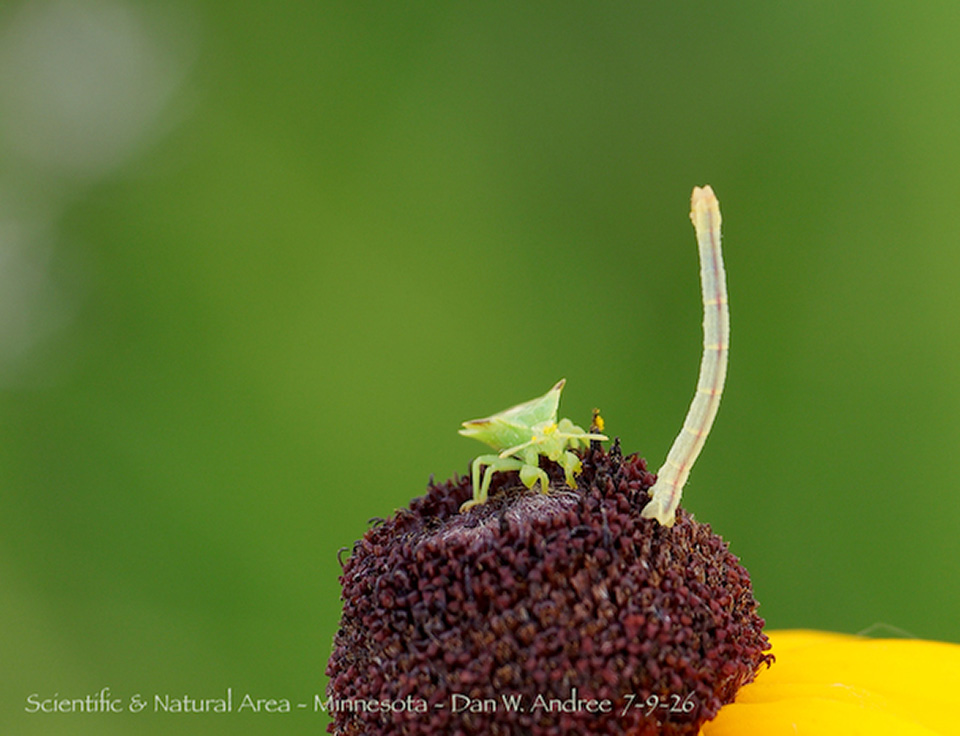
The caterpillar is less than 1″ (2.5 cm) long. The body is pale green with minute whitish speckling. The head is brownish. There are pale, slender horns on the head and first thoracic segment that project forward. There is a pale longitudinal stripe in the middle (middorsal stripe) and on each side there is one thin pale stripe in the subdorsal area, one above the breathing pores (spiracles), one through the spiracles, and one below the spiracles. There is also a yellow band between each abdominal segment. Mature caterpillars are active from May to fall.
Size
Wingspan: 9 ⁄16″ to ⅞″ (14 to 23 mm)
Similar Species
Habitat
Woodlands, fields, and other open areas
Ecology
Season
Two generations per year: May to September
Behavior
Adults are active both day and night. They sometimes come to lights but in small numbers.
Life Cycle
Larva Food/Hosts
Blackberry, raspberry, and strawberry fruits, and the flower petals of goldenrods and many other plants in the Aster (Asteraceae) family.
Adult Food
Distribution

Sources
Biodiversity occurrence data published by: Minnesota Biodiversity Atlas (accessed through the Minnesota Biodiversity Atlas Portal, bellatlas.umn.edu. Accessed 7/13/2026).
Chlorochlamys chloroleucaria (Guenée, [1858]) in Bánki, O., Roskov, Y., Döring, M., Ower, G., Hernández Robles, D. R., Plata Corredor, C. A., Stjernegaard Jeppesen, T., Örn, A., Pape, T., Hobern, D., Garnett, S., Little, H., DeWalt, R. E., Miller, J., Orrell, T., Aalbu, R., Abbott, J., Abreu, C., Acero P, A., et al. (2026). Catalogue of Life (2026-06-19 XR). Catalogue of Life Foundation, Amsterdam, Netherlands. https://doi.org/10.48580/dgy8b
Occurrence
Widespread and very common in Minnesota
Taxonomy
Order
Lepidoptera (Butterflies and Moths)
Superfamily
Geometroidea (Geometrid and Swallowtail Moths)
Family
Subfamily
Geometrinae (Emerald Moths)
Tribe
Hemitheini
Genus
Chlorochlamys
Subordinate Taxa
Synonyms
Aplodes flavilineata
Eucrostis rectilinea
Geometra desolataria
Nemoria chloroleucaria
Nemoria densaria
Nemoria indiscriminata
Thassodes deprivata
Common Names
blackberry looper