clandestine dart - Species Profile
Conservation • Description • Habitat • Ecology • Distribution • Taxonomy
Hodges #
10926
Conservation Status
IUCN Red List
not listed
NatureServe
NNR - Unranked
SNR - Unranked
Minnesota
not listed
Description
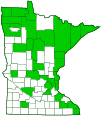
Clandestine dart is a common and widespread, medium-sized moth. It occurs in the United States in the east from Maine to New Jersey, west to Illinois and Minnesota, and in the west from Washington State to southern California, east to North Dakota and New Mexico. It occurs across southern Canada and in the west north to Alaska.
Clandestine dart is found in mostly open areas, including old fields, gardens, and forest edges. The larvae are found on trees, shrubs, and herbaceous plants. They are a pest of a variety of crops, including apple, beans, blueberry, cabbage, corn, strawberry, and of trees, including pine and maple.
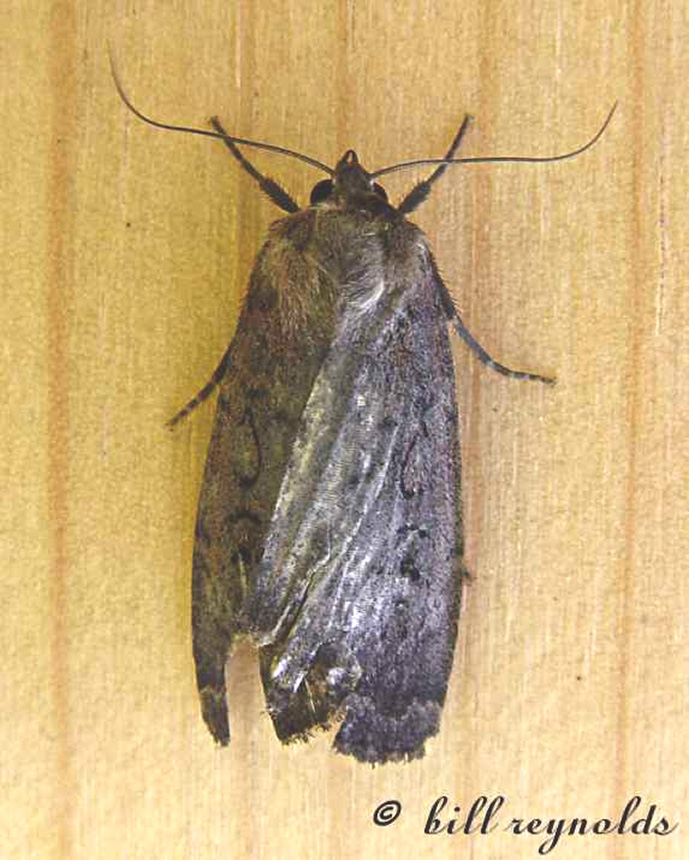
Adults are ⅞″ (22 mm) in length and have a 1½″ (38 mm) wingspan. Moth size is often given in terms of forewing length, which in this case is ⅝″ to ⅞″ (16 to 22 mm). The overall color is consistent, but the intensity is highly variable, ranging from light reddish brown to almost black.
The head and front of the thorax are shaded darker reddish brown. The first thoracic segment (prothorax) has a distinct line of white-tipped scales along the rear margin.
The forewings are long, relatively narrow, and dark brown, though in certain lighting they can appear blackish gray (sooty). They lack the black streaks common on most dart moths. The antemedial (AM) and postmedial (PM) lines are jagged and doubled, slightly paler inside with dark borders that end at the leading edge (costal margin) as a pair of dark spots. The lines are often obscure and sometimes completely absent, represented only by the dark spots on the costal margin. The large round spot near the AM line (orbicular spot) is the most distinct marking on the forewing. It is almond shaped, it has a dark border, and it is often connected to the less distinct kidney-shaped spot (reniform spot) by a bold black line.
The hindwing is dirty white in the middle and tinted brown toward the margins.
The mature caterpillar is pale brown and 1⅜″ to 1 9⁄16″ (35 to 40 mm) long. It has prominent, dark brown, wedge-shaped markings on each abdominal segment that form a conspicuous row of W-shaped marks. This is the feature that gives the caterpillar the common name W-marked cutworm.
Size
Total length: ⅞″ (22 mm)
Forewing length: ⅝″ to ⅞″ (16 to 22 mm)
Wingspan: about 1½″ (38 mm)
Similar Species
Habitat
Open areas, including old fields, gardens, and forest edges
Ecology
Season
Two generations per year: June through September
Behavior
Adults are active at night and will come to lights.
Life Cycle
Larva Food/Hosts
Leaves of trees, shrubs, and herbaceous plants
Adult Food
Flower nectar
Distribution
Sources
Biodiversity occurrence data published by: Minnesota Biodiversity Atlas (accessed through the Minnesota Biodiversity Atlas Portal, bellatlas.umn.edu. Accessed 3/16/2026).
Spaelotis clandestina Harris, 1841 in GBIF Secretariat (2023). GBIF Backbone Taxonomy. Checklist dataset https://doi.org/10.15468/39omei accessed via GBIF.org. Accessed 3/16/2026.
Quinn, Edward. M., and Ron Danielson. April 27, 2009. A Survey of Lepidoptera in Three Priority Areas of the Minnesota State Parks System. https://files.dnr.state.mn.us/eco/nongame/projects/consgrant_reports/2009
/2009_quinn_danielson.pdf.
Occurrence
Common
Taxonomy
Order
Lepidoptera (Butterflies and Moths)
Superfamily
Noctuoidea (Owlet Moths and Allies)
Family
Noctuidae (Cutworm Moths and Allies)
Subfamily
Noctuinae (Cutworms and Dart Moths)
Tribe
Noctuini
Subtribe
Noctuina
Genus
Spaelotis
Subordinate Taxa
Synonyms
Mamestra nigriceps
Mamestra unicolor
Noctua clandestina
Spaelotis clandestina
Spaelotis clanestina
Spaelotis nigriceps
Spaelotis unicolor
Common Names
clandestine dart
clandestine dart moth
W-marked cutworm (larva)
