Common Gray - Species Profile
Conservation • Description • Habitat • Ecology • Distribution • Taxonomy

Hodges #
6590
Conservation Status
IUCN Red List
not listed
NatureServe
NNR - Unranked
SNR - Unranked
Minnesota
not listed
Description
Common gray is a common, widespread, medium-sized, typical geometer moth. It occurs throughout the United States, southern Canada, and Mexico. It is common in Minnesota.
The larvae are food generalists (polyphagous). They feed on the leaves of a wide variety of deciduous and coniferous trees and shrubs, and on forbs and grasses. In Minnesota, adults are found from May through September in virtually all wooded and open habitats.
Adults have a ⅞″ to 1⅜″ (23 to 34 mm) wingspan.
The first abdominal segment is white and is bordered above and below with a black line. The upper line is a continuation of the antemedial (AM) line that crosses both the hindwings and the forewings.
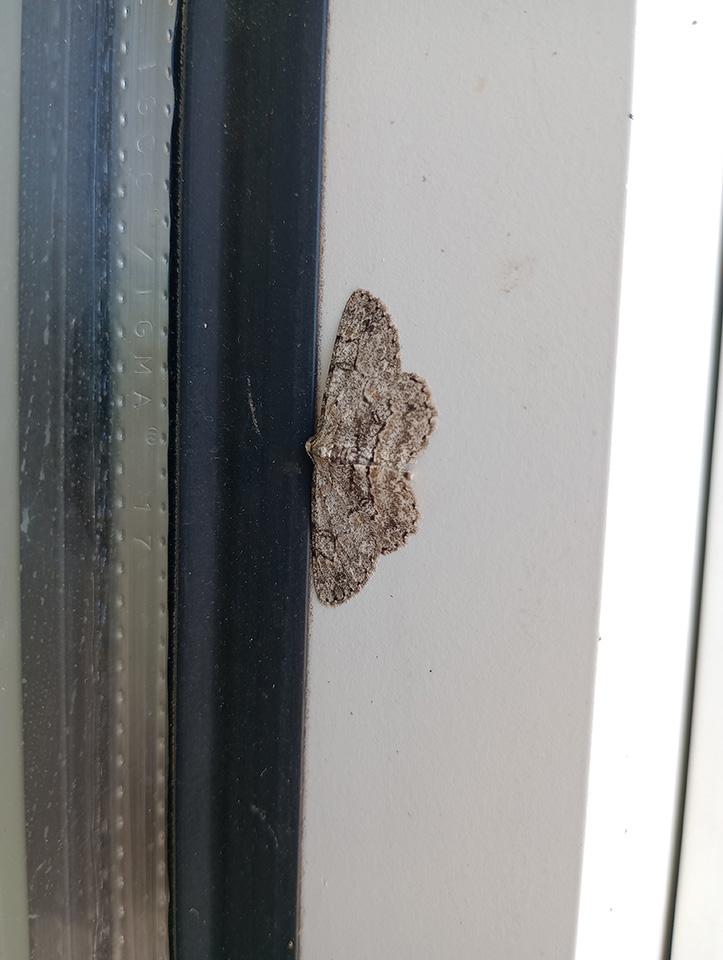
The forewings are broad, moderately long, and medium gray to light yellowish gray. They are crossed with black lines and are heavily mottled with dark brown to black shading. The AM line has dark shading above, and it breaks before curving forward near the leading edge (costal margin). The median line is usually broken, diffuse, or both, and it is sometimes indistinct. When visible, it also curves forward at the costal margin. The postmedial (PM) line is wavy and toothed, and it has dark shading below. All three lines are much thicker and bolder near the costal margin. The subterminal (ST) line is scalloped and whitish, and it has dark shading above. It is often indistinct.
The hindwings are similar in color and markings to the forewings.
Size
Wingspan: ⅞″ to 1⅜″ (23 to 34 mm)
Similar Species
Habitat
All habitats
Ecology
Season
Two or more generations per year in Minnesota: May to September
Behavior
Adults are active at night and are attracted to lights. The wings are held flat and spread wide when at rest. The cryptic, bark-like coloration on both sets of wings makes the moth difficult to see when it rests on the trunk or branch of a tree.
Life Cycle
Larva Food/Hosts
Leaves of a wide variety of trees, shrubs, forbs, and grasses
Adult Food
Distribution

Sources
Biodiversity occurrence data published by: Minnesota Biodiversity Atlas (accessed through the Minnesota Biodiversity Atlas Portal, bellatlas.umn.edu. Accessed 8/23/2026).
Anavitrinella pampinaria (Guenée, [1858]) in Bánki, O., Roskov, Y., Döring, M., Ower, G., Hernández Robles, D. R., Plata Corredor, C. A., Stjernegaard Jeppesen, T., Örn, A., Pape, T., Hobern, D., Garnett, S., Little, H., DeWalt, R. E., Miller, J., Orrell, T., Aalbu, R., Abbott, J., Abreu, C., Acero P, A., et al. (2026). Catalogue of Life (2026-07-17 XR). Catalogue of Life Foundation, Amsterdam, Netherlands. https://doi.org/10.48580/dgykv
Quinn, Edward. M., and Ron Danielson. April 27, 2009. A Survey of Lepidoptera in Three Priority Areas of the Minnesota State Parks System. https://files.dnr.state.mn.us/eco/nongame/projects/consgrant_reports/2009
/2009_quinn_danielson.pdf.
Occurrence
Common
Taxonomy
Order
Lepidoptera (Butterflies and Moths)
Superfamily
Geometroidea (Geometrid and Swallowtail Moths)
Family
Subfamily
Ennominae (Typical Geometers)
Tribe
Boarmiini
Genus
Anavitrinella
Subordinate Taxa
Synonyms
Anavitrinelia pampinaria (misspelling)
Boarmia collecta
Boarmia fraudulentaria
Boarmia frugaliaria
Boarmia pampinaria
Boarmia psilogrammaria
Cleora nubiferaria
Phibalapteryx erosiata
Vitrinella stygia
Common Names
Common Gray