elm sawfly - Species Profile
Conservation • Description • Habitat • Ecology • Distribution • Taxonomy
Conservation Status
IUCN Red List
not listed
NatureServe
not listed
Minnesota
not listed
Description
Elm sawfly large, is a large, colorful sawfly, the largest sawfly in North America.
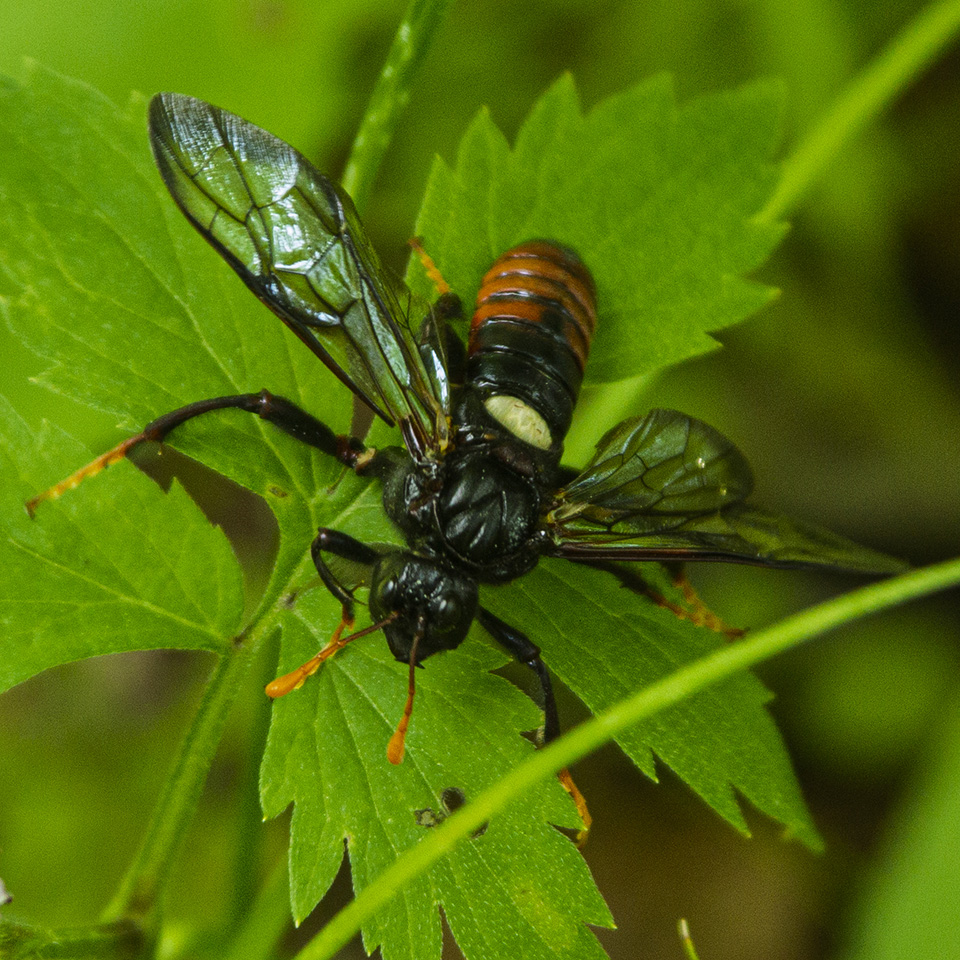
The body is bluish-black, stout, and almost parallel sided. The base of the abdomen is broadly attached to the thorax, not a slender wasp-like waist.
The thorax is black and hairless, with a large yellowish-white spot on the upper (dorsal) surface. On the male the spot is distinct and conspicuous. On the female it is faint.
The male abdomen may is black with reddish-brown bands. The female abdomen is black and has 3 or 4 white or yellowish-white spots on the sides of the abdomen. The ovipositor of the female is conspicuous and saw-like, an attribute common to all sawflies.
The head is black and squarish in front. The antennae are orange with 4 to 7 segments and are slightly expanded (clubbed) at the tip.
There are two pairs of transparent, smoky brown wings.
The legs are bi-colored or tri-colored. The third and fourth segments (femur and tibia respectively) may be black, reddish-brown, or a combination of both. The tibia of the front leg has 2 spurs at the tip. The femur of the hind legs are especially robust. The five foot segments (tarsi) are yellow.
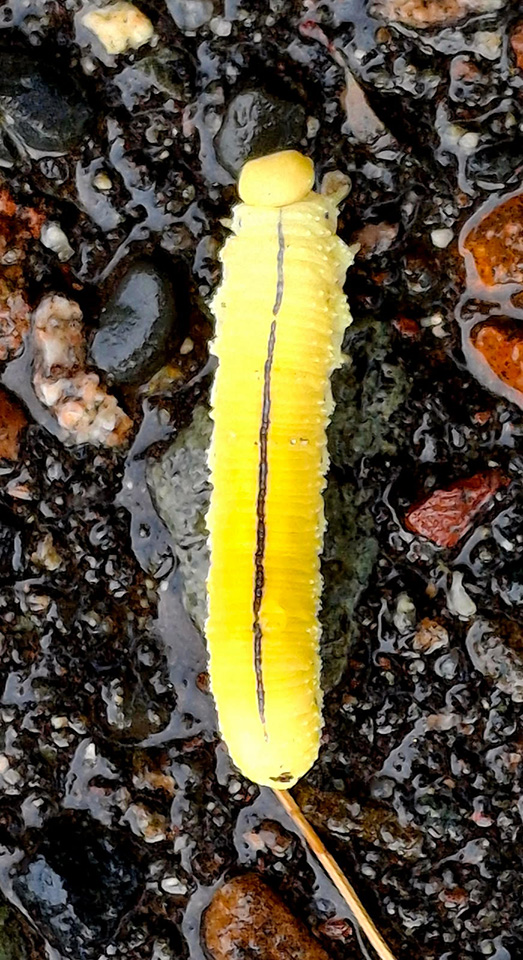
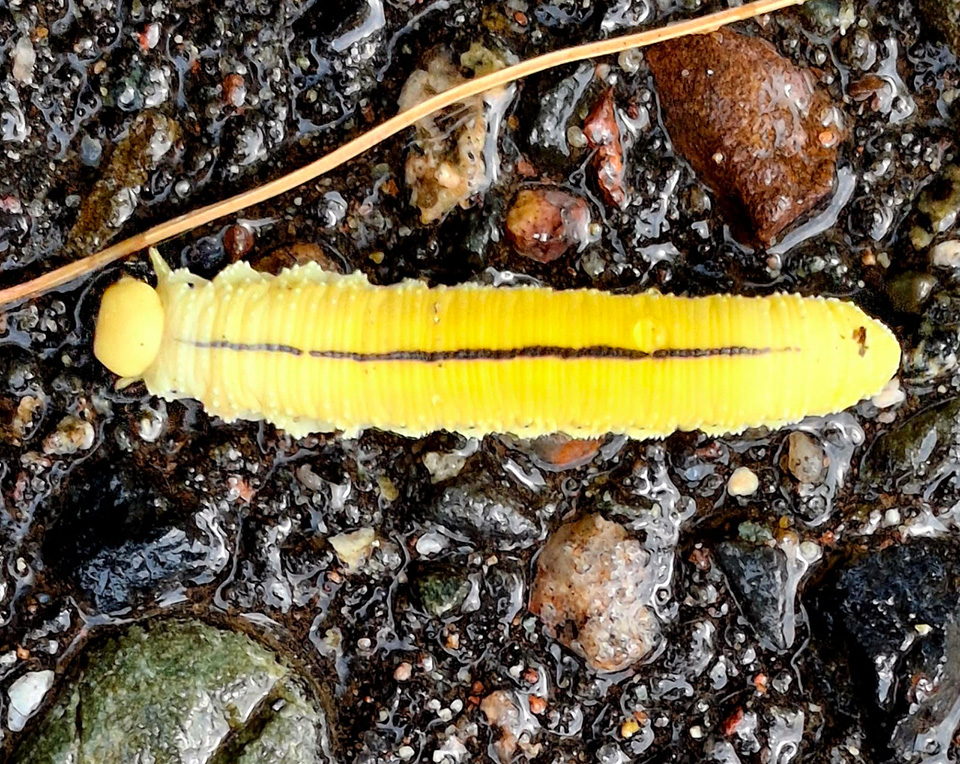
The larvae resemble caterpillars but that name is reserved for the larvae of moths and butterflies. The body is cylindrical in shape, pale green or yellow, and warty. The head is smooth, distinctly separated from the thorax, and has no cleavage line. The eyes are black. A black longitudinal stripe extends from the thorax behind the head to the eighth abdominal segment. The thorax has 3 pairs of well-developed true legs. The abdomen has small black spots surrounding the breathing pores (spiracles). There are 7 pairs of false legs (prolegs) attached to the abdomen, unlike true caterpillars, which have only 5 pairs.
Size
Total length: 11 ⁄16″ to 1″
Wingspan: 1¾″
Larva: 1½″ to 2″
Similar Species
Habitat
Woodlands
Ecology
Season
One generation per year: mid-May to mid-August
Behavior
Larvae feed with the rear of their abdomen coiled around a twig. They rest in a coiled position. They rarely cause serious damage but can cause sporadic defoliation. They are not considered forest pests.
Adults use their powerful mandibles to cut horizontal gashes in the bark of twigs and small branchlets in order to feed on sap. They sometimes girdle the limb, causing it to die.
Life Cycle
The female uses her saw-like ovipositor to cut a slit on the underside of leaves and deposit eggs. The eggs hatch in 7 to 10 days and the larvae feed on leaves. In late summer or early fall the larvae drop to the ground and spin cocoons in the leaf litter at the base of the host tree. They overwinter in the cocoons, pupate in the spring, and emerge as adults in May or June. Some larvae spend two winters in the cocoon before pupating.
Larva Food/Hosts
Leaves of elm, maple, birch, willow, and American basswood.
Adult Food
Tree sap of mostly elm and willow, but also other hardwoods including maple, birch, and American basswood.
Distribution

Sources
Biodiversity occurrence data published by: Minnesota Biodiversity Atlas (accessed through the Minnesota Biodiversity Atlas Portal, bellatlas.umn.edu. Accessed 8/5/2026).
Cimbex americana Leach in Bánki, O., Roskov, Y., Döring, M., Ower, G., Hernández Robles, D. R., Plata Corredor, C. A., Stjernegaard Jeppesen, T., Örn, A., Pape, T., Hobern, D., Garnett, S., Little, H., DeWalt, R. E., Miller, J., Orrell, T., Aalbu, R., Abbott, J., Abreu, C., Acero P, A., et al. (2026). Catalogue of Life (2026-07-17 XR). Catalogue of Life Foundation, Amsterdam, Netherlands. https://doi.org/10.48580/dgykvOccurrence
Common and widespread
Taxonomy
Order
Hymenoptera (Ants, Bees, Wasps, and Sawflies)
Suborder
Symphyta (Sawflies, Horntails, and Wood Wasps)
Superfamily
Tenthredinoidea (Typical Sawflies)
Family
Cimbicidae (Club-horned Sawflies)
Subfamily
Cimbicinae
Genus
Cimbex
Species epithet gender
The International Code of Zoological Nomenclature (ICZN) is widely accepted as the arbiter for naming of organisms. The ICZN ruled years ago that the genus Cimbex is masculine, and therefore the species epithets should end in -us. This ruling has been widely adopted in Europe, but curiously not in the United States. BugGuide.net and iNaturalist have adopted the -us spelling, but almost no other sources on this side of the pond, including GBIF, ITIS, NatureServe, and Catalogue of Life, have done so.
Subordinate Taxa
Synonyms
Cimbex americanus
Common Names
elm sawfly