snowberry clearwing - Species Profile
Conservation • Description • Habitat • Ecology • Distribution • Taxonomy

Hodges #
7855
Conservation Status
IUCN Red List
not listed
NatureServe
N4N5 - Apparently Secure to Secure
SNR - Unranked
Minnesota
not listed
Description
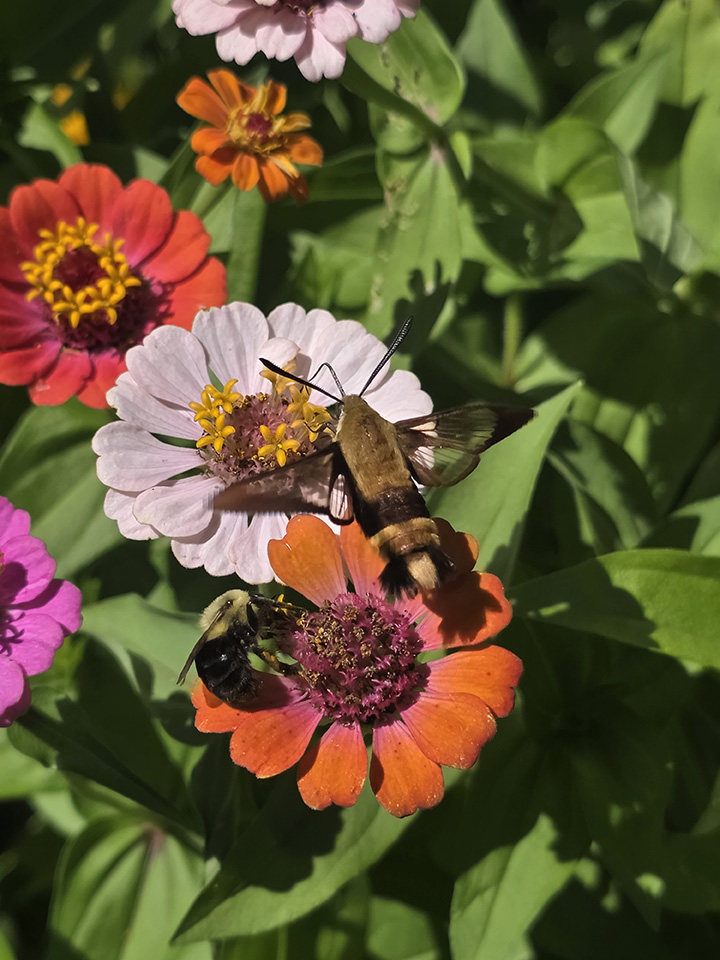
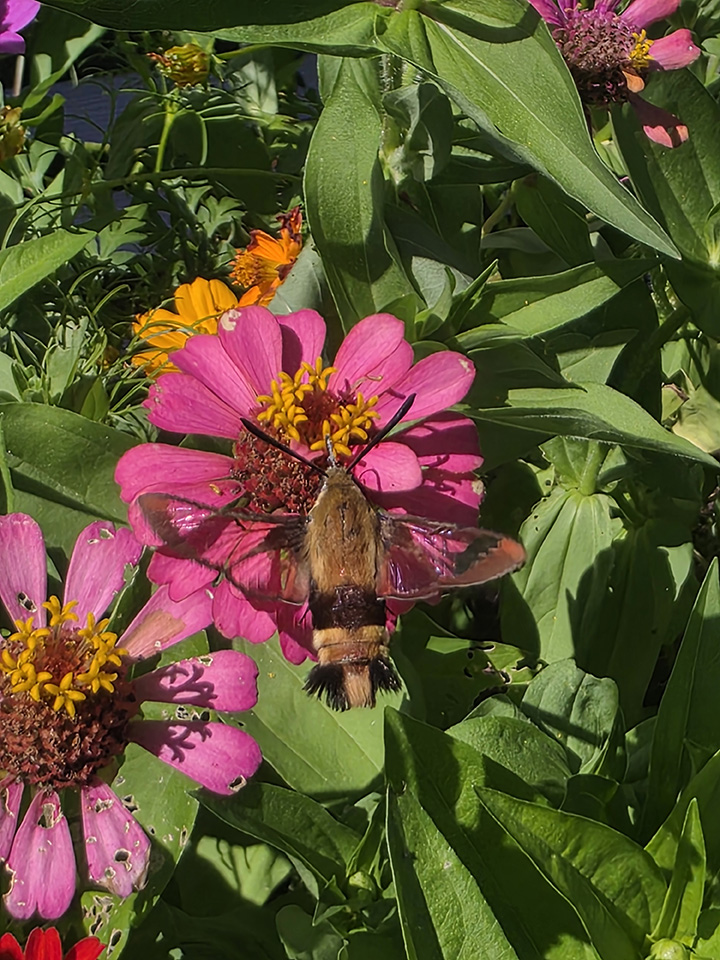
Snowberry clearwing is a common, colorful, small to medium-sized, day-flying sphinx moth. It has a wingspan of 1¼″ to 2″. It is highly variable in appearance across its range. Fifteen forms have been described.
When the adult first emerges from the cocoon the wings are completely covered with reddish-brown scales. The scales begin to drop off with the first flight, eventually leaving the wings clear except on the margins and along the veins. The forewing is long and narrow with a smooth, slightly convex outer margin. It is mostly transparent except at the base; a thin terminal margin with a usually smooth inner edge; an orange apical spot; an orange stripe along the inner margin; and dark scales outlining each vein making them appear bold. The forewing cell is boldly outlined and undivided. The hindwing is mostly transparent except at the base, a thin terminal margin, and bold veins.
The thorax is golden-yellow on the sides blending to olive-brown or olive-green with a brown dorsal stripe above. The abdomen is mostly blackish. The first 3 abdominal segments are black. On some freshly emerged individuals there are some blue hairs on the first abdominal segment. The fourth and fifth abdominal segments are yellow above and on the sides and black below, forming a broken band. Tufts of long hairs flare outward from the last abdominal segment and look like feathers. There is often with a patch of golden-yellow to golden-brown hairs in the middle.
The head is olive-green or olive-brown above, golden-yellow below. There is a black stripe through the eyes that continues diagonally across the thorax. The antennae are black, thickened, and club-like. The proboscis is long and is coiled under the head when not in use.
The legs are black.
The caterpillar is up to 1¾″ long. It is usually bluish-green above and yellowish-green on the sides. Sometimes it is entirely brown. The head, thorax, and abdomen are moderately covered with prominent, minute, white bumps (granules). The head is green. The leading edge of the thorax has a yellow collar covered with prominent yellow granules. A long, curved horn extends from the eighth abdominal segment. The horn is yellow at the base, black from the middle to the tip. The spiracles are outlined with a black spot within a white spot. There is a minute white dot within the black spot above and below each spiracle. The leg-like structures (prolegs) are yellowish-green at the base, black in the middle, and dark brown at the end. Mature caterpillars can be found from June onward.
Size
Wingspan: 1⅜″ to 2″
Total length: ⅞″ to 1 3 ⁄16″
Similar Species
Hummingbird clearwing (Hemaris thysbe) legs are pale.
Habitat
Mostly open areas. Overgrown fields, woodland openings, forest edges, streamsides, powerlines, fencerows, gardens.
Ecology
Season
Two broods: May to early August
Behavior
Adults fly during the day. They are not attracted to light.
They do not land on a flower but hover next to it while feeding. Sometimes they extend their forelegs into the flower, possibly to taste it.
Life Cycle
Females attract males by releasing pheromones. After mating, she lays spherical green eggs on the underside of host leaves. The eggs hatch in about one week and the caterpillars begin feeding on leaves and fruit of the host plant. They molt five times in four weeks before pupating. The first generation pupates in a cocoon among the leaf litter on the ground. Adults emerge two to four weeks later. The second generation caterpillar burrows into the soil and overwinters as a pupa and emerges in as an adult in May or June.
Larva Food/Hosts
Northern bush-honeysuckle (Diervilla lonicera), honeysuckle (Lonicera spp.), viburnum (Viburnum spp.), elderberry (Sambucus spp.), and other plants in the Caprifoliaceae (Honeysuckle) family; also snowberry (Symphoricarpos) and dogbane (Apocynum spp.).
Adult Food
Flower nectar.
Distribution

Sources
7, 21, 24, 27, 30, 75, 82, 83.
Biodiversity occurrence data published by: Minnesota Biodiversity Atlas (accessed through the Minnesota Biodiversity Atlas Portal, bellatlas.umn.edu. Accessed 8/6/2026).
Hemaris diffinis Boisduval, 1836 in Bánki, O., Roskov, Y., Döring, M., Ower, G., Hernández Robles, D. R., Plata Corredor, C. A., Stjernegaard Jeppesen, T., Örn, A., Pape, T., Hobern, D., Garnett, S., Little, H., DeWalt, R. E., Miller, J., Orrell, T., Aalbu, R., Abbott, J., Abreu, C., Acero P, A., et al. (2026). Catalogue of Life (2026-07-17 XR). Catalogue of Life Foundation, Amsterdam, Netherlands. https://doi.org/10.48580/dgykv
Occurrence
Common
Taxonomy
Order
Lepidoptera (Butterflies and Moths)
Superfamily
Bombycoidea (Hawk, Sphinx, Silk, Emperor, and Allied Moths)
Family
Subfamily
Macroglossinae (Macroglossine Sphinx Moths)
Tribe
Dilophonotini
Subtribe
Hemarina
Genus
Hemaris (Clearwings and Bee Hawkmoths)
Subordinate Taxa
Synonyms
Hemaris aethra
Hemaris ariadne
Hemaris axillaris
Hemaris diffinis
Hemaris diffinis ssp. aethra
Hemaris diffinis ssp. ariadne
Hemaris fuciformis
Hemaris fumosa
Hemaris grotei
Hemaris marginalis
Hemaris metathesis
Hemaris metathetis
Hemaris senta
Hemaris tenuis
Common Names
bumblebee moth
snowberry clearwing