Summer Azure - Species Profile
Conservation • Description • Habitat • Ecology • Distribution • Taxonomy

Conservation Status
IUCN Red List
not listed
NatureServe
N5 - Secure
S5 - Secure
Minnesota
not listed
Description
Summer Azure is a small to medium-sized butterfly with a wingspan of 15 ⁄16″ to 1⅛″. It occurs in North America east of the Great Plains. It is very common in Minnesota.
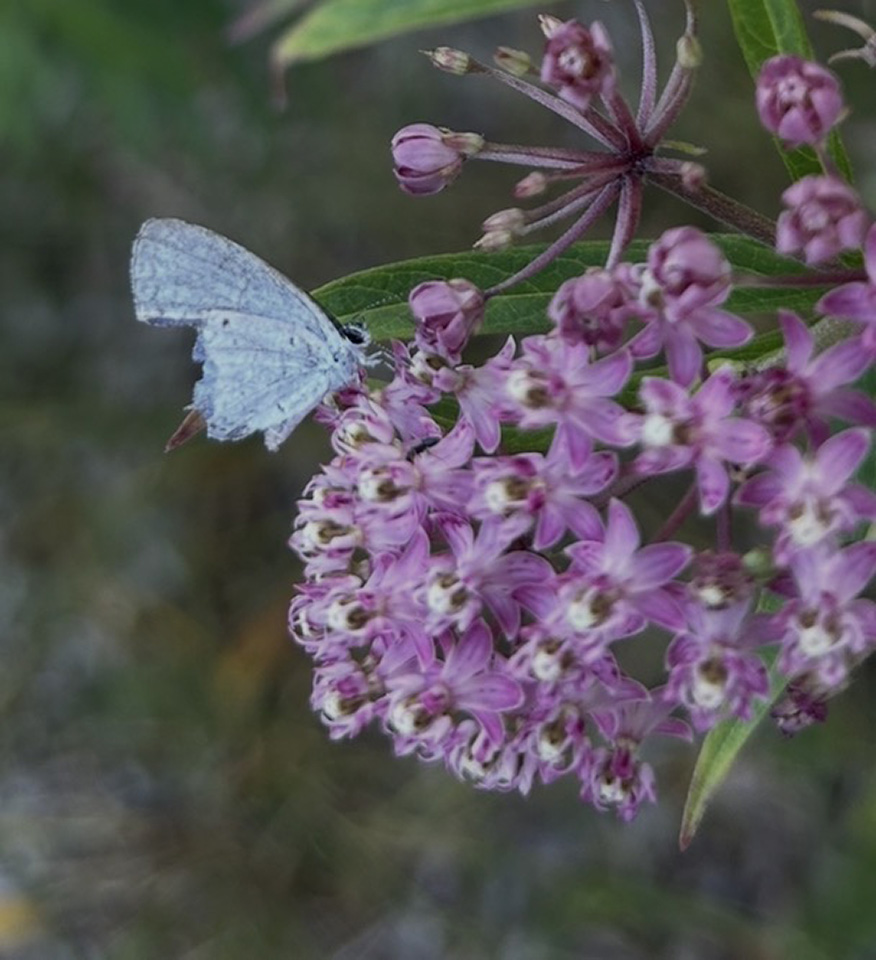
On the male, the upperside of the forewing is powder blue with a narrow black border just near the wingtip. The hindwing is lighter blue with no black markings. On the female, there is a broad black border on the forewing. On both sexes, the underside of both wings is pale grayish-blue or white with several black spots, more or less forming an inner and outer band across both wings, and a zigzag line in the submarginal area. The hindwing has no orange on the underside and it has no tail. The fringe on the forewing is white with black spots, while on the hindwing it is entirely white.
The eyes are black.
The antennae are black-and-white striped with a white-tipped club.
Size
Wingspan: 15 ⁄16″ to 1⅛″ (24 to 29 mm)
Similar Species
Spring Azure (Celastrina ladon) and Northern Spring Azure (Celastrina lucia) fly from late April to late June. Any azure seen in Minnesota after July 1 is almost certainly a Summer Azure.
Habitat
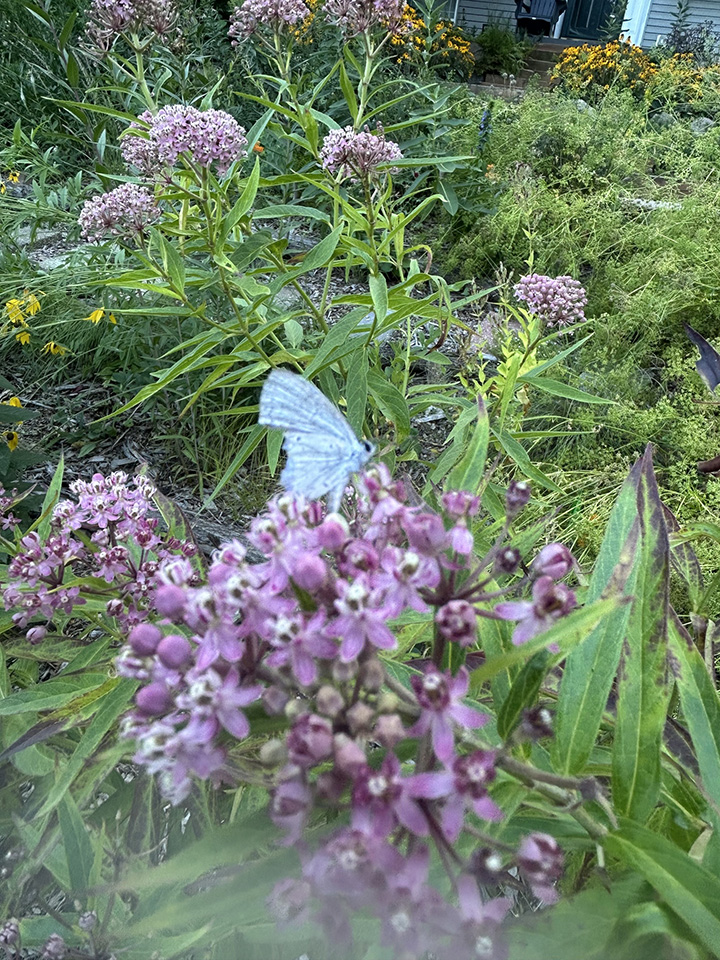
Forest edges, woodland trails, open woodlands, powerline rights-of-way, old fields, bogs, and swamps.
Ecology
Season
One generation per year: Early July to early September
Behavior
Life Cycle
Pupa (chrysalids) overwinter and emerge as adults in late spring or summer.
Larva Food/Hosts
Unlike its close relatives, Summer Azure caterpillars feed on a wide variety of trees and shrubs, including dogwood, meadowsweet, and New Jersey tea.
Adult Food
Flower nectar
Distribution

Sources
Biodiversity occurrence data published by: Minnesota Biodiversity Atlas (accessed through the Minnesota Biodiversity Atlas Portal, bellatlas.umn.edu. Accessed 8/17/2026).
Celastrina neglecta (Summer Azure) in Bánki, O., Roskov, Y., Döring, M., Ower, G., Hernández Robles, D. R., Plata Corredor, C. A., Stjernegaard Jeppesen, T., Örn, A., Pape, T., Hobern, D., Garnett, S., Little, H., DeWalt, R. E., Miller, J., Orrell, T., Aalbu, R., Abbott, J., Abreu, C., Acero P, A., et al. (2026). Catalogue of Life (2026-07-17 XR). Catalogue of Life Foundation, Amsterdam, Netherlands. https://doi.org/10.48580/dgykv
Quinn, Edward. M., and Ron Danielson. April 27, 2009. A Survey of Lepidoptera in Three Priority Areas of the Minnesota State Parks System. https://files.dnr.state.mn.us/eco/nongame/projects/consgrant_reports/2009
/2009_quinn_danielson.pdf.
Occurrence
Common
Taxonomy
Order
Lepidoptera (Butterflies and Moths)
Superfamily
Papilionoidea (Butterflies)
Family
Lycaenidae (Gossamer-winged Butterflies)
Subfamily
Polyommatinae (Blues)
Tribe
Polyommatini (Typical Blues)
Subtribe
Celastrinina
Genus
Celastrina (Holarctic Azures)
Genus
Global Biodiversity Information Facility (GBIF) lists this species both as Celastrina neglecta and as Cyaniris neglecta.
Formerly subspecies
Unitl recently, most North American azures were considered subspecies of Celastrina ladon. Research in the 1990s identified at least six distinct species in what is now recognized as the Celastrina ladon complex. Three of these new species occur in Minnesota: northern spring azure (Celastrina lucia), spring azure (Celastrina ladon), and Summer Azure (Celastrina neglecta).
Subordinate Taxa
Synonyms
Celastrina ladon neglecta
Cyaniris neglecta
Lycaena neglecta
Common Names
Summer Azure