tricolored bumble bee - Species Profile
Conservation • Description • Habitat • Ecology • Distribution • Taxonomy

Conservation Status
IUCN Red List
not listed
NatureServe
N5 - Secure
SNR - Unranked
Minnesota
not listed
Description
Tricolored bumble bee is a common, small, colonial, ground-nesting bumble bee.
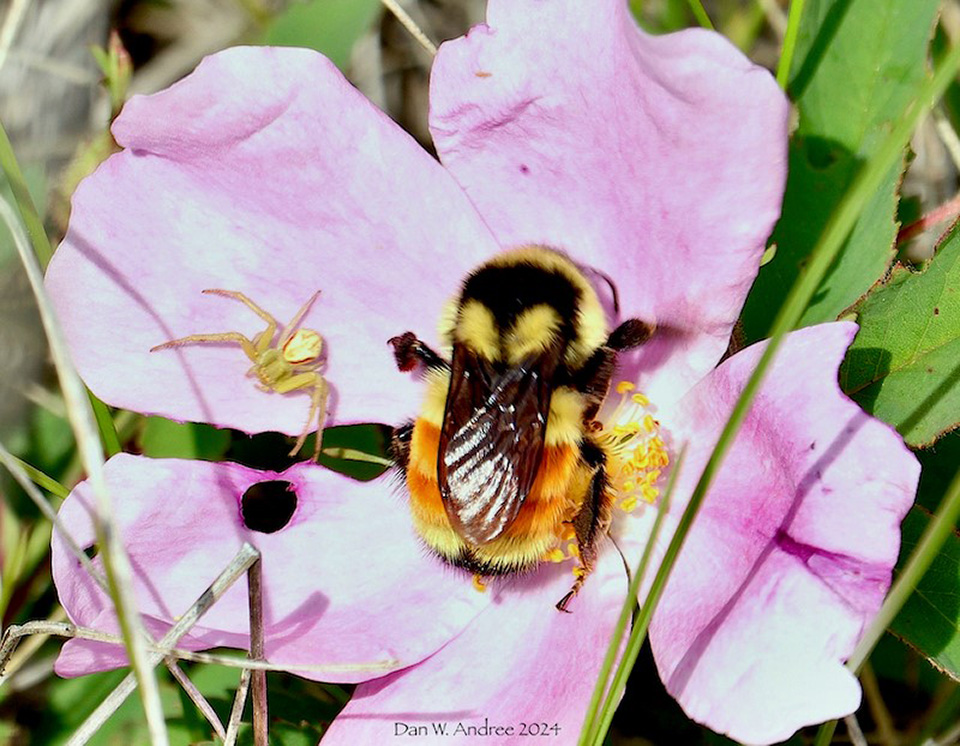
The female (worker) bee is 5 ⁄16″ to ½″ long. The thorax and abdomen are densely covered with short hairs. The thorax is mostly yellow with a conspicuous black T-shaped mark. There are six abdominal segments. The first and fourth abdominal segments are yellow, the second and third are orange, and the fifth and sixth are black. The head is black with a few yellow hairs, especially around the base of the antennae. The tongue is short.
The queen is similar but longer and plumper.
The male (drone) is similar but has longer hairs, a yellow head with a few black hairs, and yellow on the sides of the fifth and sixth abdominal segments.
Size
Queen: ⅝″ to ¾″
Male: ⅜″ to ½″
Worker: 5 ⁄16″ to ½″
Similar Species
Red-belted bumble bee (Bombus rufocinctus) has a black dot, not a T-shaped mark, on the thorax.
Habitat
Various
Ecology
Season
May to October
Behavior
Bumble bees will sting to protect themselves or their nest. The stinger is not barbed and the bee can sting multiple times.
Life Cycle
In April the queen emerges from hibernation and searches for a new nesting site. A suitable site is typically a small rodent burrow or a natural crevice in the ground. After locating a site the queen will forage for pollen and nectar to feed her future offspring. She then lines the nest with a waxy substance that she secretes, lays eggs fertilized in the previous season, and incubates the eggs.
After the eggs hatch the newly emerged larvae, all female workers, pass through three stages before pupating and finally emerging as adults. The workers assist in expanding the nest, foraging for food, and incubating the eggs. The queen continues laying fertilized eggs throughout the summer. In late summer she begins laying unfertilized eggs which will develop into drones.
In early fall the queen lays the last of her fertilized eggs. These develop into queens. The new queens forage for food, build up body fat, and mate with drones. In mid-fall the old queen and the rest of the colony dies, leaving only the new queens.
The queens overwinter individually under a few inches of loose soil or leaf litter.
Larva Food/Hosts
Larvae are fed both nectar for carbohydrates and pollen for protein.
Adult Food
Adults feed mostly on nectar but also on some pollen, especially flowers of blackberries, raspberries, goldenrods, blueberries, bilberries, and milkweeds.
Distribution

Sources
Biodiversity occurrence data published by: Minnesota Biodiversity Atlas (accessed through the Minnesota Biodiversity Atlas Portal, bellatlas.umn.edu. Accessed 5/17/2026).
Bombus ternarius Say, 1837 in GBIF Secretariat (2023). GBIF Backbone Taxonomy. Checklist dataset https://doi.org/10.15468/39omei accessed via GBIF.org. Accessed 5/17/2026.
Occurrence
Common in northern Minnesota
Taxonomy
Order
Hymenoptera (Ants, Bees, Wasps, and Sawflies)
Suborder
Apocrita (Narrow-waisted Wasps, Ants, and Bees)
Infraorder
Aculeata (Ants, Bees, and Stinging Wasps)
Superfamily
Apoidea (Bees and Apoid Wasps)
Epifamily
Family
Apidae (Honey Bees, Bumble Bees, and Allies)
Subfamily
Apinae (Honey, Bumble, Longhorn, Orchid, and Digger Bees)
Tribe
Bombini (Bumble Bees)
Genus
Subgenus
Pyrobombus
Subfamily
In the not-too-distant past, bumble bees were often placed in the in the subfamily Bombinae, and sometimes in the family Bombidae. Today, both of these terms are considered taxonomically invalid, though they can still be found in use on the Web.
Subordinate Taxa
Synonyms
Bombus ornatus
Bombus ternarius expallidus
Common Names
orange-belted bumble bee
tricolored bumble bee
tricolored bumblebee