twenty-spotted lady beetle - Species Profile
Conservation • Description • Habitat • Ecology • Distribution • Taxonomy
Conservation Status
IUCN Red List
not listed
NatureServe
NNR - Unranked
Minnesota
not listed
Description
Twenty-spotted lady beetle is a common, fungus-eating, lady beetle. It occurs throughout the United States, including Hawaii and Alaska, across southern Canada and north in the west to the Yukon, in Mexico, and in Central America.
Adults are active from March to October. In the spring, they feed on new foliage. In the summer, when easily harvested patches of mildew are available, they feed on mildew on any part of the plant, from ground level to the tops of trees.
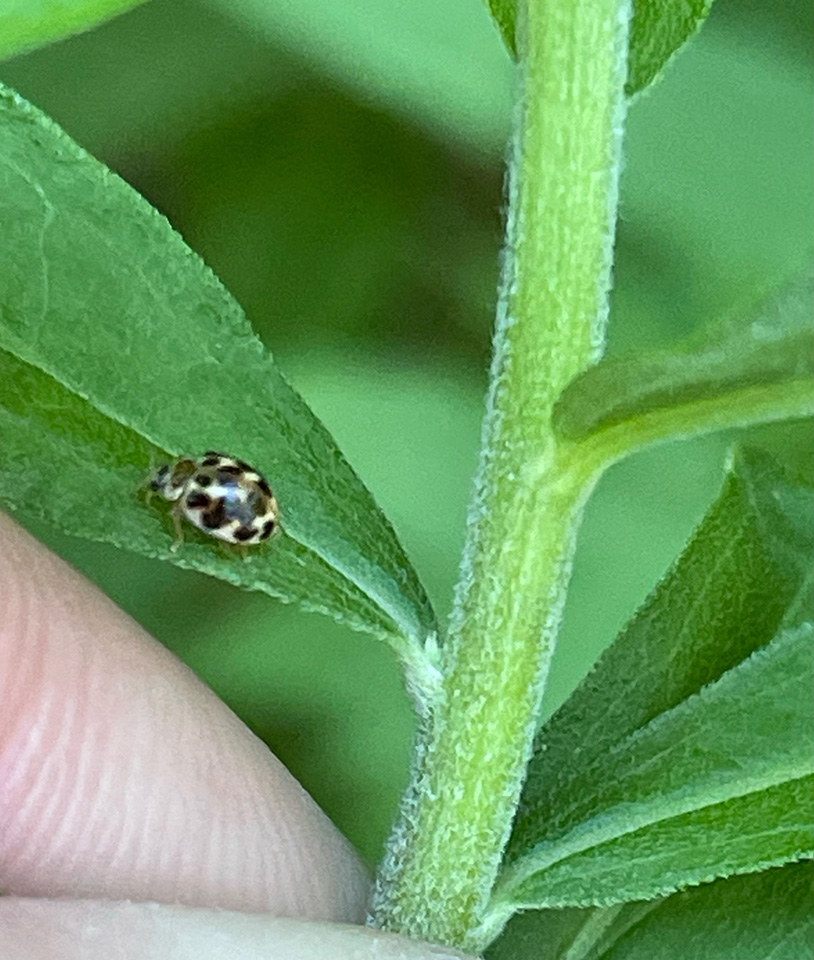
Adults are very small, 1⁄16″ to ⅛″ (1.75 to 3.0 mm) in length. The body is elongate oval, slightly flattened top to bottom, and pale yellow (pale) with brown or black (dark) spots.
The head is mostly pale, but the top of the head (vertex) is dark.
The upper thoracic plate (pronotum) has four large dark spots, and often a small dark spot at the base in the center, all loosely arranged in an M pattern.
Each hardened wing cover (elytron) has nine dark spots: two near the base, two on the front half, one near the tip, and four on the rear half that are usually merged into a single cluster. While high-resolution photos clearly show four distinct spots in this cluster, authors who count them as just three spots arrive at eight spots per elytron—which, combined with the four spots on the pronotum, yields the twenty spots for which the species is named. The spot pattern is consistent, but the spots vary in size and in merging. The whitish background of the elytra features a subtle orange underlay on the rear half. While eastern populations typically exhibit broad orange patches along both the outer margins and the central seam (suture), and western populations typically show no orange, specimens in Minnesota and the Upper Midwest more commonly show a distinct thin line along the rear suture with little to no lateral orange.
Size
Total length: 1⁄16″ to ⅛″ (1.75 to 3.0 mm)
Similar Species
Habitat
Ecology
Season
March to October
Behavior
Life Cycle
Larva Food/Hosts
Adult Food
Mostly powdery mildew
Distribution
Sources
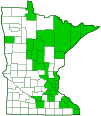
Biodiversity occurrence data published by: Minnesota Biodiversity Atlas (accessed through the Minnesota Biodiversity Atlas Portal, bellatlas.umn.edu. Accessed 9/8/2026).
Psyllobora vigintimaculata (Say, 1824) in Bánki, O., Roskov, Y., Döring, M., Ower, G., Hernández Robles, D. R., Plata Corredor, C. A., Stjernegaard Jeppesen, T., Örn, A., Pape, T., Hobern, D., Garnett, S., Little, H., DeWalt, R. E., Miller, J., Orrell, T., Aalbu, R., Abbott, J., Abreu, C., Acero P, A., et al. (2026). Catalogue of Life (2026-07-17 XR). Catalogue of Life Foundation, Amsterdam, Netherlands. https://doi.org/10.48580/dgykv
Stehr, W.C. 1930. The Coccinellidae (ladybird beetles) of Minnesota. University of Minnesota Agricultural Experiment Station, Technical Bulletin 75. 54 pp.
Occurrence
Common and widespread
Taxonomy
Order
Coleoptera (Beetles)
Suborder
Polyphaga (Water, Rove, Scarab, Long-horned, Leaf, and Snout Beetles)
Infraorder
Cucujiformia
Superfamily
Coccinelloidea (Lady, Fungus, Scavenger, and Bark Beetles)
Family
Subfamily
Coccinellinae (Common Lady Beetles)
Tribe
Coccinellini (Black-spotted Lady Beetles)
Genus
Psyllobora (Fungus-eating Lady Beetles)
Subordinate Taxa
Synonyms
Coccinella vigintimaculata
Psyllobora vigintisignata
Psyllobora 20-maculata
Common Names
twenty-spotted lady beetle
20-spotted Lady Beetle
