Vestal moth
(Cabera variolaria)
Conservation • Description • Habitat • Ecology • Distribution • Taxonomy
Hodges #
6678
Conservation Status
IUCN Red List
not listed
NatureServe
NNR - Unranked
SNR - Unranked
Minnesota
not listed
Description
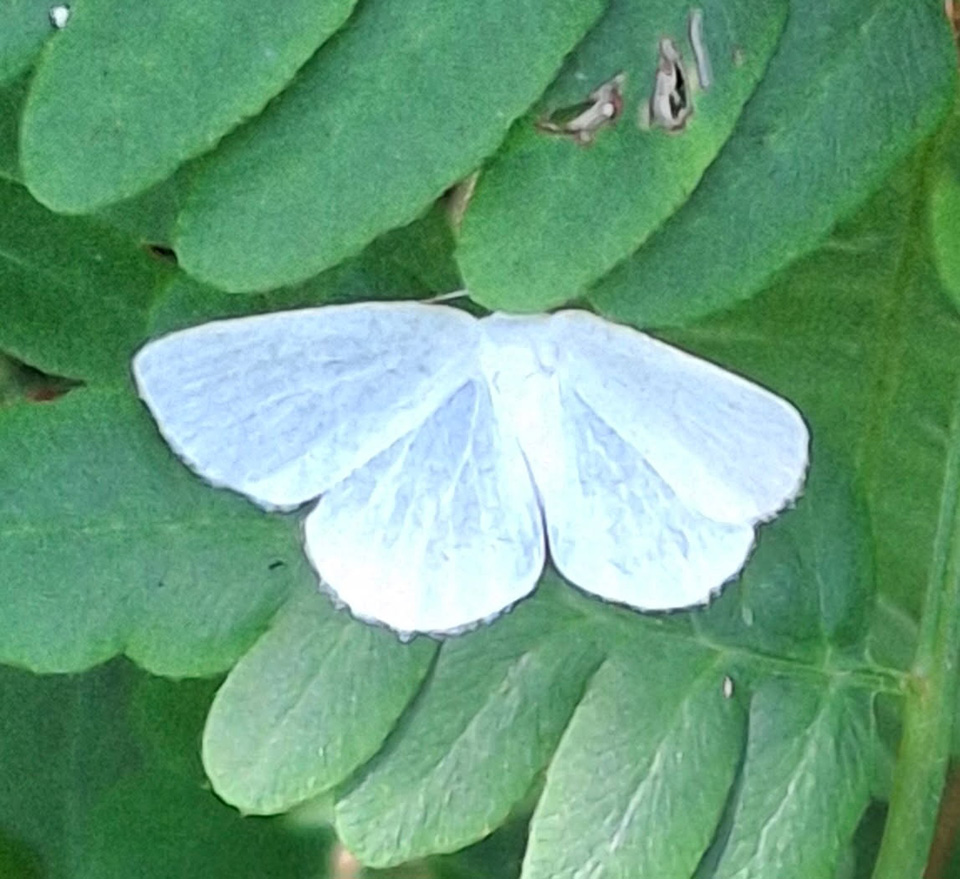
Vestal moth is a common, small, geometer moth. It occurs across the northern United States and southern Canada.
Adults are active from mid-May to early September. The larvae are known to feed on the leaves of willow and poplar, and they have also been reported on chokecherry.
Size of moths is often given in terms of forewing length. In the female, the forewing length is 7⁄16″ to ⅝″ (11 to 16 mm), in the male it is ½″ to ⅝″ (12 to 16 mm). The wingspan is ⅞″ to 1″ (22 to 25 mm).
The upper surface of the head (vertex) is white. The upper part of the face (frons) is broadly yellow above. The antennae on the female are slender and thread-like. On the male, they are branched, feather-like, on one side.
The thorax and abdomen are white above and below.
On the wings of the male, the upper surface is pure white with no markings, but with scattered, yellow or grayish-brown scales. On the female, the scales sometimes form barely visible or washed-out traces of the antemedial, median, and postmedial cross lines.
The legs are white with yellowish-brown scales, especially on the front legs.
The caterpillar, called a spanworm, is somewhat flattened and about 1″ (2.5 cm) long. The ground color may be green, bluish green, or yellowish green to brown. On the first through seventh abdominal segments (A1 through A7) there is a small black spot in the middle of the leading margin (middorsal). There is often pink on both sides of each spot. There is a bold, pale, subdorsal stripe and a narrow, wavy, pale, subspiracular stripe. There are 3 pairs of legs on the thorax, one on each thoracic segment, and just 2 pairs of leg-like structures (prolegs) on the abdomen, one pair on A6 and one pair on A10. The prolegs are pinkish. The head is squarish and is projected forward. It has a reddish, dark, cheek line and reddish antennae. Mature caterpillars are active from June onward.
The caterpillar cannot be distinguished from the yellow-dusted cream moth (Cabera erythemaria) and must be raised to the adult stage to determine the species.
Size
Female forewing length: 7⁄16″ to ⅝″ (11 to 16 mm)
Male forewing length: ½″ to ⅝″ (12 to 16 mm)
Wingspan: ⅞″ to 1″ (22 to 25 mm)
Similar Species
Northern eudeilinia moth (Eudeilinia herminiata): The frons is entirely white.
Virgin moth (Protitame virginalis): On the front of the head, there is a narrow, brownish-black band below the antennae.
Habitat
Deciduous and mixed woodlands, open streamside thickets
Ecology
Season
Two generations per year: Mid-May to early September
Behavior
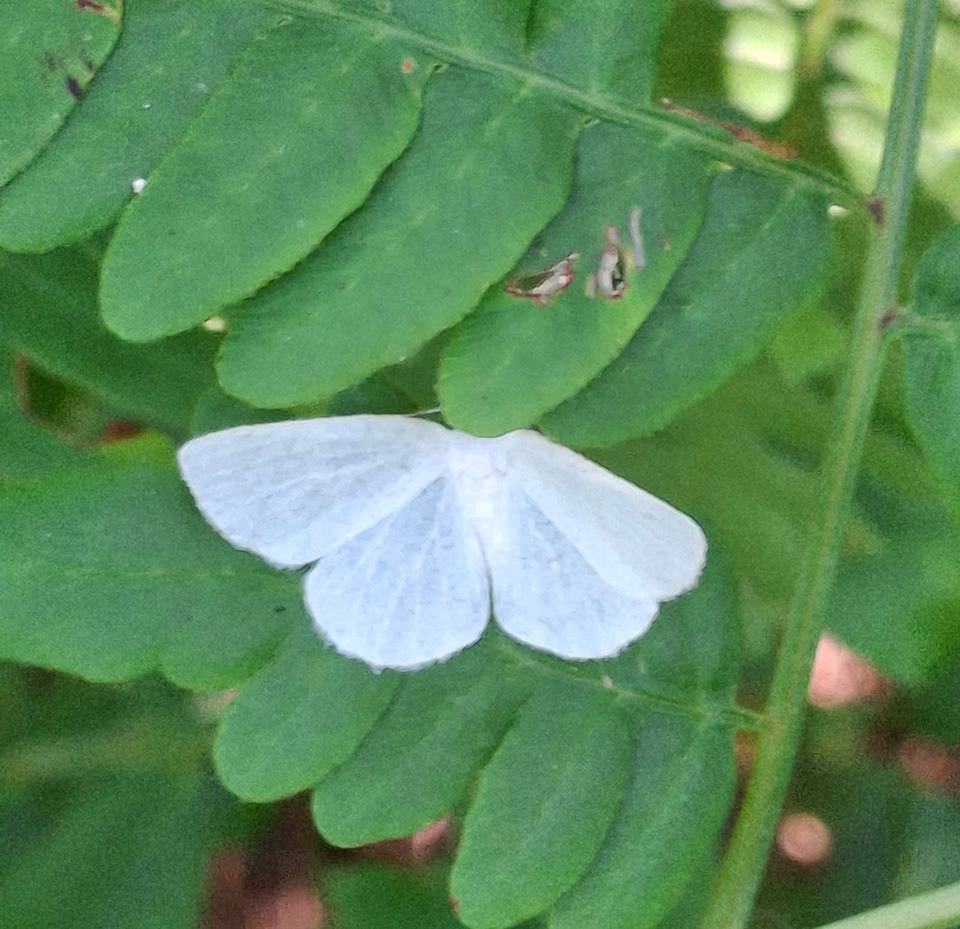
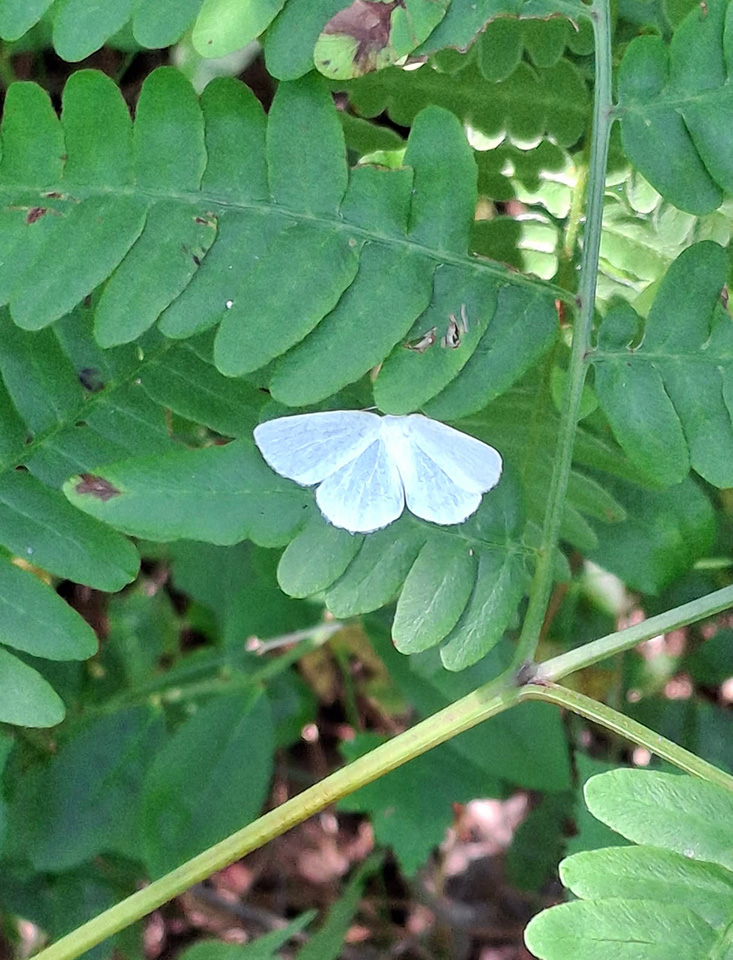
Adults rest with their wings spread flat. They are active at night and will come to lights.
Life Cycle
Larva Food/Hosts
Poplar, willow, and chokecherry
Adult Food
Distribution
Sources
Biodiversity occurrence data published by: Minnesota Biodiversity Atlas (accessed through the Minnesota Biodiversity Atlas Portal, bellatlas.umn.edu. Accessed 9/28/2026).
Cabera variolaria Guenée, [1858] in Bánki, O., Roskov, Y., Döring, M., Ower, G., Hernández Robles, D. R., Plata Corredor, C. A., Stjernegaard Jeppesen, T., Örn, A., Pape, T., Hobern, D., Garnett, S., Little, H., DeWalt, R. E., Miller, J., Orrell, T., Aalbu, R., Abbott, J., Abreu, C., Acero P, A., et al. (2026). Catalogue of Life (2026-08-26 XR). Catalogue of Life Foundation, Amsterdam, Netherlands. https://doi.org/10.48580/dgyy9
Quinn, Edward. M., and Ron Danielson. April 27, 2009. A Survey of Lepidoptera in Three Priority Areas of the Minnesota State Parks System. https://files.dnr.state.mn.us/eco/nongame/projects/consgrant_reports/2009
/2009_quinn_danielson.pdf.
A Revision of the American Species of Deilinia [Cabera] (Lepidoptera, Geometridae) Frederick H. Rindge . 1956. American Museum Novitates 1810: 1-31.
Occurrence
Common
Taxonomy
Order
Lepidoptera (Butterflies and Moths)
Superfamily
Geometroidea (Geometrid and Swallowtail Moths)
Family
Subfamily
Ennominae (Typical Geometers)
Tribe
Caberini
Genus
Cabera
Subordinate Taxa
Synonyms
Cabera intentaria
Deilinia variolaria
Common Names
pink-striped willow spanworm
pink-striped willow spanworm moth
the vestal
vestal moth
Visitor Photos
This button not working for you?
Simply email us at info@MinnesotaSeasons.com.
Attach one or more photos and, if you like, a caption.
Minnesota Seasons Photos
Slideshows
Slideshows
Visitor Videos
This button not working for you?
Simply email us at info@MinnesotaSeasons.com.
Attach a video, a YouTube link, or a cloud storage link.
Other Videos
Visitor Sightings
This button not working for you?
Simply email us at info@MinnesotaSeasons.com.
Be sure to include a location.
Luciearl
8/3/2026

Location: Fairview Twp.
Saw a few of these white butterflies. Seem smaller and whiter than cabbage white.
Minnesota Seasons Sightings