tall bellflower - Species Profile
Conservation • Weed • Wetland • Description • Habitat • Ecology • Use • Distribution • Taxonomy

Conservation Status
IUCN Red List
not listed
NatureServe
N5? - Secure
SNR - Unranked
Minnesota
not listed
Wetland Indicator Status
Great Plains
FAC - Facultative
Midwest
FAC - Facultative
Northcentral & Northeast
FAC - Facultative
Description
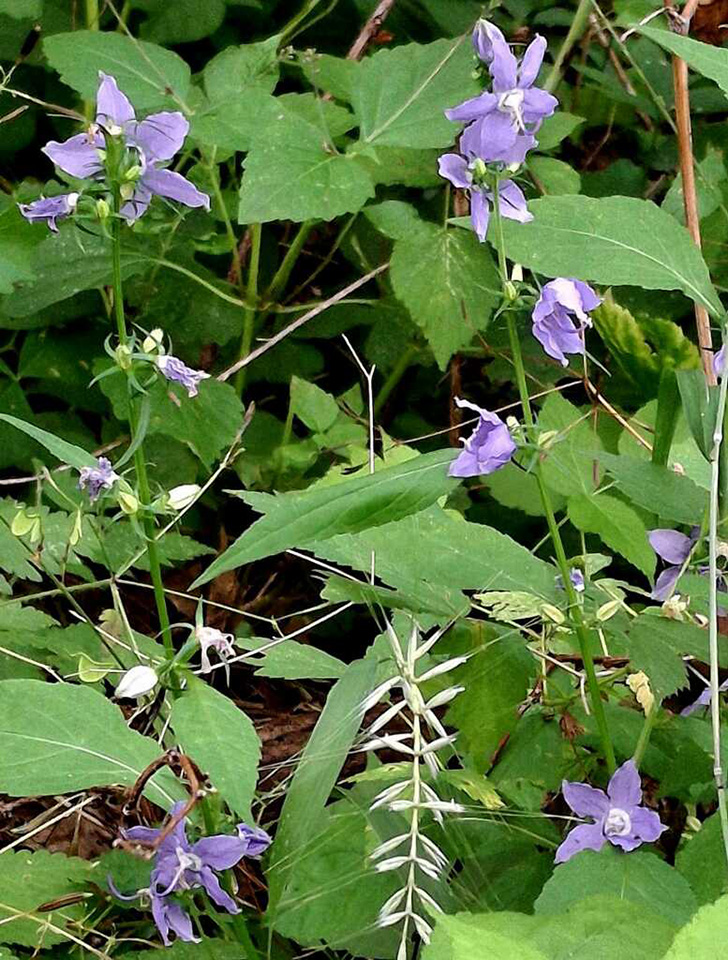
Tall bellflower, also called American bellflower, is a 3′ to 6′ tall, erect, winter-annual or biennial forb that rises from a taproot.
The stems are erect, stout, more or less hairy, unbranched or sometimes branched above the middle. When broken or cut they exude a milky sap.
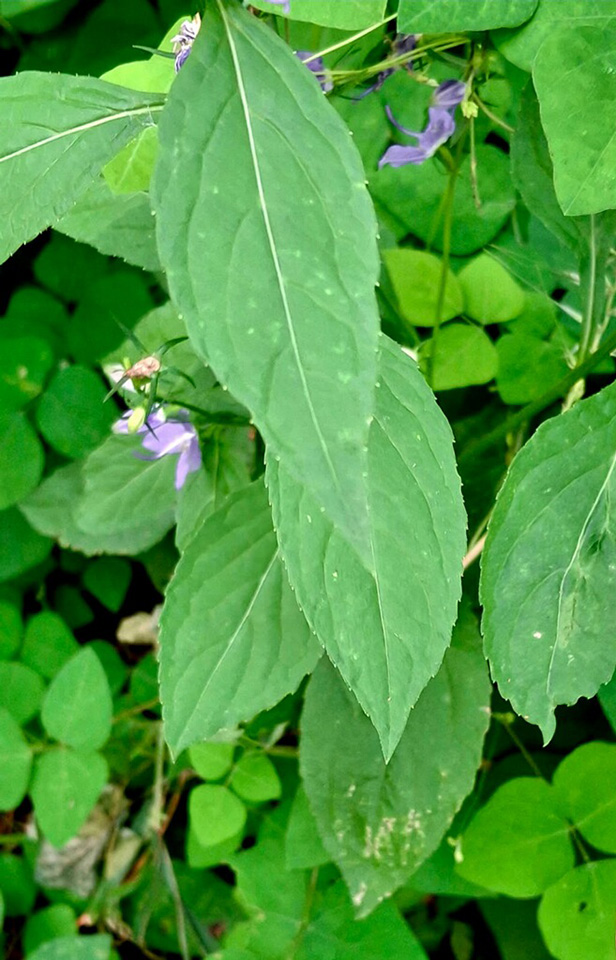
The leaves are alternate, thin, lance-shaped to oblong egg-shaped, 3″ to 6″ long, and ½″ to 2″ wide. They taper at the base and are attached to the stem by a short leaf stalk or no stalk at all. They taper gradually at the tip to a point with concave sides along the tip. The margins are toothed and have a fringe of short hairs. The upper and lower surfaces are sparsely hairy.
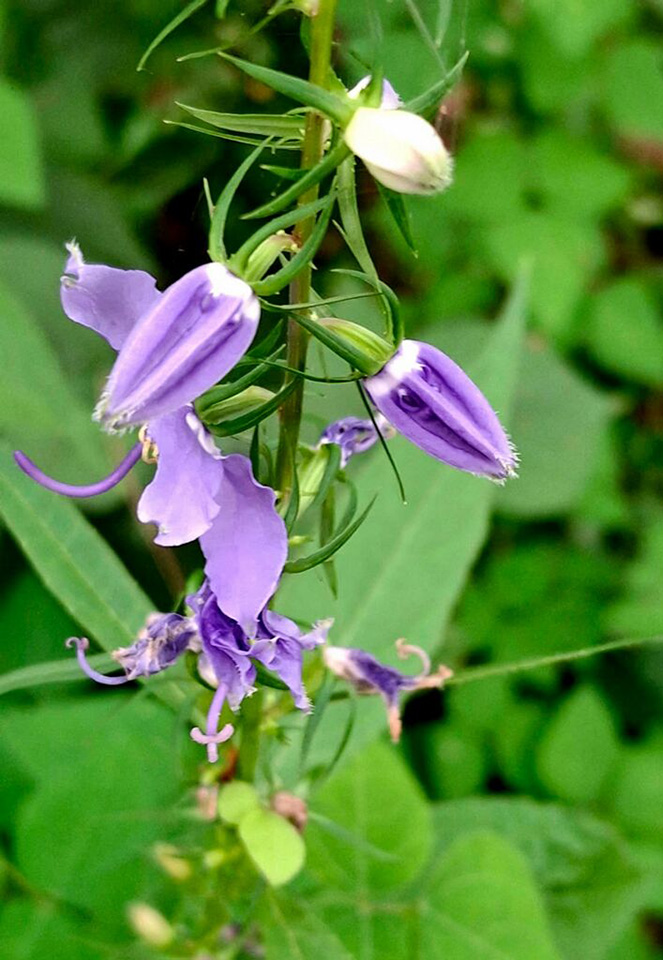
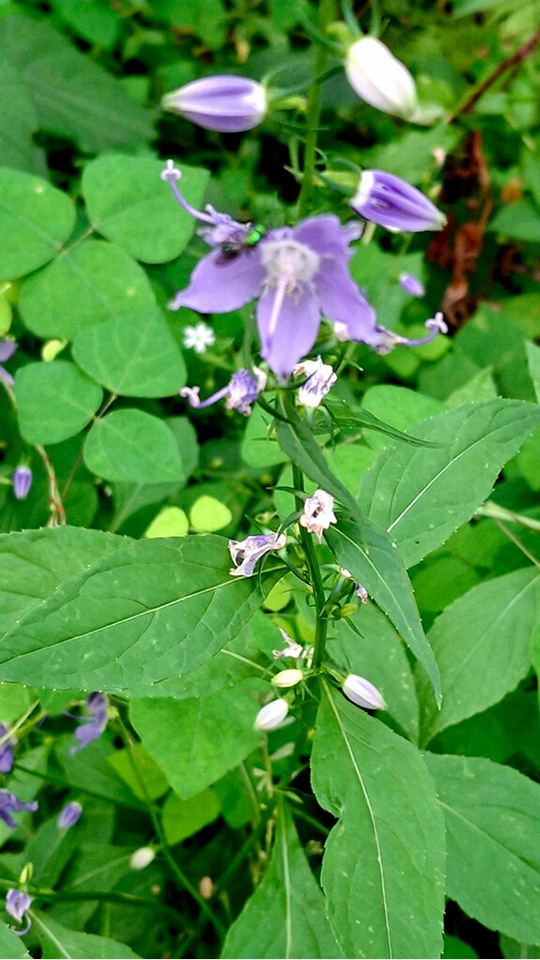
The inflorescence is a 4″ to 16″ spike of many flowers at the ends of the stems. The lower bracts on the spike are leaf-like, the upper bracts are much smaller. The flowers are in clusters of 1 to 3 in the axils of the bracts.
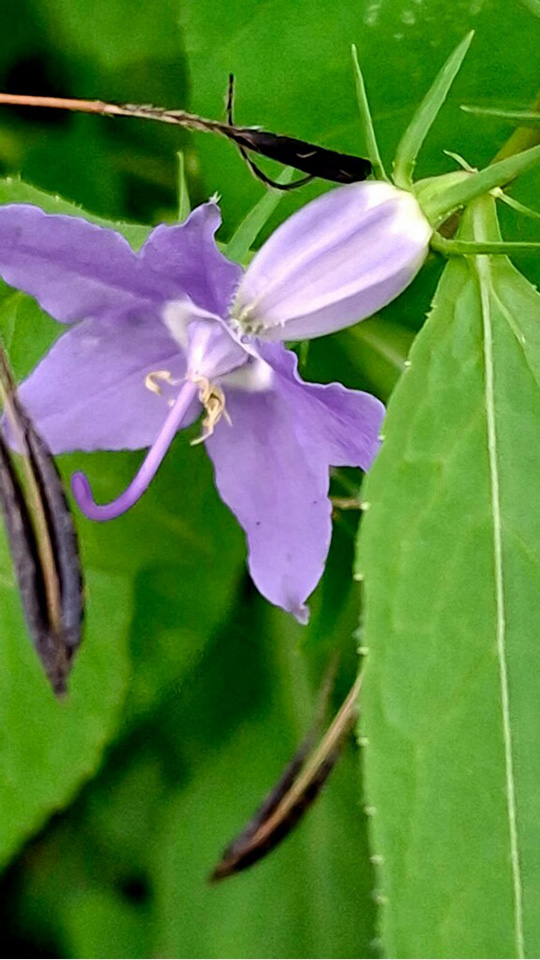
The flowers are ¾″ to 1″ wide, flat, and circular, with 5 blue petals. The petals are fused at the base into a tube, then separated into 5 widely spreading lobes. They are whitish near the throat, giving an overall appearance of white central ring. The petal lobes are egg-shaped and have wavy margins. The style is blue, as dark or darker than the petals, protrudes well beyond the petals, bends downward, then curves upward. At the end of the style is a white stigma with 3 widely spreading lobes.
The fruit is a cylinder-shaped, ¼″ to ½″ long, hairless, 3-chambered capsule with many seeds.
Height
3′ to 6′
Flower Color
Blue with a white central ring
Similar Species
The widely spreading lobes and inner pale ring of this bellflower make it easy to identify. Other bellflowers in Minnesota have bell-shaped flowers.
Habitat
Moist. Wood borders, open woods, stream banks.
Ecology
Flowering
July to September
Pests and Diseases
Use
Distribution

Sources
Biodiversity occurrence data published by: Minnesota Biodiversity Atlas (accessed through the Minnesota Biodiversity Atlas Portal, bellatlas.umn.edu. Accessed 8/8/2026).
Midwest Herbaria Portal. 2026. https://midwestherbaria.org/portal/index.php. Accessed 8/8/2026.
Campanulastrum americanum (L.) Small in Bánki, O., Roskov, Y., Döring, M., Ower, G., Hernández Robles, D. R., Plata Corredor, C. A., Stjernegaard Jeppesen, T., Örn, A., Pape, T., Hobern, D., Garnett, S., Little, H., DeWalt, R. E., Miller, J., Orrell, T., Aalbu, R., Abbott, J., Abreu, C., Acero P, A., et al. (2026). Catalogue of Life (2026-07-17 XR). Catalogue of Life Foundation, Amsterdam, Netherlands. https://doi.org/10.48580/dgykv
Nativity
Native
Occurrence
Locally common
Taxonomy
Kingdom
Subkingdom
Pteridobiotina
Phylum
Tracheophyta (Vascular Plants)
Class
Order
Asterales (Sunflowers, Bellflowers, Fanflowers, and Allies)
Family
Campanulaceae (Bellflower)
Subfamily
Campanuloideae (Bellflower)
Tribe
Campanulastrum
Genus
Campanulastrum (Tall Bellflowers)
Subordinate Taxa
Synonyms
Campanula acuminata
Campanula americana
Campanula americana f. albiflora
Campanula americana f. americana
Campanula americana f. tubuliflora
Campanula americana var. americana
Campanula americana var. illinoensis
Campanula americana var. subulata
Campanula asteroides
Campanula illinoensis
Campanulastrum americanum var. illinoense
Phyteuma americanum
Specularia americana
Common Names
American bellflower
tall bellflower