Crested wood fern
(Dryopteris cristata)
Information
Conservation • Wetland • Description • Habitat • Ecology • Use • Distribution • Taxonomy

Conservation Status
IUCN Red List
LC - Least Concern
NatureServe
N5 - Secure
SNR - Unranked
Minnesota
not listed
Wetland Indicator Status
Great Plains
OBL - Obligate wetland
Midwest
OBL - Obligate wetland
Northcentral & Northeast
OBL - Obligate wetland
Description
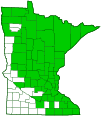
Crested wood fern is a common, easily identified, medium-sized fern. It occurs in Europe, northwestern Asia, and North America. In the United States it occurs from Maine to South Carolina, west to Minnesota, Iowa, and Tennessee, and there is a disjunct (geographically separate) population in the foothills of the Rocky Mountains in northeast Washington, northern Idaho, and northwest Montana. It occurs throughout southern Canada.
Crested wood fern is found in a variety of wet habitats with rich soil, including swampy deciduous woodlands, coniferous swamps and bogs, and open shrubby wetlands.
Crested wood fern rises on several closely spaced or clustered leaves (fronds) from an erect to prostrate and short-creeping underground stem (rhizome). There is usually a rosette of cluster of overwintering sterile fronds along with several fertile fronds.
The fronds are 14″ to 28″ (35 to 70 cm) long and 3″ to 4¾″ (8 to 12 cm) wide. They are pinnate-pinnatifid, meaning that they are once cut into separate leaflets (pinnae), and those pinnae are only lobed, not cut into separate units. This gives the frond a sturdy rather than a lacy appearance.
The frond stalk (petiole) is one-third to one-quarter the length of the leaf, and it is scaly, at least near the base. The scales on the petiole and the rhizome are tan, linear to egg-shaped, and a single color (concolorous). They are not shiny.
The fertile frond is tall, narrow, and stiffly erect. The blade is narrowly lance shaped or with almost parallel sides (linear), widest at or above the middle, and tapered gradually to the base. It is pinnately compound, divided into 10 to 20 pairs of pinnae. The overall shape of the frond is said to resemble a rooster’s comb or crest—the inspiration for both the common name and the species epithet, cristata. The central axis (rachis) is green, stout, and slightly scaly toward the bottom.
The sterile frond is spreading, broader, triangular, and shorter, one-half to three-quarters the length of the fertile frond. It remains green through the winter.
The pinnae are ¾″ to 3½″ (2 to 9 cm) long and vary from triangular to linear. Lower pinnae on fertile fronds are triangular, widely spaced, and often louvered, twisted 90° like an opened Venetian blind. They become gradually less triangular and less widely spaced approaching the tip. They are cut into 6 or more pairs of blunt lobes. The lowest lobe of the lowest pinna is the same length as the opposite lobe and is slightly longer than the next lobe.
The reproductive structures are born on the underside of the lobes. There are 1 to 6 round clusters (sori) of spore-bearing cases (sporangia) arranged halfway between the midvein and the margin of each lobe. Each sorus is covered with a thin, kidney-shaped, protective veil (indusium). The indusium is pale white or tan and clearly visible at first, but it is usually shriveled at maturity.
Height
14″ to 28″ (35 to 70 cm)
Similar Species
Habitat
Swampy deciduous woodlands, coniferous swamps and bogs, and open shrubby wetlands
Ecology
Sporulation
June to September
Pests and Diseases
Use
Distribution
Sources
2, 3, 5, 7, 24, 28, 29, 30, 83.
Biodiversity occurrence data published by: Minnesota Biodiversity Atlas (accessed through the Minnesota Biodiversity Atlas Portal, bellatlas.umn.edu. Accessed 1/6/2026).
Midwest Herbaria Portal. 2026. https://midwestherbaria.org/portal/index.php. Accessed on January 06.
Tryon, R. M. (1980). Ferns of Minnesota (2nd ed., revised). University of Minnesota Press.
Nativity
Native
Occurrence
Common
Taxonomy
Kingdom
Subkingdom
Pteridobiotina
Phylum
Tracheophyta (Vascular Plants)
Subdivision
Polypodiophytina
Class
Polypodiopsida (ferns)
Subclass
Polypodiidae (leptosporangiate ferns)
Order
Polypodiales
Suborder
Polypodiineae (eupolypods I)
Family
Dryopteridaceae (shieldfern)
Subfamily
Dryopteridoideae
Genus
Dryopteris (wood ferns)
Subordinate Taxa
Three varieties have been described, but all of them are now treated as synonyms.
Synonyms
Acrostichum callipteris
Aspidium cristatum
Aspidium cristatum var. crenatum
Aspidium lancastriense
Asplenium lancastriensis
Dryopteris cristata var. cristata
Dryopteris cristata var. lancastriensis
Dryopteris cristata var. mariana
Dryopteris goldieana var. spinulosa
Filix cristata
Filix-mas cristata
Lastrea callipteris
Lastrea cristata
Lastrea lancastriense
Lastrea lancastriensis
Lophodium callipteris
Nephrodium cristatum
Nephrodium lancastriense
Polypodium callipteris
Polypodium cristatum
Polystichum callipteris
Polystichum cristatum
Tectaria cristata
Thelypteris cristata
Common Names
crested Buckler fern
crested Buckler-fern
crested shield fern
crested shieldfern
crested wood fern
crested woodfern
Photos
Visitor Photos
Share your photo of this plant.
This button not working for you?
Simply email us at info@MinnesotaSeasons.com.
Attach one or more photos and, if you like, a caption.
Nancy Falkum
Do you think this is Dryopteris cristata Crested Fern? Found @ Whitewater WMA Game Refuge cartway
Maybe Crested Fern

Minnesota Seasons Photos
Slideshows
Slideshows
Videos
Visitor Videos
Share your video of this plant.
This button not working for you?
Simply email us at info@MinnesotaSeasons.com.
Attach a video, a YouTube link, or a cloud storage link.
Other Videos
Dryopteris cristata / crested buckler-fern / kapraď hřebenitá - 240604
Josef Navrátil
Sightings
Visitor Sightings
Report a sighting of this plant.
This button not working for you?
Simply email us at info@MinnesotaSeasons.com.
Be sure to include a location.
Nancy Falkum
5/7/2025

Location: Whitewater WMA
Do you think this is Dryopteris cristata Crested Fern? Found @ Whitewater WMA Game Refuge cartway
John Valo
12/17/2025
Yes. The widely spaced pinnae tilting toward the horizontal like open Venetian blinds; the blunt, triangular, basal pinnae; and the pinnules on the upper side shorter than the corresponding pinnules on the lower side, all key to Dryopteris cristata.