



tall boneset
(Eupatorium altissimum)
Conservation • Description • Habitat • Ecology • Use • Distribution • Taxonomy
|
|
|||||||||||||
Description |
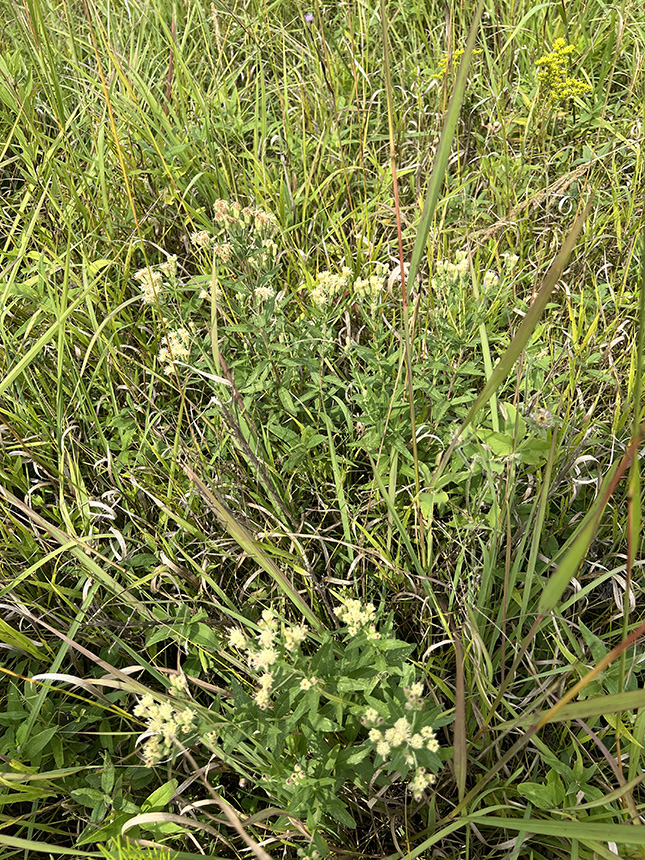
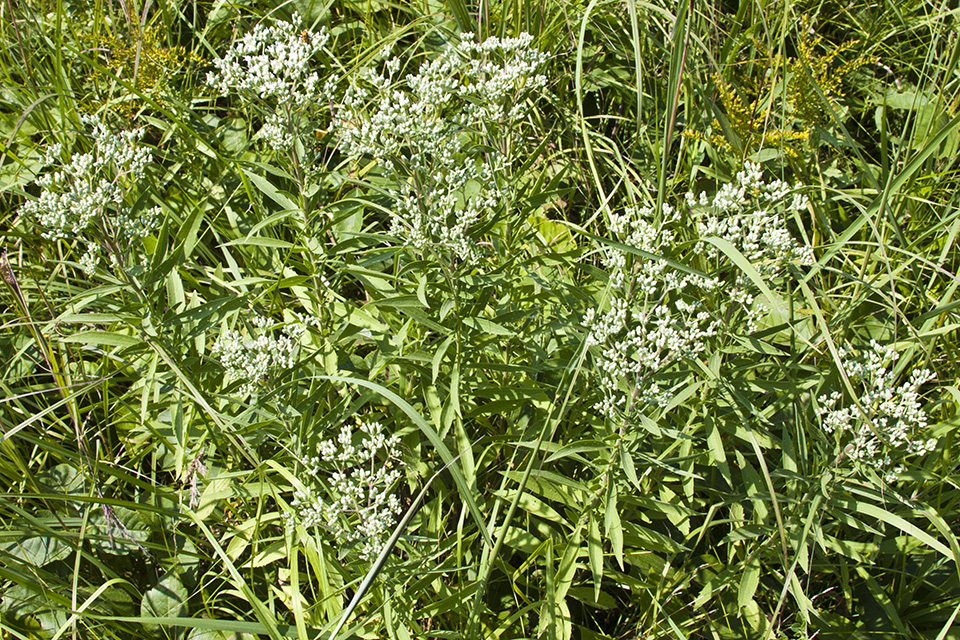
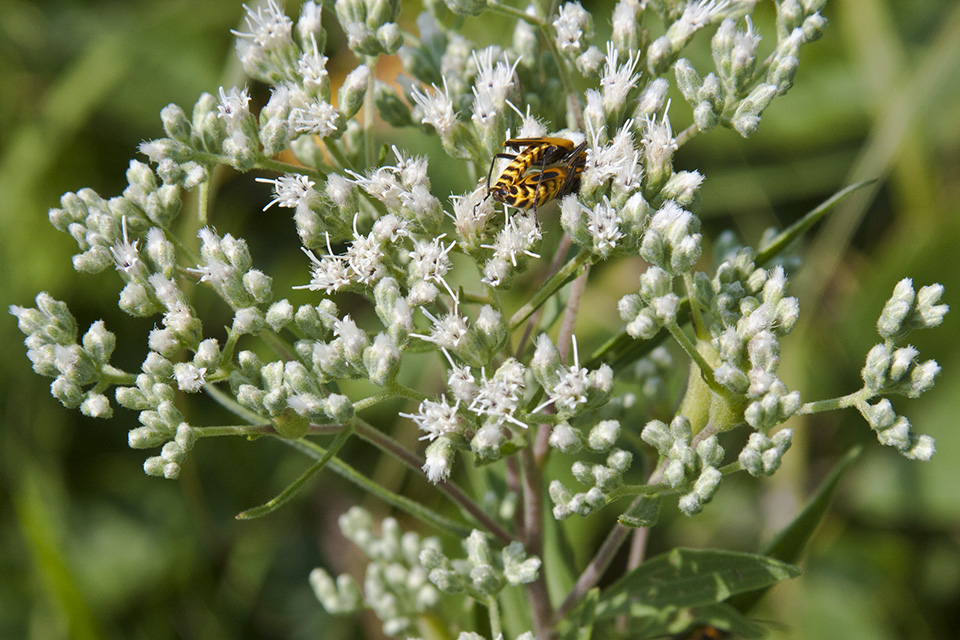
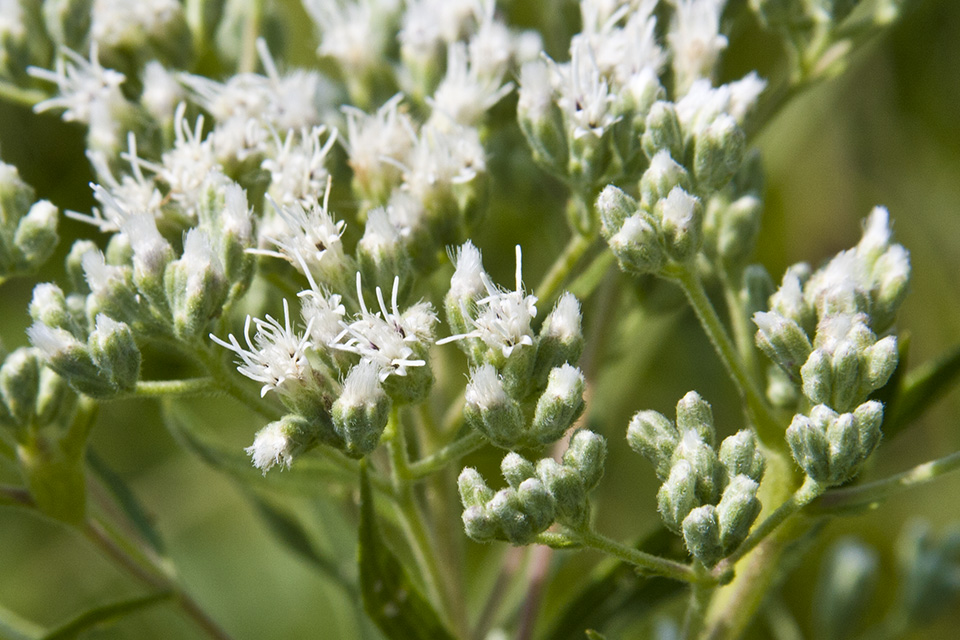
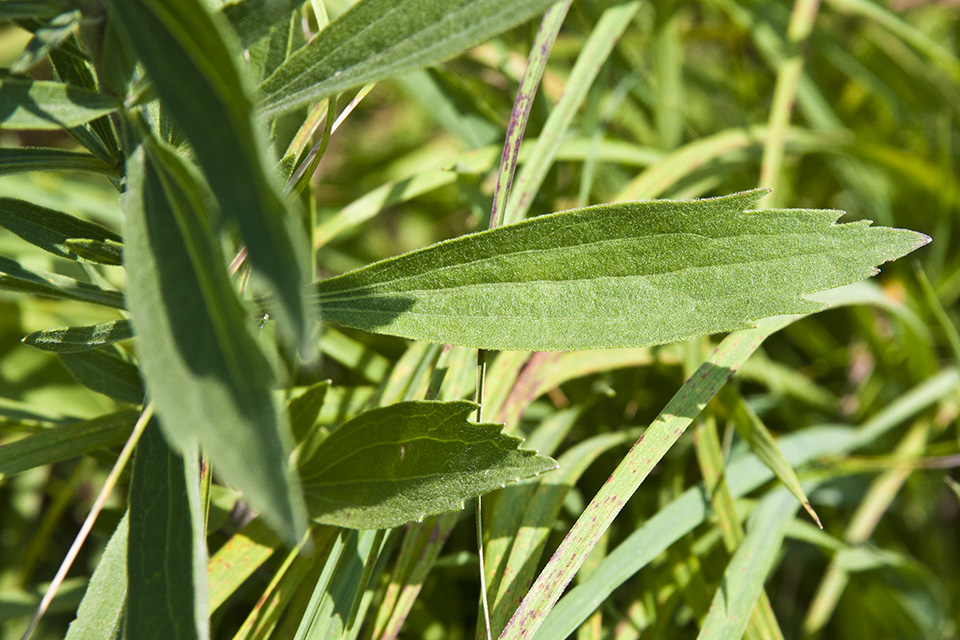
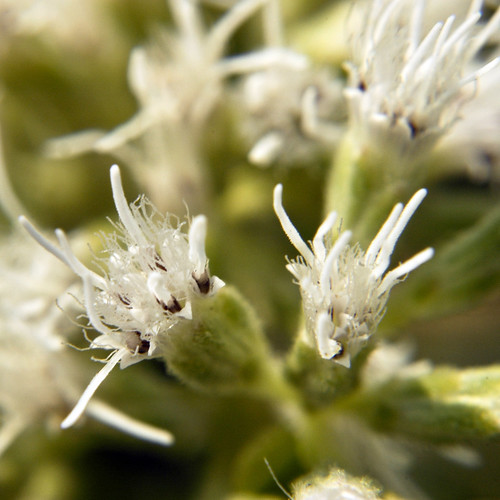
Tall boneset is a 3′ to 6½′ tall, perennial forb that rises on a single stem or pair of stems from a short caudex or stout rhizomes. The stems are erect, sparsely branched near the top, and leafy. Near the top they are covered with long, soft, shaggy but unmatted hairs. The hairs are reduced descending the stem. The lower stem is hairless. The leaves are opposite, numerous, hairy, lance-shaped, and pointed at both ends. They taper gradually to a narrow, wedge-shaped base. They taper from above the base to a sharp, drawn-out point forming concave sides along the tip. They are mostly stalkless or are attached to the stem on short leaf stalks. They are 2½ to 7 times as long as wide. The lower leaves are 2″ to 4¾″ long and ⅓″ to 1⅛″ wide, becoming smaller as they ascend the stem. There are 3 prominent veins running the length of the leaf. The 2 lateral veins are distinctly separated from the midvein all the way to the base. The blade margins are untoothed near the base, with sharp, forward-pointing teeth above the middle. The inflorescence is a more or less flat-topped, much-branched cluster of many flower heads at the end of the stem. The flower heads are cylinder-shaped, about ¼″ tall and about ⅛″ wide. Each flower contains 5 disk florets and no ray florets. Each disk floret consists of a dull white flower tube with 5 short, spreading lobes. A white, forked style protrudes from the floral tube well beyond the lobes. There is little or no fragrance. The fruit is a tiny dark achene with a small tuft of 30 to 40 light brown hairs about ⅛″ long. |
Height |
3′ to 6½′ |
Flower Color |
White |
Similar Species |
Canada goldenrod (Solidago canadensis) is similar in appearance when not in bloom. Common boneset (Eupatorium perfoliatum var. perfoliatum) leaves are fused around the stem at their bases. They do not have 3 prominent lateral veins. Instead, they have a conspicuous network of veins, depressed on the upper surface of the blade, giving the blade a wrinkled appearance. The leaf margins have rounded teeth all the way to the base. Each flower contains 9 to 23 disk florets. The flowers are fragrant. The fruit has a tuft of 20 to 30 white hairs. False boneset (Brickellia eupatorioides var. corymbulosa) leaves are alternate and densely crowded, often appearing whorled. Upland boneset (Eupatorium sessilifolium var. brittonianum) leaves are broadly rounded at the base. They have 3 prominent lateral veins. The leaf margins are toothed all the way to the base. Each flower contains 5 or sometimes 6 disk florets. White snakeroot (Ageratina altissima var. altissima) leaves are shorter, wider, and on long leaf stalks. The flower heads are much larger. It is found in woods, always in shade. |
Habitat |
Dry. Open woods, thickets, savannas, glades, and clearings. |
Ecology |
Flowering |
July to September |
Pests and Diseases |
white snakeroot leaf miner (Liriomyza eupatoriella) |
Use |
|
Distribution |
||
|
Sources |
|
| 2/5/2025 | ||
Nativity |
||
Native |
||
Occurrence |
||
|
||
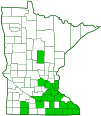
Taxonomy |
|
Kingdom |
|
Subkingdom |
Pteridobiotina |
Phylum |
Tracheophyta (Vascular Plants) |
Class |
|
Order |
Asterales (Sunflowers, Bellflowers, Fanflowers, and Allies) |
Family |
Asteraceae (Sunflowers, Daisies, Asters, and Allies) |
Subfamily |
Asteroideae |
Tribe |
Eupatorieae (bonesets, blazingstars, and allies) |
Subtribe |
Eupatoriinae |
Genus |
Eupatorium (bonesets) |
Subordinate Taxa |
|
|
|
Synonyms |
|
Eupatorium elatum Eupatorium floridanum Eupatorium floridanum Eupatorium ramosum Eupatorium rupestre Eupatorium saltuense Uncasia altissima |
|
Common Names |
|
tall boneset tall eupatorium tall joepyeweed tall thoroughwort |
|
Glossary
Achene
A dry, one-chambered, single-seeded seed capsule, formed from a single carpel, with the seed attached to the membranous outer layer (wall) only by the seed stalk; the wall, formed entirely from the wall of the superior ovary, does not split open at maturity, but relies on decay or predation to release the contents.
Caudex
A short, thickened, woody, persistent enlargement of the stem, at or below ground level, used for water storage.
Rhizome
A horizontal, usually underground stem. It serves as a reproductive structure, producing roots below and shoots above at the nodes.
Visitor Photos |
||
Share your photo of this plant. |
||
This button not working for you? |
||
Nancy Falkum |
 |
MinnesotaSeasons.com Photos |
||
 |
 |
|
Plant |
|
|
 |
 |
|
Inflorescence |
Inflorescence |
|
 |
 |
|
Inflorescence |
Leaves |

Slideshows |
Eupatorium altissimum TALL BONESET |
|

Visitor Videos |
||
Share your video of this plant. |
||
This button not working for you? |
||
|
Other Videos |
||
Tall Boneset Eupatorium altissimum) |
About
Published on Sep 16, 2013 |

Visitor Sightings |
||
Report a sighting of this plant. |
||
This button not working for you? |
||
Nancy Falkum |
Location: Oronoco Prairie SNA |
 |
MinnesotaSeasons.com Sightings |
||
|
Created: 4/3/2009 Last Updated: © MinnesotaSeasons.com. All rights reserved. |