



false boneset
(Brickellia eupatorioides var. corymbulosa)
Conservation • Description • Habitat • Ecology • Use • Distribution • Taxonomy
Conservation Status |
|
|||||||
| IUCN Red List | not listed |
|||||||
| NatureServe | NNR - Unranked SNR - Unranked |
|||||||
| Minnesota | not listed |
|||||||
Description |
||
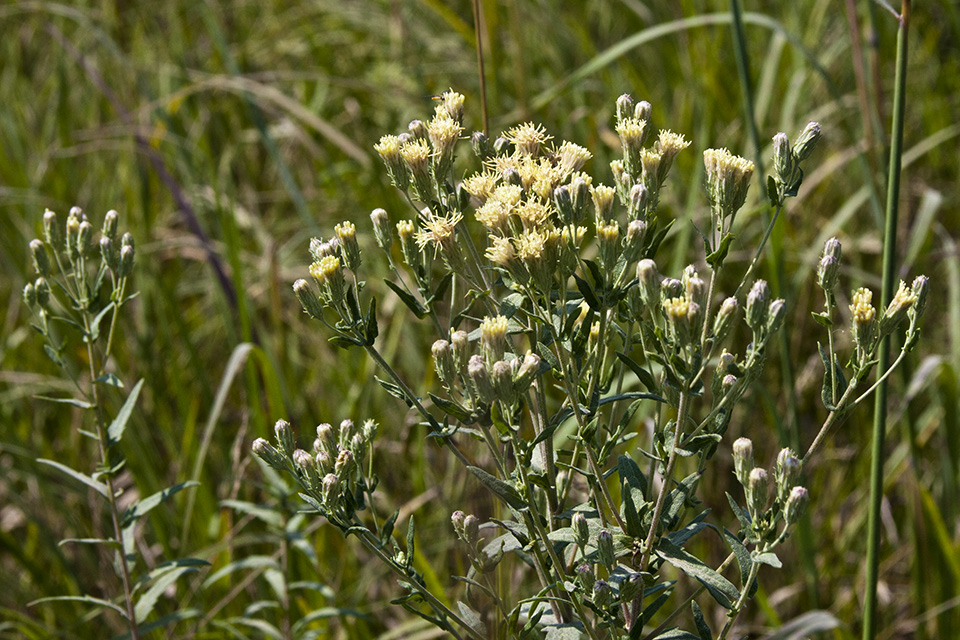
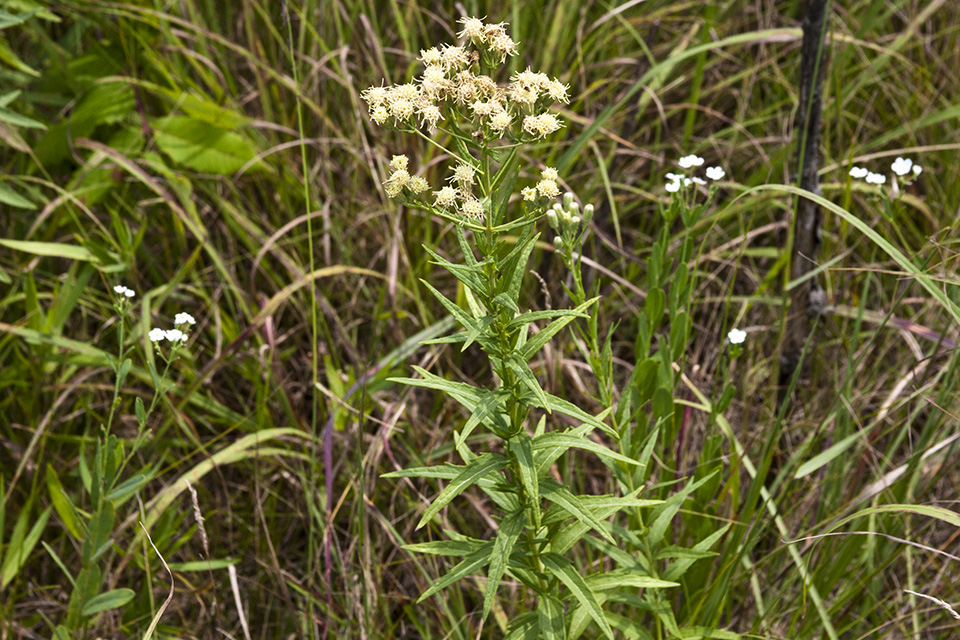
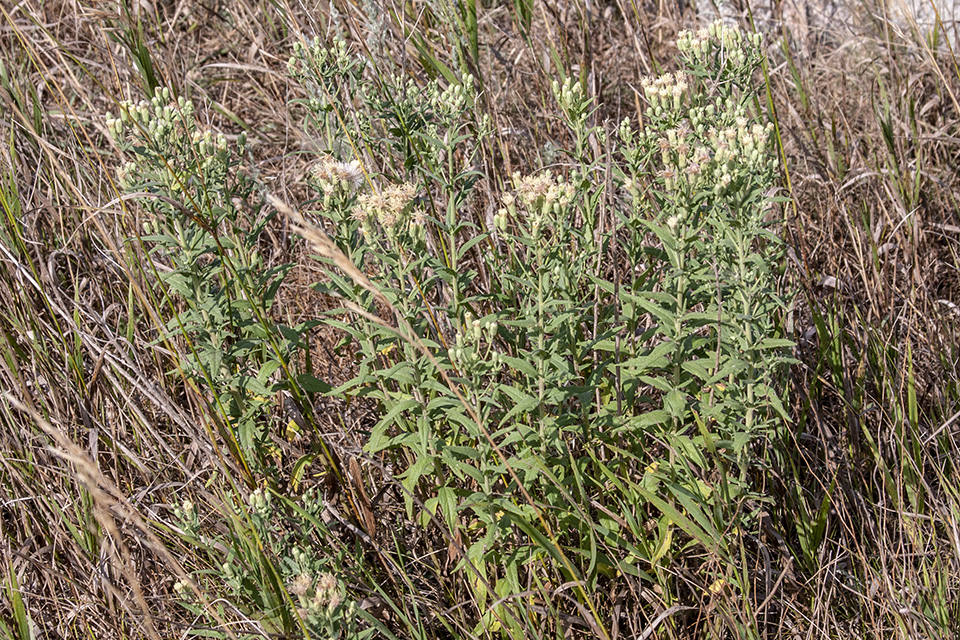
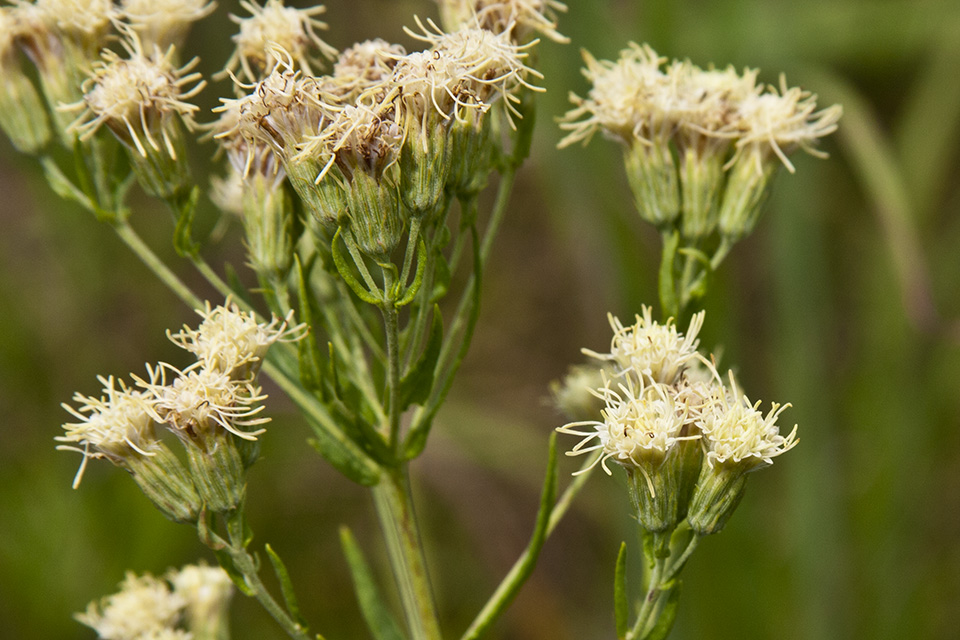
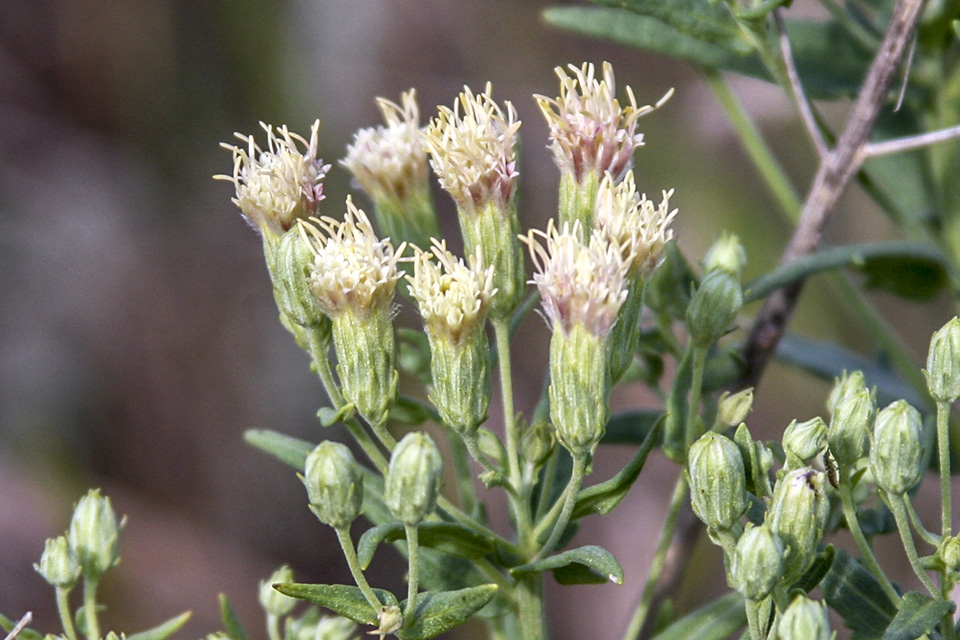
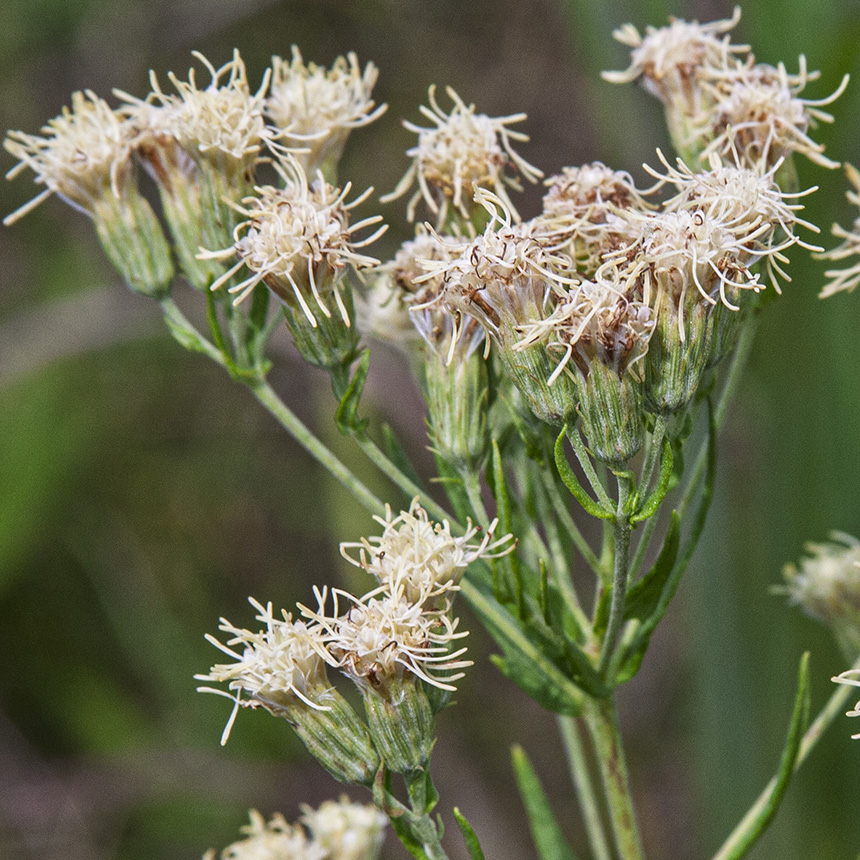
False boneset is an erect, annual biennial perennial forb that rises on one or a cluster of 2 to several stems from a deep taproot. It is usually 12″ to 32″ tall, sometimes taller. The taproot can reach up to 16′ deep. The stems are erect, round, and branched near the top. They are densely covered with short, curly hairs. They do not have spines or prickles. They are green when young, often becoming brown and woody with age. Basal leaves are usually absent at flowering time. When present, they are no larger than the lower and middle stem leaves. Stem leaves are alternate, numerous, and densely crowded, sometimes appearing opposite or whorled. Lower leaves are on leaf stalks that are up to 3 ⁄16″ long. The main leaves are lance-shaped, 1″ to 3½″ long, and 3 ⁄16″ to ⅝″ wide. The blades are tapered at the base and taper to a sharp point at the tip. The upper surface is hairless or sparsely hairy and has scattered glands. The lower surface is sparsely to moderately covered with short, fine hairs, at least along the veins, and moderately to densely covered with glands. The margins are untoothed or have one to a few coarse teeth. The leaves become gradually smaller and shorter stalked as they ascend the stem. Upper leaves are stalkless. The inflorescence is a small, branched, flat-topped or rounded cluster (panicle) of mostly 3 to 8 flower heads at the end of the stem and branches. The flower heads are ⅓″ to ½″ wide and are held erect or ascending on 3 ⁄16″ to ⅝″ long stalks. The whorl of bracts at the base of the flower head (involucre) is narrowly cup-shaped and 5 ⁄16″ to ⅝″ long. The base of the involucre is not swollen. There are 22 to 26 bracts in 4 to 6 overlapping series. The middle and outer series of bracts are half as long or less than the inner series. They taper to a sharp point but not to a hairlike tip. There are no ray florets and 15 to 35 disk florets. Each disk floret is cream-colored, narrowly tubular, and divided at the tip into 5 short, ascending to spreading lobes. A white, forked style protrudes from the floral tube well beyond the lobes. The fruit is a dry cypsela with white, feathery hairs attached. The cypsela is brown to dark brown, ⅛″ to 3 ⁄16″ long, and has 10 longitudinal ribs. |
||
Height |
||
12″ to 32″ |
||
Flower Color |
||
Cream-colored |
||
Similar Species |
||
American burnweed (Erechtites hieraciifolius var. hieraciifolius) stem is angled, not round. Middle and upper stem leaves are lobed. The leaf margins are sharply toothed. The involucre is conspicuously swollen at the base. Tall boneset (Eupatorium altissimum) leaves are opposite and well spaced, not crowded. |
||
Habitat |
||
Dry to moderate moisture. Prairies, savannas, forest openings, river banks, streambanks. Full sun. |
||
Ecology |
||
Flowering |
||
August to October |
||
Pests and Diseases |
||
|
||
Use |
||
|
||
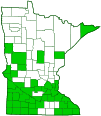
Distribution |
||||
|
Sources |
|||
| 4/14/2023 | ||||
Nativity |
||||
Native |
||||
Occurrence |
||||
|
||||
Taxonomy |
|||
| Kingdom | Plantae (Plants) | ||
| Subkingdom | Pteridobiotina | ||
| Phylum | Tracheophyta (Vascular Plants) | ||
| Class | Magnoliopsida (Dicots) | ||
Order |
Asterales (Sunflowers, Bellflowers, Fanflowers, and Allies) | ||
Family |
Asteraceae (Sunflowers, Daisies, Asters, and Allies) | ||
| Subfamily | Asteroideae | ||
| Tribe | Eupatorieae (bonesets, blazingstars, and allies) | ||
| Subtribe | Alomiinae | ||
Genus |
Brickellia (brickellbushes) | ||
| Species | Brickellia eupatorioides (false boneset) | ||
Subordinate Taxa |
|||
|
|||
Synonyms |
|||
Kuhnia eupatorioides var. corymbulosa Kuhnia hitchcockii |
|||
Common Names |
|||
brickellbush Brickell-bush false boneset falseboneset |
|||
Glossary
Bract
Modified leaf at the base of a flower stalk, flower cluster, or inflorescence.
Cypsela
A dry, one-chambered, single-seeded fruit, formed from a single carpel, with the seed attached to the membranous outer layer (wall) only by the seed stalk; the wall, formed from the wall of the inferior ovary and also from other tissues derived from the receptacle or hypanthium, does not split open at maturity, but relies on decay or predation to release the contents.
Involucre
A whorl of bracts beneath or surrounding a flower, flower head, or flower cluster.
Panicle
A pyramidal inflorescence with a main stem and branches. Flowers on the lower, longer branches mature earlier than those on the shorter, upper ones.
Visitor Photos |
|||||
Share your photo of this plant. |
|||||
| This button not working for you? Simply email us at info@MinnesotaSeasons.com. Attach one or more photos and, if you like, a caption. |
|||||
|
|||||
MinnesotaSeasons.com Photos |
|||||
Plant |
|||||
 |
 |
||||
 |
|||||
Inflorescence |
|||||
 |
 |
||||
Flower Heads |
|||||
 |
 |
||||
 |
 |
||||
Leaves |
|||||
 |
|||||

Slideshows |
||

Visitor Videos |
|||
Share your video of this plant. |
|||
| This button not working for you? Simply email us at info@MinnesotaSeasons.com. Attach a video, a YouTube link, or a cloud storage link. |
|||
Other Videos |
|||

Visitor Sightings |
|||||
Report a sighting of this plant. |
|||||
| This button not working for you? Simply email us at info@MinnesotaSeasons.com. Be sure to include a location. |
|||||
|
|||||
MinnesotaSeasons.com Sightings |
|||||
|
Created: Last Updated: © MinnesotaSeasons.com. All rights reserved. |