limber honeysuckle - Species Profile
Conservation • Wetland • Description • Habitat • Ecology • Use • Distribution • Taxonomy
Conservation Status
IUCN Red List
not listed
NatureServe
N5 - Secure
SNR - Unranked
Minnesota
not listed
Wetland Indicator Status
Great Plains
FACU - Facultative upland
Midwest
FACU - Facultative upland
Northcentral & Northeast
FACU - Facultative upland
Description
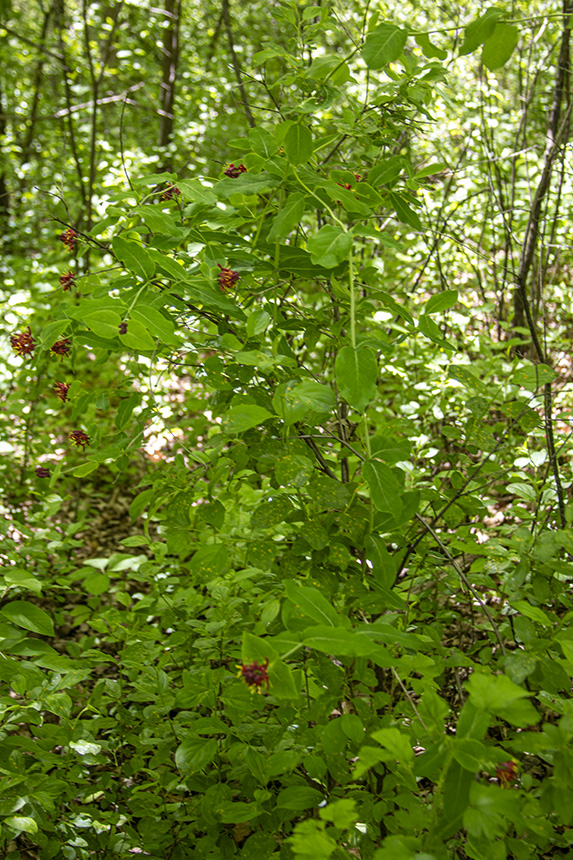
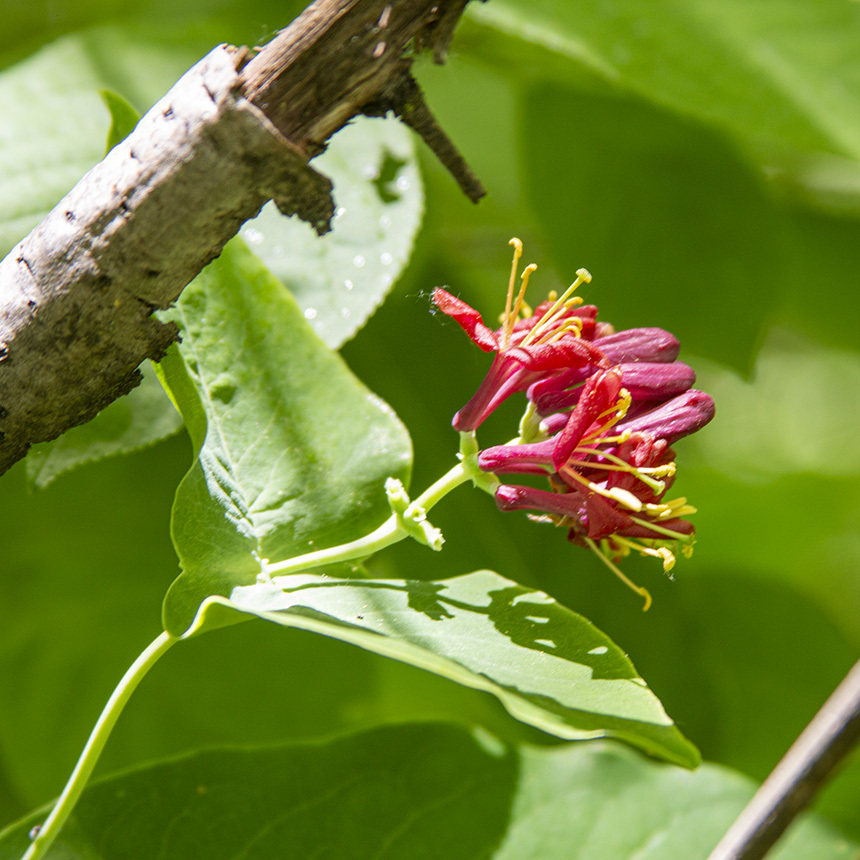
Limber honeysuckle, also called glaucous honeysuckle or wild honeysuckle, is a perennial vine or semi-erect shrub. It usually climbs over adjacent vegetation or sprawls on the ground. Occasionally, it forms a mound of arching stems.
The stems are climbing, sprawling, or semi-erect and arching. They are round, up to ¾″ in diameter, and can be 3′ to 9′ long but are usually 5′ to 6½′ long. First-year branches are greenish, hairless, and usually covered with a whitish, waxy bloom (glaucous). Second-year branches are gray or brown. The bark of mature stems is gray or brown with long, fibrous, shredded, peeling strips. The buds are egg-shaped and pointed. The leaf scars are thin and crescent-shaped with 3 vascular bundle scars.
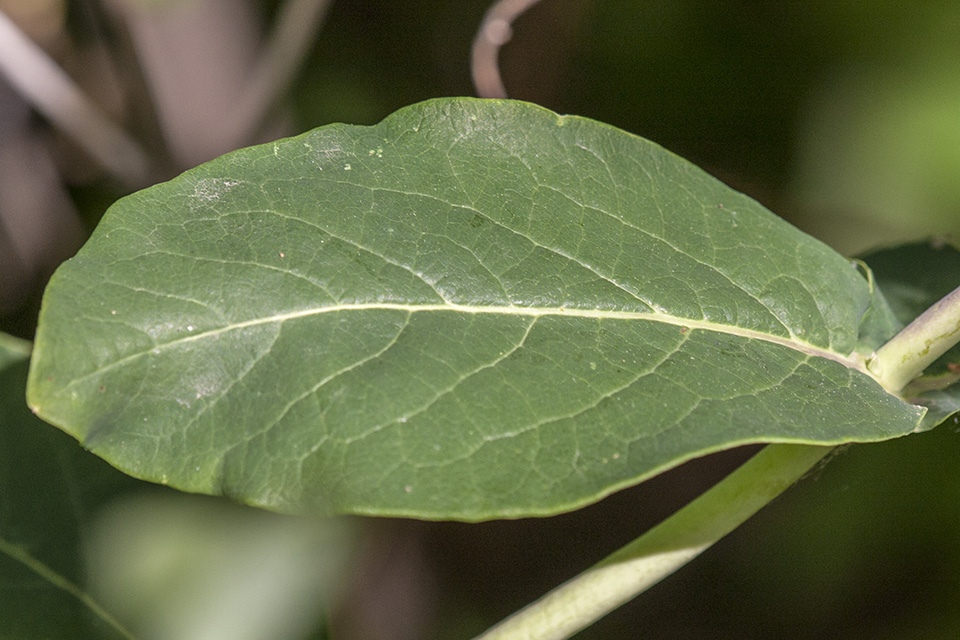
The leaves are opposite and variable in shape; oblong, elliptic, or inversely egg-shaped. The larger leaves are 2″ to 3½″ long, and 1¼″ to 2¾″ wide. They are rounded or blunt at the tip and tapered or rounded at the base. They may be stalkless or on leaf stalks up to ⅜″ long. The upper surface of the leaf blade is dark green and hairless. The lower surface is bluish or whitish, glaucous, and is usually moderately to densely hairy, occasionally hairless. The margins are untoothed, often wavy, and do not have a fringe of long hairs.
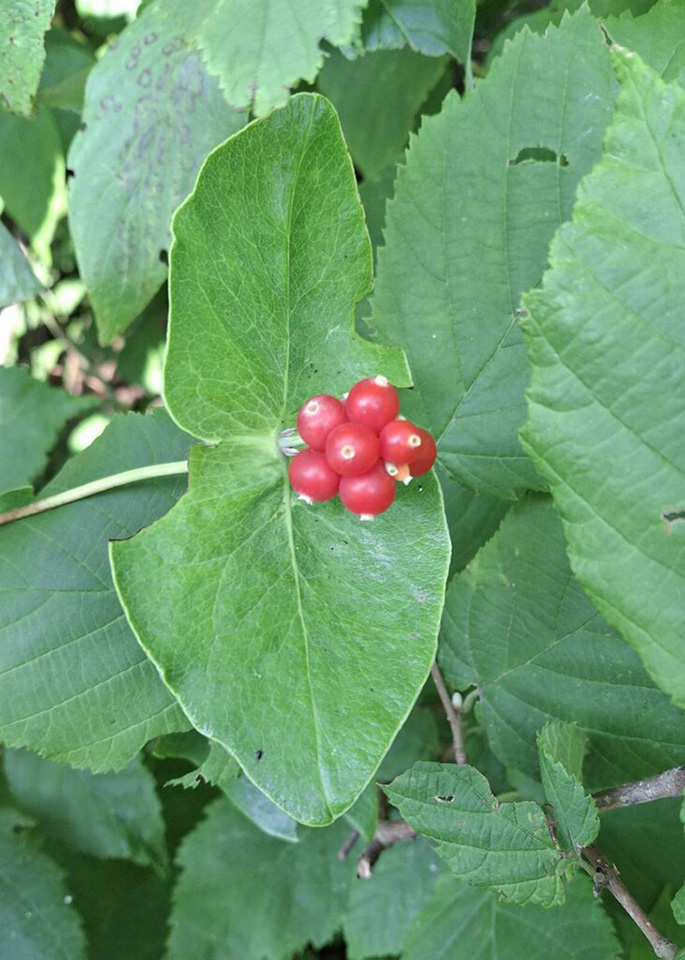
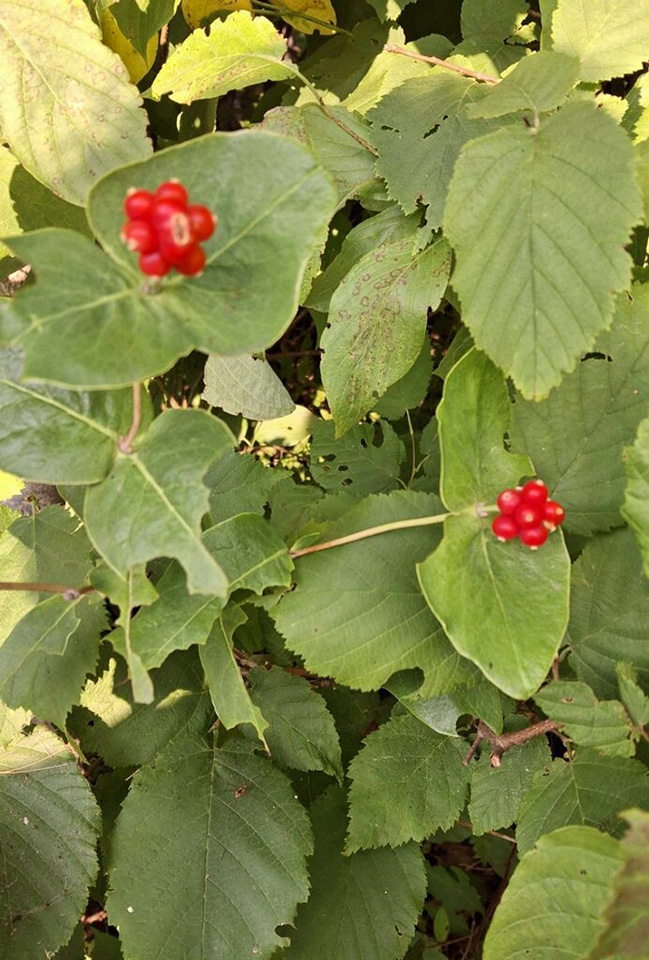
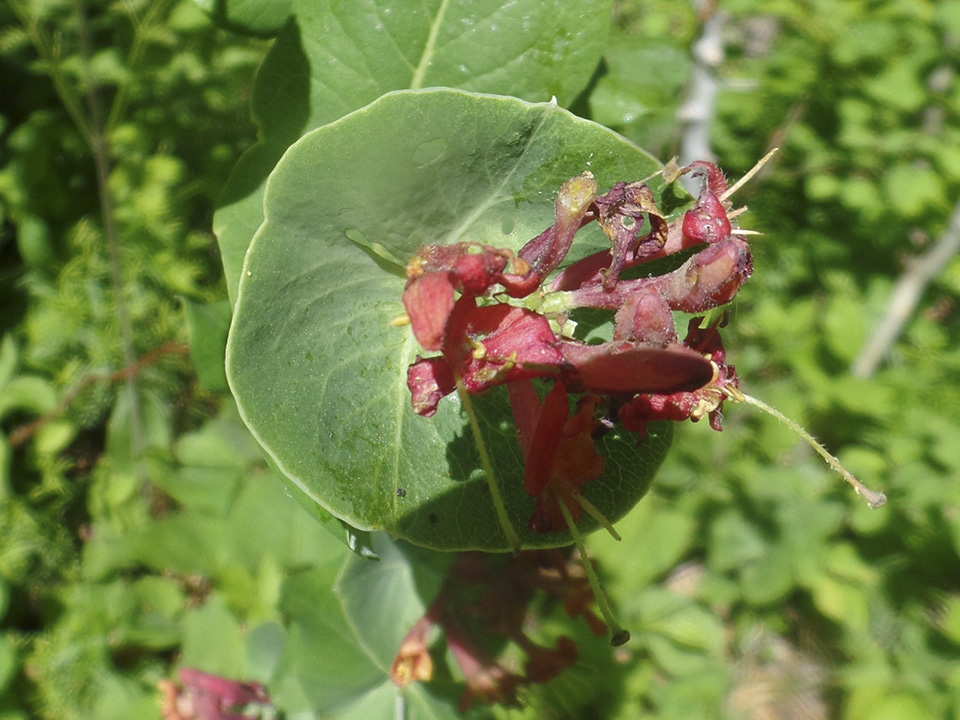
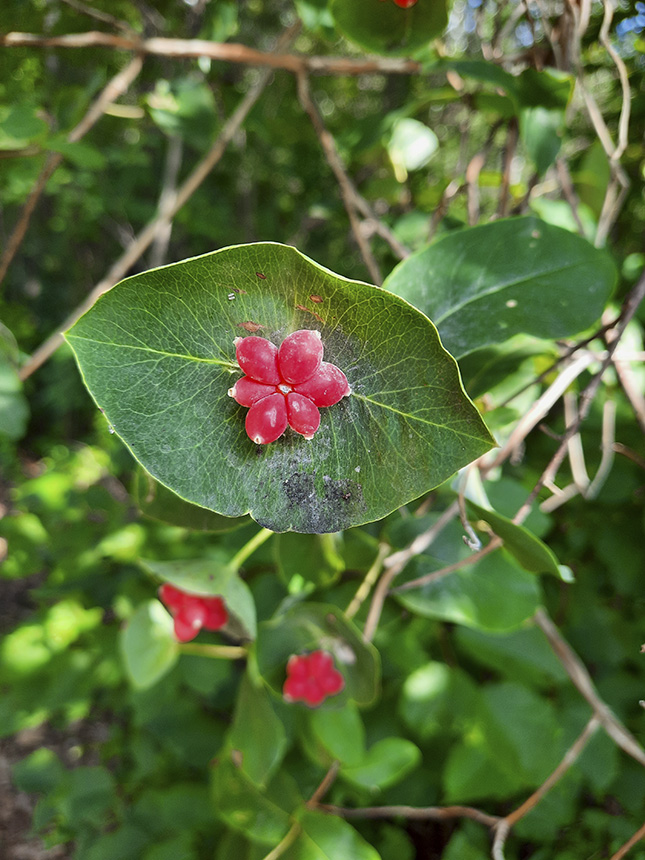
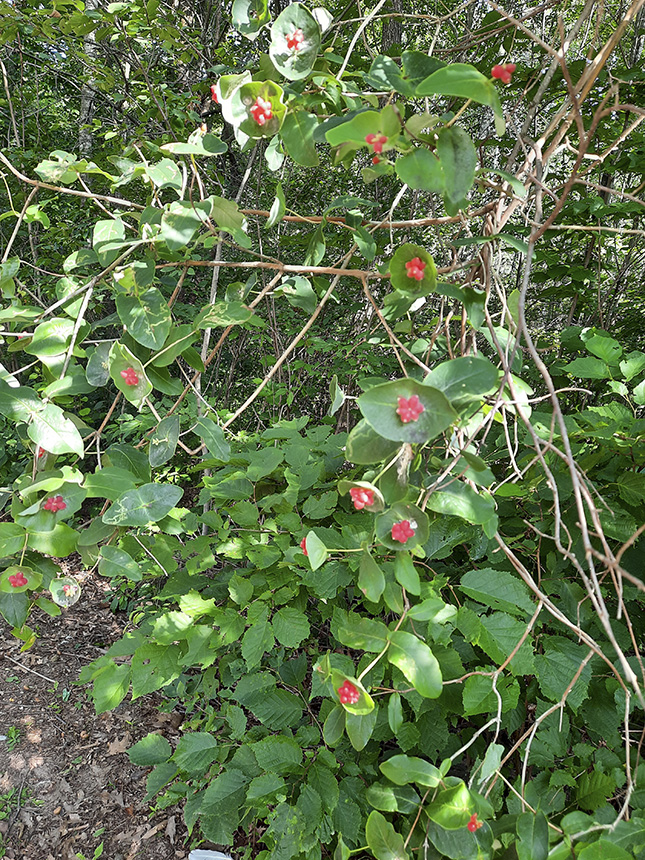
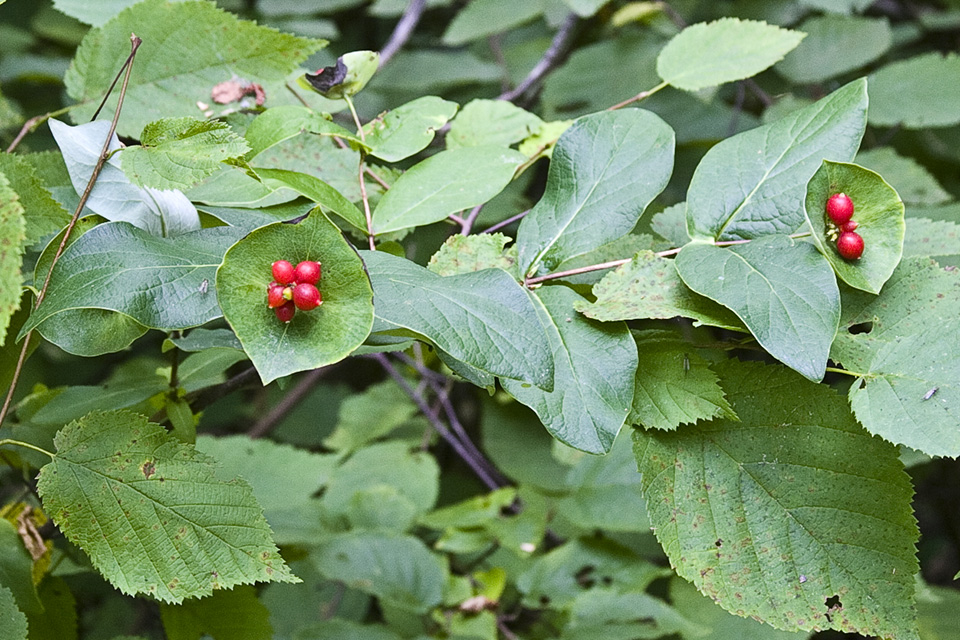
On flowering stems the uppermost pair of leaves is fused together at the base into a single disk-like leaf. The tip of each fused leaf is tapered to a point or is rounded and has a tiny, short, sharp, abrupt point. The upper surface is green and is not glaucous.
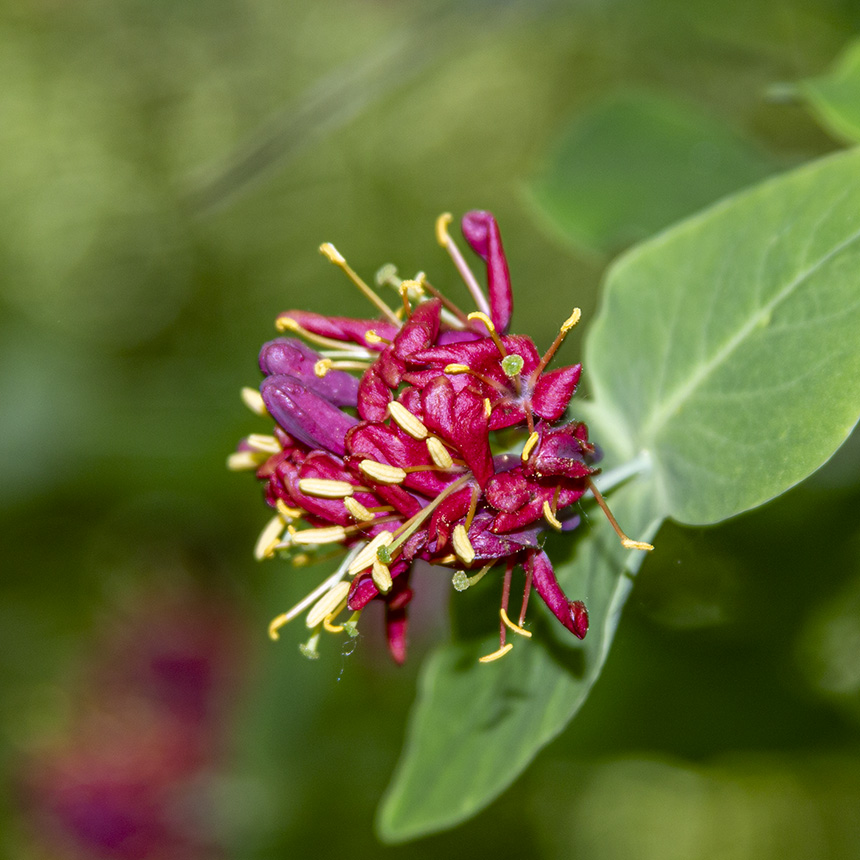
The inflorescence is 1 to 3 whorls of 6 stalkless flowers per whorl on a single spike (rarely 3 spikes) at the end of the stem. The whorls are not separated and the flowers are crowded.
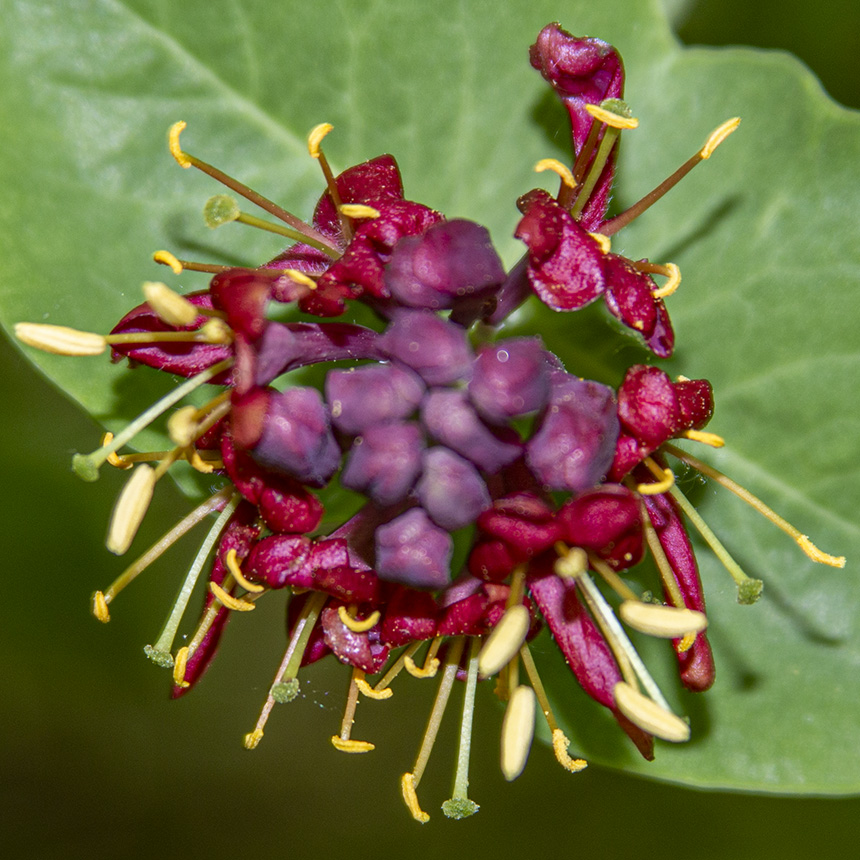
The flowers are ⅝″ to 1″ long and are strongly symmetrical, so that a plane dividing the flower in two would produce one side that is a mirror image of the other. There are 5 petals fused at the base into a corolla tube then separated ⅓ to ½ of the way to the base into 2 lips. The upper lip is divided into 4 shallow lobes, the lower lip is undivided. The petals are purple, red, or, rarely, yellow tinged with purple or red. There are 5 stamens with yellow anthers and a style with a light green, head-like stigma. The stamens and style protrude well beyond the corolla tube. The flowers appear on last season’s stems after the leaves are fully developed and peak from mid-May to early June. In Minnesota they are pollinated by ruby-throated hummingbird and bumble bees.
The fruit is a soft, globular, 5 ⁄16″ to ½″ in diameter berry. It is green initially, becoming orange, ultimately red or orange-red when ripe. They do not fall but remain on the plant until picked off by birds or they dry on the plant. It matures in late June to early August.
Height
Vine: 3′ to 9′ long
Flower Color
Purplish
Similar Species
Grape honeysuckle (Lonicera reticulata) leaves are nearly circular. The upper 2 or 3 pairs of leaves are fused at the base into single disk-like leaves. The upper surface of the fused leaves is often glaucous and bluish. The flower whorls are normally separated from one another. The flowers are pale yellow. In Minnesota it is found only in the southeast.
Hairy honeysuckle (Lonicera hirsuta) leaves are narrowly elliptic. The upper leaf surface is velvety-hairy. The leaf margins have a fringe of long hairs. The flowers are yellow.
Habitat
Moist. Forest edges and clearings, thickets, lakeshores, river banks. Partial or full sun.
Limber honeysuckle is found in exposed areas where its red or purple flowers can be seen by hummingbirds and its brightly colored red or orange-red fruit can be seen by fruit-eating birds.
Ecology
Flowering
Mid-May to early June
Pests and Diseases
Use
Distribution
Sources
Biodiversity occurrence data published by: Minnesota Biodiversity Atlas (accessed through the Minnesota Biodiversity Atlas Portal, bellatlas.umn.edu. Accessed 7/24/2026).
Midwest Herbaria Portal. 2026. https://midwestherbaria.org/portal/index.php. Accessed 7/24/2026.
Lonicera dioica L. in Bánki, O., Roskov, Y., Döring, M., Ower, G., Hernández Robles, D. R., Plata Corredor, C. A., Stjernegaard Jeppesen, T., Örn, A., Pape, T., Hobern, D., Garnett, S., Little, H., DeWalt, R. E., Miller, J., Orrell, T., Aalbu, R., Abbott, J., Abreu, C., Acero P, A., et al. (2026). Catalogue of Life (2026-07-17 XR). Catalogue of Life Foundation, Amsterdam, Netherlands. https://doi.org/10.48580/dgykv
Smith, Welby R. 2008. Trees and Shrubs of Minnesota: The Complete Guide to Species Identification. The University of Minnesota Press, Minneapolis, MN.
Nativity
Native
Occurrence
Common but not abundant
Taxonomy
Kingdom
Subkingdom
Pteridobiotina
Phylum
Tracheophyta (Vascular Plants)
Class
Order
Dipsacales (Honeysuckles, Moschatels, and Allies)
Family
Caprifoliaceae (Honeysuckle)
Subfamily
Caprifolioideae
Genus
Lonicera (Honeysuckles)
Subgenus
Lonicera
Subordinate Taxa
Some sources (Gleason & Cronquist, 1991) separate this species into four varieties, two of which occur in Minnesota. Lonicera dioica var. glaucescens, described above, has a moderately to densely hairy lower leaf surface. Lonicera dioica var. dioica has a hairless lower leaf surface. The Minnesota DNR recognizes this separation of varieties.
Steyermark’s Flora of Missouri Vol. 2 (Yatskievych, 2006) states that there is a complete intergradation of the distinguishing characteristics and rejects the separation. Most sources recognize no varieties or subspecies.
Synonyms
Caprifolium bracteosum
Caprifolium dioicum
Caprifolium glaucescens
Caprifolium glaucum
Caprifolium parviflorum
Lonicera dioica ssp. glaucescens
Lonicera dioica var. dasygyna
Lonicera dioica var. glaucescens
Lonicera glauca
Lonicera glaucescens
Lonicera hirsuta var. glaucescens
Lonicera parviflora
Common Names
Douglas’ honeysuckle
glaucous honeysuckle
glaucous-leaved honeysuckle
limber honeysuckle
mountain honeysuckle
red honeysuckle
small honeysuckle
smooth-leaved honeysuckle
twining honeysuckle
wild honeysuckle