


European Skipper
(Thymelicus lineola)
Conservation • Description • Habitat • Ecology • Distribution • Taxonomy
Conservation Status
IUCN Red List
not listed
NatureServe
NNA - Not applicable
SNA - Not applicable
Minnesota
not listed
Description
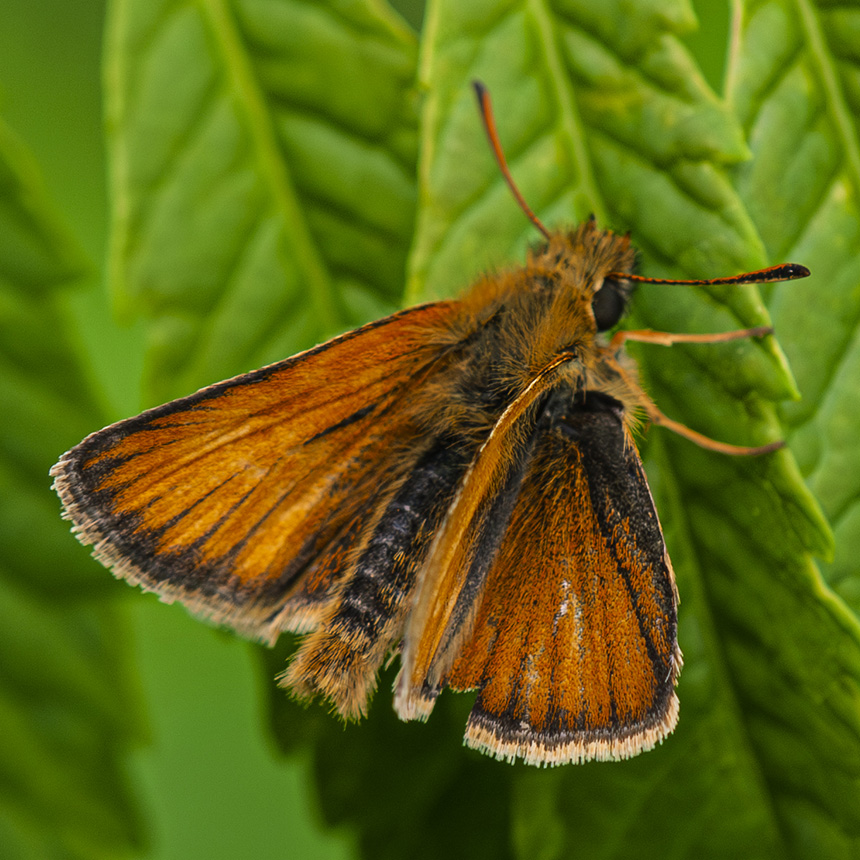
European Skipper is an exotic, small grass skipper with a wingspan of ¾″ to 1⅛″. It is native to Europe and Asia, where it is known as Essex skipper. It was introduced into Ontario in 1910, and has since been spreading about 20 miles per year. It is common in Minnesota.
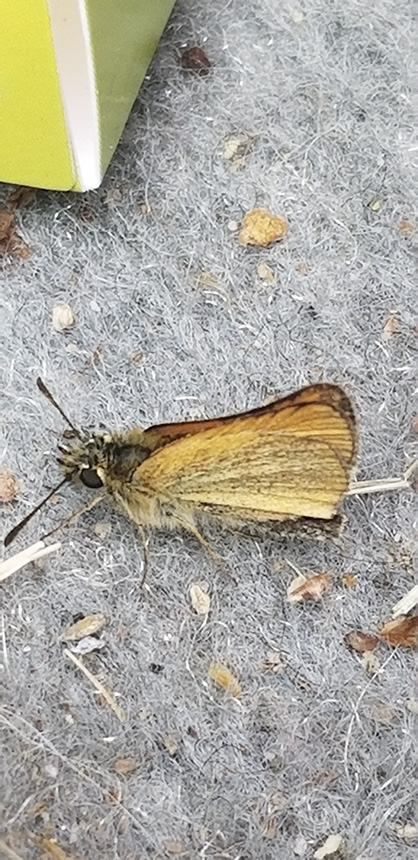
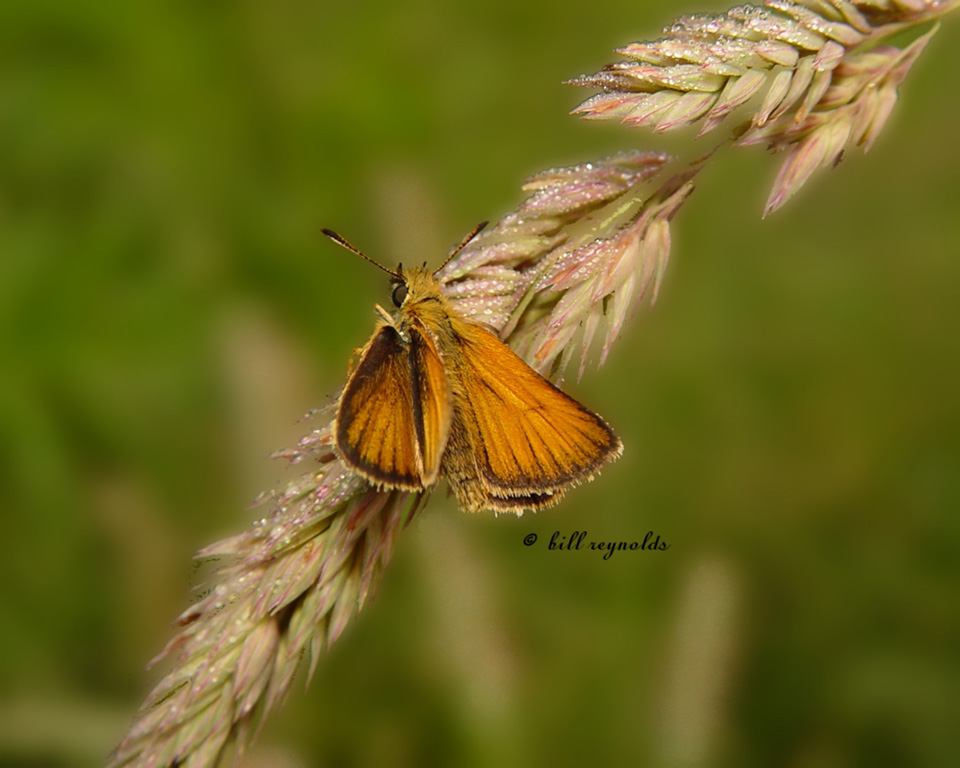
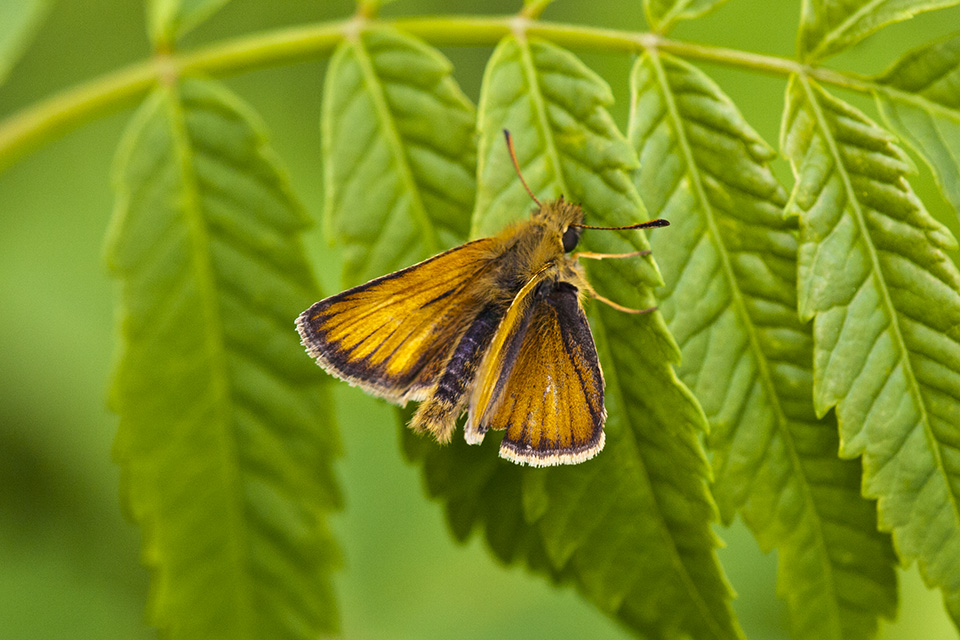
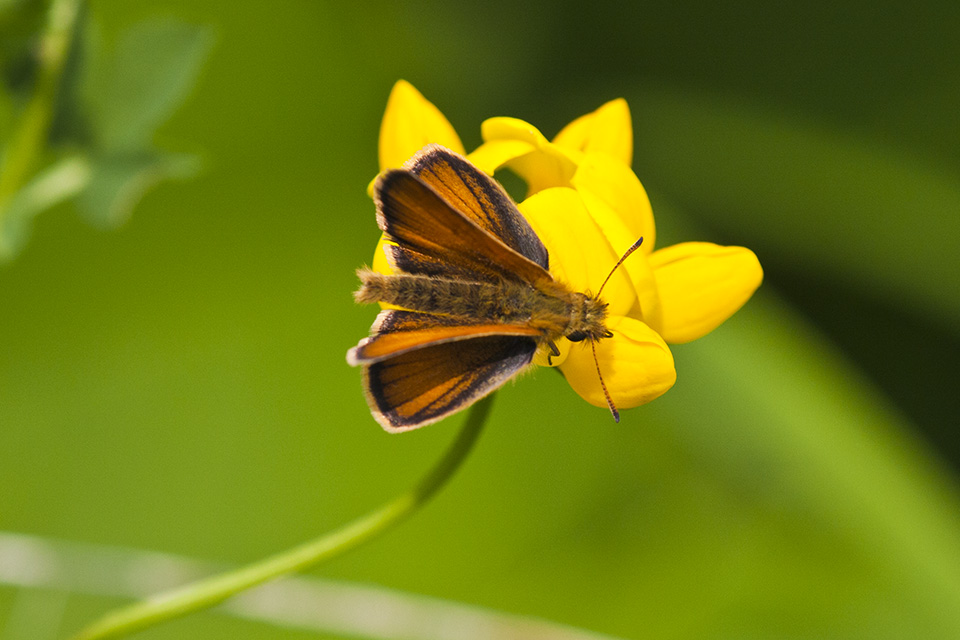
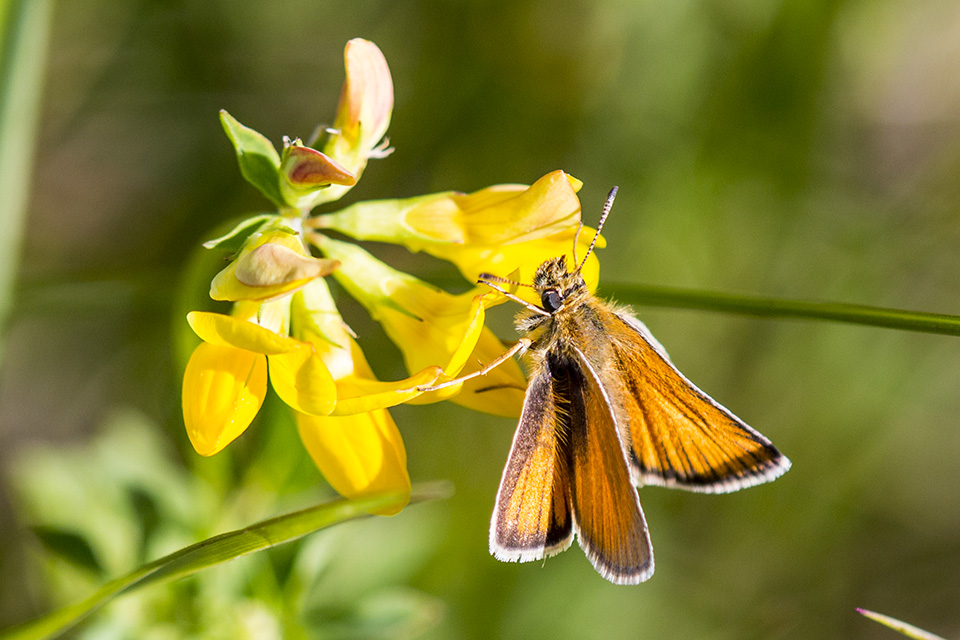
The upperside of the both wings is mostly bright, brassy orange. There is a thin black margin at the tip and a very thin black margin at the upper edge. The veins are slightly darkened near the margin. There is no black cell end bar. There is a very thin black stigma on forewing of the male. There is usually a thin vertical black line at the end of the forewing cell of the female. The wings are otherwise unmarked.
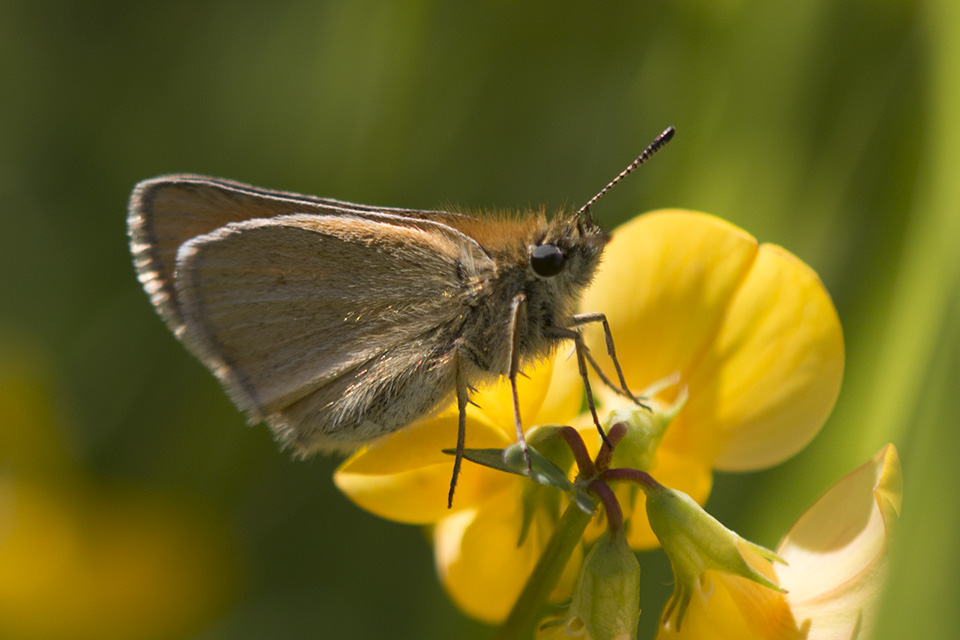
The underside of the forewing is orange, that of the hindwing is grayish-brown. The underside of both wings has a powdery, whitish tint. The wingtips are rounded, not pointed.
The antennae are short, barred, reddish, and blunt-tipped.
The caterpillar is green, slender, and up to 1″ long. The head is pale green with a central, inverted Y shaped stripe, and two wide, vertical, white stripes. The white stripes are sometimes bordered by narrower, black stripes. There is no constricted section (“neck”) between the head and the first thoracic segment. There is a narrow, green, vertical stripe on the middle of the upper (dorsal) surface extending from the second thoracic segment across all abdominal segments. On each side of this middorsal stripe is a pale greenish-white stripe. There is also a whitish subdorsal stripe and a whitish lateral stripe. There is a white wax gland along the bottom of each side of abdominal sections 7 and 8. The thorax and abdomen are moderately covered with white hairs and sparsely covered with contrasting rust-colored hairs. Mature caterpillars are seen in early spring.
Size
Wingspan: ¾″ to 1⅛″
Similar Species
Habitat
Open, dry, grassy areas. Meadows, pastures, forest openings, parks, roadsides, railways.
Ecology
Season
One generation per year: Early June to mid-July
Behavior
Like all skippers, they have a rapid, darting flight.
Life Cycle
The females lay a row of up to 30 eggs on a host plant. The eggs overwinter and hatch in the spring
Larva Food/Hosts
Timothy (Phleum pratense), orchard grass (Dactylis glomerata glomerata), quackgrass (Elymus repens), rice cutgrass (Leersia oryzoides), and bluegrass (Poa spp.).
Adult Food
Flower nectar
Distribution
Sources
7, 21, 24, 29, 30, 75, 82, 83.
Biodiversity occurrence data published by: Minnesota Biodiversity Atlas (accessed through the Minnesota Biodiversity Atlas Portal, bellatlas.umn.edu, 12/21/2025).
Quinn, Edward. M., and Ron Danielson. April 27, 2009. A Survey of Lepidoptera in Three Priority Areas of the Minnesota State Parks System. https://files.dnr.state.mn.us/eco/nongame/projects/consgrant_reports/2009
/2009_quinn_danielson.pdf.
Occurrence
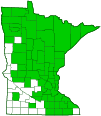
Common. Locally abundant.
Where found, this species is often explosively abundant.
Taxonomy
Order
Lepidoptera (Butterflies and Moths)
Superfamily
Papilionoidea (Butterflies)
Family
Hesperiidae (Skippers)
Subfamily
Hesperiinae (Grass Skippers)
Tribe
Hesperiini
Subtribe
Thymelicina
Genus
Thymelicus
Superfamily
Skippers have traditionally been placed in their own superfamily Hesperioidea because of their morphological similarity. Recent phylogenetic analysis (Kawahara and Breinholt [2014]) suggests that they share the same common ancestor as other butterfly families, and thus belong in the superfamily, Papilionoidea.
Subordinate Taxa
Synonyms
Adopaea antiardens
Adopaea brunnea
Adopaea clara
Adopaea hemmingi
Adopaea intermedia
Adopaea intermediaclara
Adopaea intermedialineola
Adopaea lineola
Adopaea major
Adopaea majorclara
Adopaea majornitida
Adopaea melissus
Adopaea pallida
Adopaea pseudothaumas
Adopaea suffusa
Adopoea fornax
Hesperia ardens
Hesperia italamixta
Hesperia lineola
Pamphila kirbyi
Pamphila ludoviciae
Papilio lineola
Papilio virgula
Thymelicus diluta
Thymelicus marginatus
Common Names
Essex skipper (Europe)
European Skipper (North America)
Glossary
Stigma
In plants, the portion of the female part of the flower that is receptive to pollen. In Lepidoptera, an area of specialized scent scales on the forewing of some skippers, hairstreaks, and moths. In other insects, a thickened, dark, or opaque cell on the leading edge of the wing.
Visitor Photos
Share your photo of this insect.
This button not working for you?
Simply email us at info@MinnesotaSeasons.com.
Attach one or more photos and, if you like, a caption.
Danny Johnson
Dan W. Andree
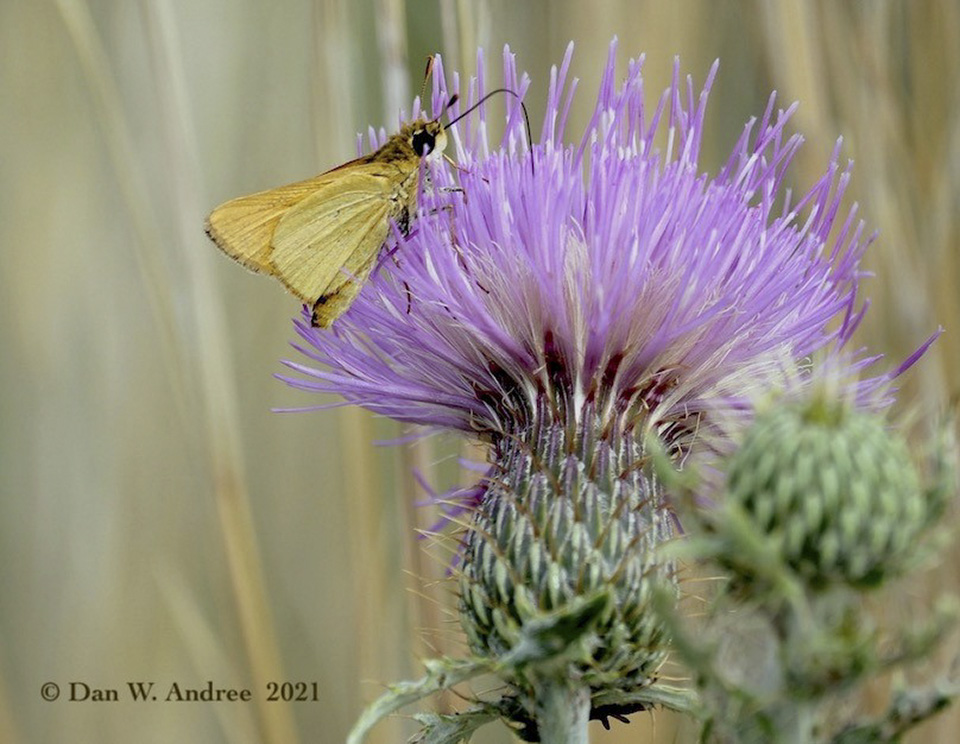
Skipper on Thistle....
Skipper’s can be really confusing to me. Some look similar to some others so I guess all I know is this is some kind of skipper. July 2021
Signed….
Confused Dan…👀
MinnesotaSeasons.com Photos




Slideshows
European Skipper
DianesDigitals
European Skipper (Thymelicus lineola)
Andree Reno Sanborn
Thymelicus lineola (European Skipper)
Allen Chartier
The European Skipper Butterfly
I Love Insects

Visitor Videos
Share your video of this insect.
This button not working for you?
Simply email us at info@MinnesotaSeasons.com.
Attach a video, a YouTube link, or a cloud storage link.
Other Videos
A Mating pair of Essex Skippers Butterflies Thymelicus lineola
Disclose.tv1
Essex Skipper male
Roger Wilmshurst

Visitor Sightings
Report a sighting of this insect.
This button not working for you?
Simply email us at info@MinnesotaSeasons.com.
Be sure to include a location.
Danny Johnson
6/27/2023
Location: 1 mile south of Alida, Clearwater County, MN
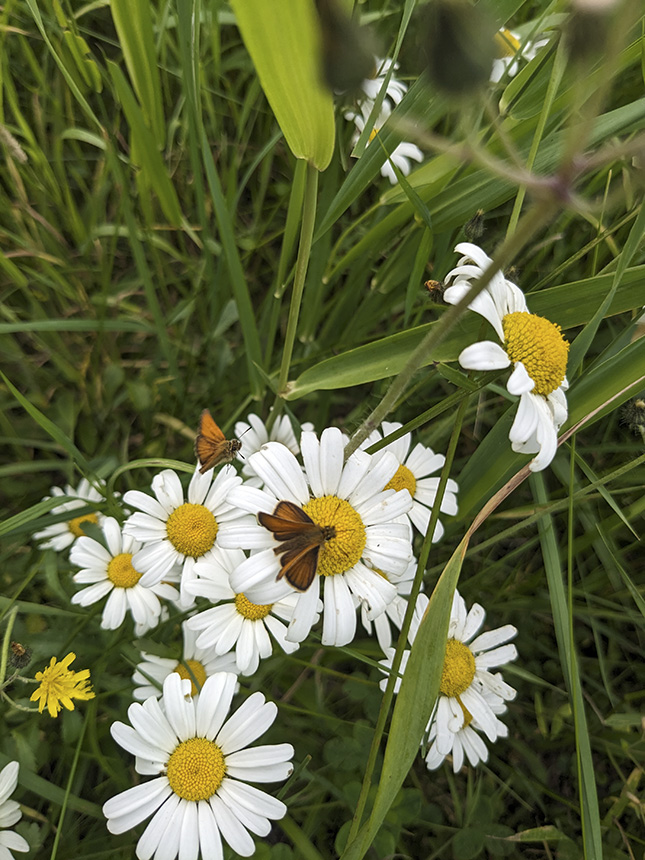
there were literally hundreds of these small butterflies on the daisies on the edge of a hayfield. Could someone confirm that this is an European Skipper for me? There are 2 of them in the attached photo.
Thanks
Dan W. Andree
7/15/2021
Location: Rural Norman Co., Mn.
Skipper’s can be really confusing to me. Some look similar to some others so I guess all I know is this is some kind of skipper. July 2021
Signed….
Confused Dan…👀
Cynthia Schroeder
7/8/2019
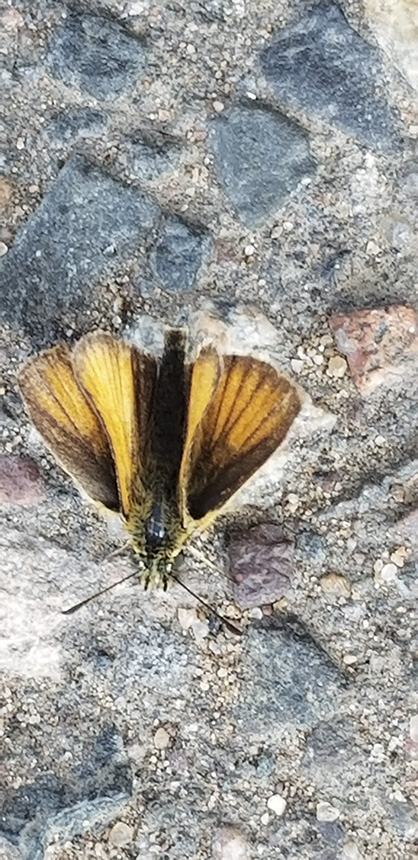
Location: Pine City MN
Minnesota Seasons Sightings