


Thynnid flower wasp
(Myzinum maculatum)
Conservation • Description • Habitat • Ecology • Distribution • Taxonomy
Conservation Status |
|
||||
| IUCN Red List | not listed |
||||
| NatureServe | NNR - Unranked |
||||
| Minnesota | not listed |
||||
Description
There are ten species of thynnid flower wasps (genus Myzinum) in North America. Adults are active from July to September. They are found in a wide range of habitats, including meadows, fields, and lawns. They feed on pollen and nectar from the flowers of at least 22 species of plants, mostly sunflowers, daisies, asters, and allies (Family Asteraceae) and carrot (Family Apiaceae). The larvae are external parasites on the larvae of beetles, mostly scarabs (Family Scarabaeidae) and especially May beetles (Phyllophaga spp.), but also tiger beetles (Family Cicindelidae).
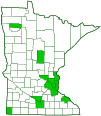
Myzinum maculatum is a common, small to medium-sized, thynnid wasp. It is the most widespread Myzinum species in North America. It occurs in the United States from Maine to Florida, west to Minnesota, Nebraska, and California. It also occurs in Mexico, Central America, and southern Ontario. Little information about the biology of Myzinum maculatum can be found.
Females are 7⁄16″ to ½″ (11 to 13 mm) in length and their bodies are robust. The body is mostly black with yellow areas and yellow markings, and it is somewhat hairy. The front part of the body (mesosoma) is connected to the rear part (metasoma) by a narrow waist.
There are two large compound eyes on the sides of the head and three simple eyes (ocelli) in a triangle on top of the head. The compound eyes are notched to slightly indented on the inner margin. There is a yellow band along the inner and outer eye margins, continuing as a broad, yellow, transverse band passing through the antennae bases. The plate on the face (clypeus) is partially yellow. The jaws (mandibles) are orange. The antennae are smooth and thread-like. They are black, they have 12 segments, and there is a yellow band along the upper side of the first segment (scape). They are usually held straight, not coiled.
The thorax is longer than wide and it has three segments, from front to back the prothorax, mesothorax, and metathorax. However, the first segment of the abdomen (propodeum) is fused to the thorax, giving the thorax the appearance of having four segments. The upper plate on the prothorax (pronotum) is short and collar-like. It extends rearward on the sides to the plate at the base of each wing (tegula). It appears horseshoe-shaped when viewed from above, triangular when viewed from the side. It is mostly black except for a large, yellow, triangular spot on the front margin on each side and a narrow yellow stripe across the rear margin. The spots are sometimes joined in the middle, creating a complete yellow band across the pronotum.
On the mesothorax, the large front plate (scutum) is crossed by a transverse groove (transmesoscutal suture), and there is a row of three spots both in front (anteriorly) and behind (posteriorly) the suture. The front row consists of a broadly U-shaped spot in the middle and a narrow yellow spot on each side. The rear row consists of three smaller spots, but these are sometimes extremely reduced or missing. The rear plate on the mesothorax (scutellum) has a yellow rectangular spot in the middle. The plate on the third thoracic segment (metanotum) is very short front to back, and it is yellow in the middle (medially). The yellow is frequently reduced to a “hairline” or lost entirely.
The propodeum has a yellow spot in the middle toward the front and a rectangular spot near each lateral margin toward the rear.
The plate on each side of the second thoracic segment (mesopleuron) has a large yellow spot at the front and sometimes a spot at the rear. The front spot is often quite striking—it can be so large that it dominates the side view of the wasp. The tegulae are yellow.
The surface of the metasoma is covered with silvery hairs except for the last segment, which is shiny. The upper part (tergum) of the first five segments (terga I–V) have a broad, partial yellow band near the rear (subbasal) that may be complete or broken in the middle (partial). The underside (sterna) of segments II–VI have a lateral yellow spot. The last metasomal segment has two rear lobes.
The wings are strongly bicolored—mostly tinted light brown, but with dark brown tinting along the leading edge (costal margin).
The legs are variable in color, black with little to extensive yellow and reddish markings.
Males are 7⁄16″ to ⅝″ (11 to 16 mm) in length and their bodies are slender. The antennae are black, they have 13 segments, and there is a small yellow spot on the upper side of the scape. The clypeus is entirely yellow. The pronotum has a narrow yellow band on the front margin and a broad yellow band on the rear margin. The scutum, scutellum, and metapleuron each have a broad yellow spot in the middle. The mesopleuron has a large yellow spot at the front and another at the rear. The metasoma is narrower, cylindrical, the yellow bands are narrower, and the last segment has an upwardly curved false stinger. The wings are mostly clear with a darkened stigma and dark tinting toward the tip.
Size
Female Total length: 7⁄16″ to ½″ (11 to 13 mm)
Male Total length: 7⁄16″ to ⅝″ (11 to 16 mm)
Similar Species
Habitat
A wide range of habitats, including meadows, fields, and lawns
Ecology
Season
July to September
Behavior
Life Cycle
Larva Food/Hosts
Larva of beetles, mostly in the families Scarabaeidae and Cicindelidae
Adult Food
Pollen and nectar of mostly Asteraceae and Apiaceae plants.
Distribution |
||
|
Sources Kimsey, Lynn S., 2009, Taxonomic purgatory: Sorting out the wasp genus Myzinum Latreille in North America (Hymenoptera, Tiphiidae, Myzininae). Zootaxa 2224: 30–50. |
|
| 1/11/2026 | ||
Occurrence |
||
Common |
||
Taxonomy
Order
Hymenoptera (Ants, Bees, Wasps, and Sawflies)
Suborder
Apocrita (Narrow-waisted Wasps, Ants, and Bees)
Infraorder
Aculeata (Ants, Bees, and Stinging Wasps)
Superfamily
Thynnoidea (Thynnid and Chyphotid Wasps)
Family
Thynnidae (thynnid flower wasps)
Subfamily
Myzininae
Tribe
Myzinini
Genus
Myzinum (New World banded thynnid wasps)
Subordinate Taxa
Synonyms
Myzinum namea
Myzinum quinquecincta
Plesia menechma
Common Names
five-banded thynnid wasp
five-banded tiphiid wasp
Glossary
Clypeus
On insects, a hardened plate on the face above the upper lip (labrum).
Mesosoma
In Hymenoptera: the front part of the body, consisting of all three segments of the thorax and the first segment of the abdomen, to which the wings are attached.
Metasoma
In Hymenoptera: the armored rear part of the body, consisting of the second segment of the abdomen and all segments posterior to it.
Ocellus
Simple eye; an eye with a single lens. Plural: ocelli.
Pronotum
The exoskeletal plate on the upper side of the first segment of the thorax of an insect.
Scape
In plants: An erect, leafless stalk growing from the rootstock and supporting a flower or a flower cluster. In insects: The basal segment of the antenna.
Scutellum
The exoskeletal plate covering the rearward (posterior) part of the middle segment of the thorax in some insects. In Coleoptera, Hemiptera, and Homoptera, the dorsal, often triangular plate behind the pronotum and between the bases of the front wings. In Diptera, the exoskeletal plate between the abdomen and the thorax.
Scutum
The forward (anterior) portion of the middle segment of the thorax (mesonotum) in insects and some arachnids.
Stigma
In plants, the portion of the female part of the flower that is receptive to pollen. In Lepidoptera, an area of specialized scent scales on the forewing of some skippers, hairstreaks, and moths. In other insects, a thickened, dark, or opaque cell on the leading edge of the wing.
Tegula
A small, hardened, plate, scale, or flap-like structure that overlaps the base of the forewing of insects in the orders Lepidoptera, Hymenoptera, Diptera, and Homoptera. Plural: tegulae.
Tergum
The upper (dorsal) surface of a body segment of an arthropod. Plural: terga.
Visitor Photos
Share your photo of this insect.
This button not working for you?
Simply email us at info@MinnesotaSeasons.com.
Attach one or more photos and, if you like, a caption.
Bill Reynolds |
||
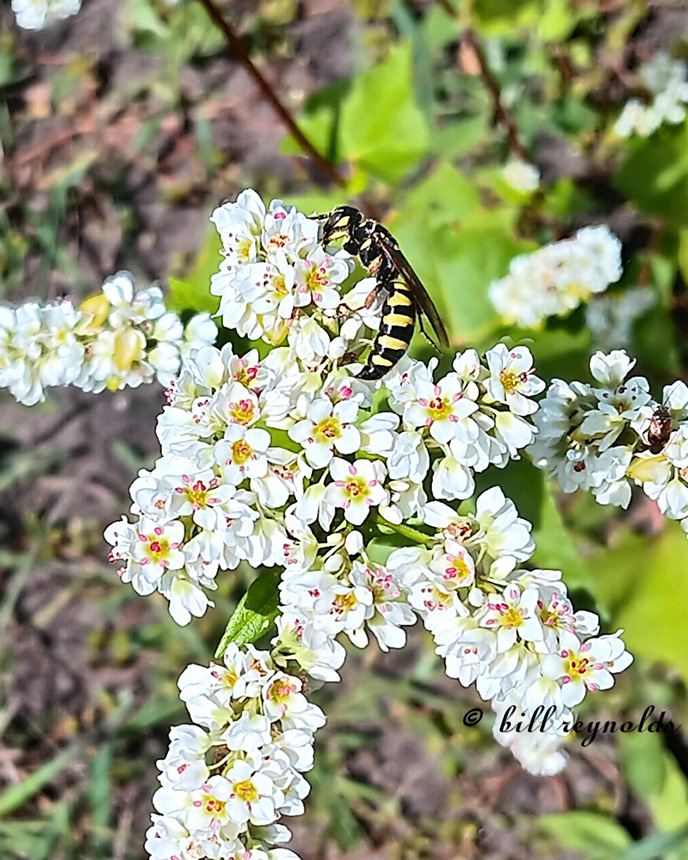
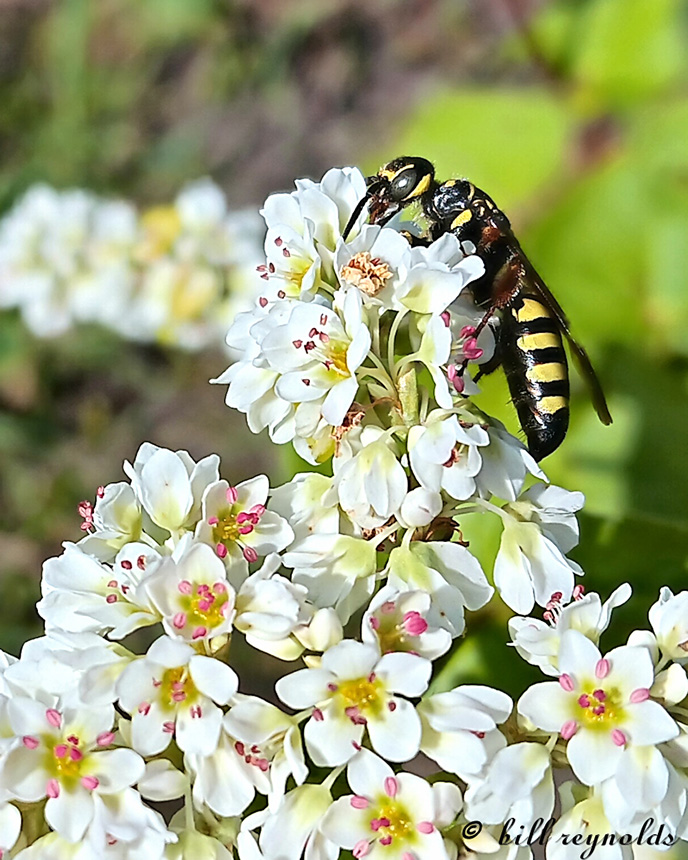
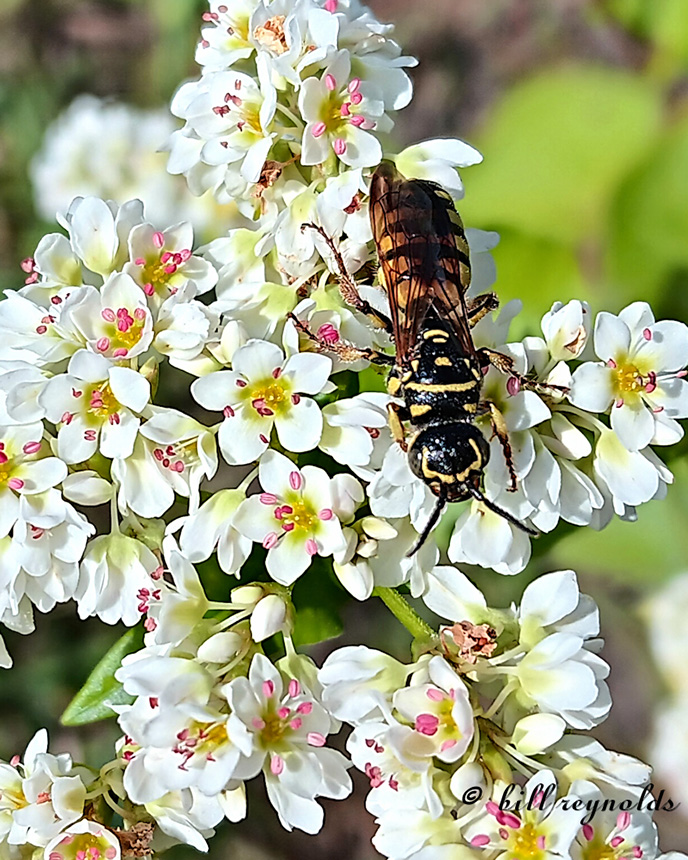
First frost of this fall happened this morning, so I was out looking at what plants were affected. On one of the Buckwheat blossums I found this wasp. … |
||
 |
 |
|
 |
||
MinnesotaSeasons.com Photos

Slideshows

Visitor Videos
Share your video of this insect.
This button not working for you?
Simply email us at info@MinnesotaSeasons.com.
Attach a video, a YouTube link, or a cloud storage link.
Other Videos
THYNNID WASP, Myzinum maculatum missing abdomen 9047777
Rob Curtis

Visitor Sightings
Report a sighting of this insect.
This button not working for you?
Simply email us at info@MinnesotaSeasons.com.
Be sure to include a location.
Bill Reynolds
9/7/2025
Location: Numedal TWP., Pennington Co., Minnesota
First frost of this fall happened this morning, so I was out looking at what plants were affected. On one of the Buckwheat blossums I found this wasp. …

Minnesota Seasons Sightings