



Michigan lily
(Lilium michiganense)
Conservation • Wetland • Description • Habitat • Ecology • Use • Distribution • Taxonomy
|
|
||||||||||||||||||||||||
Description |
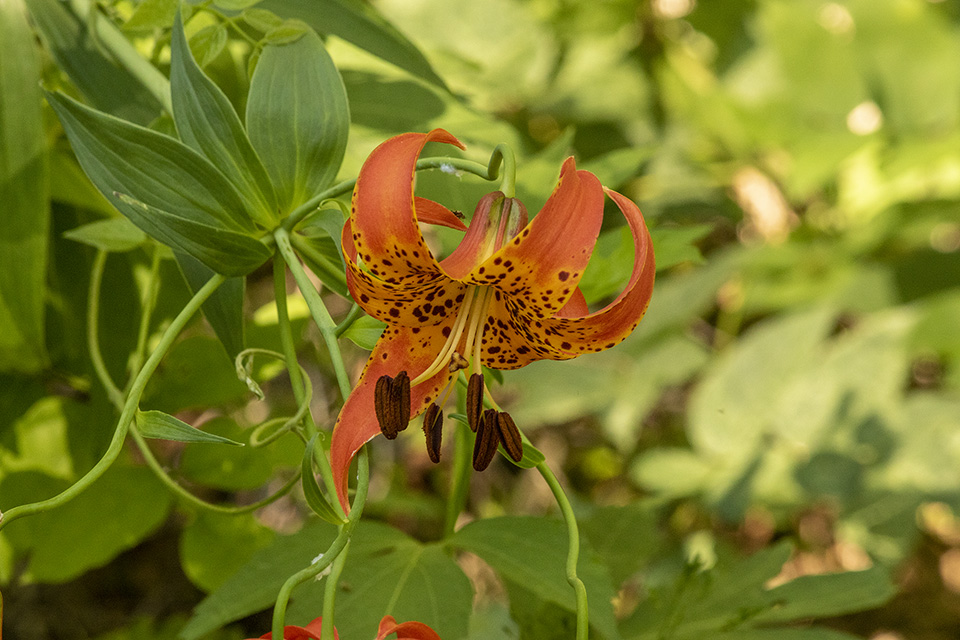
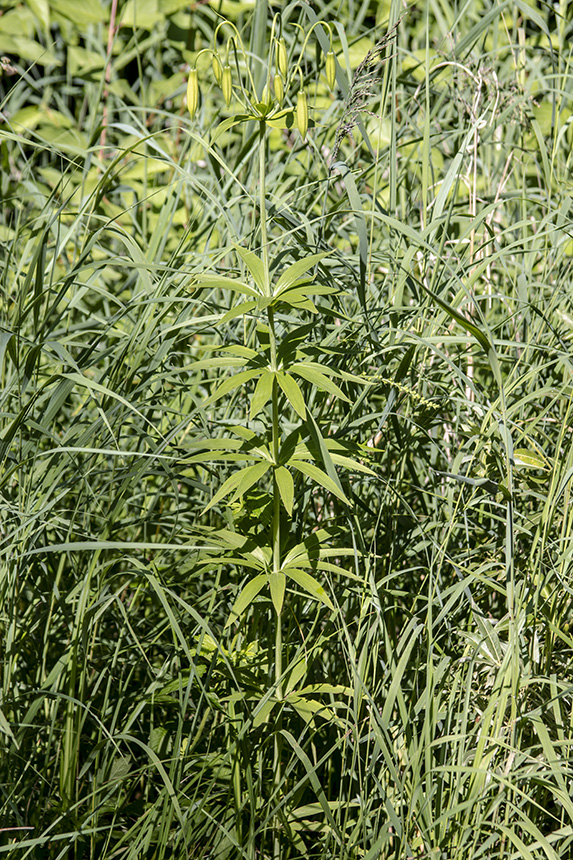
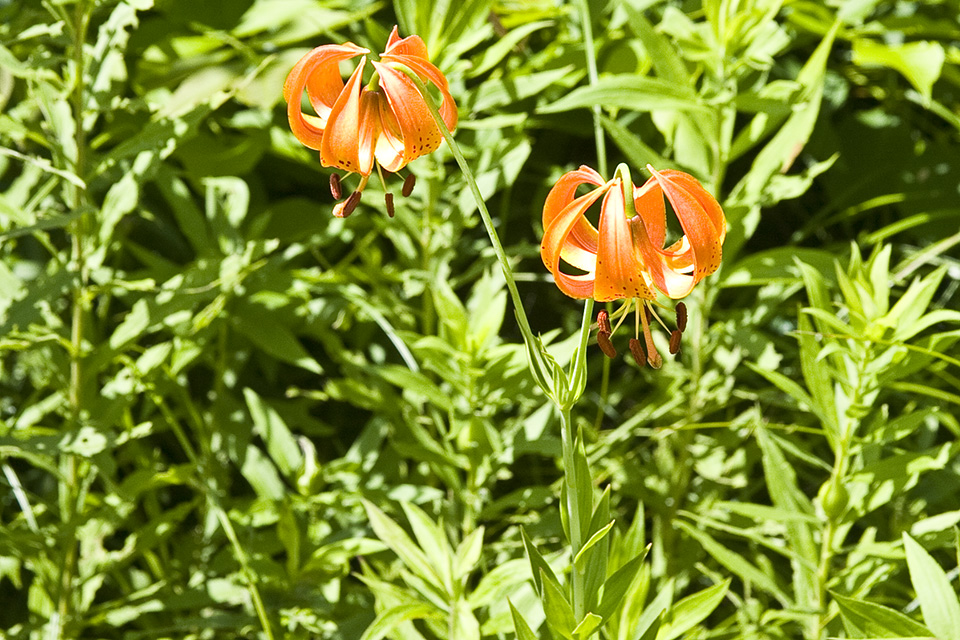
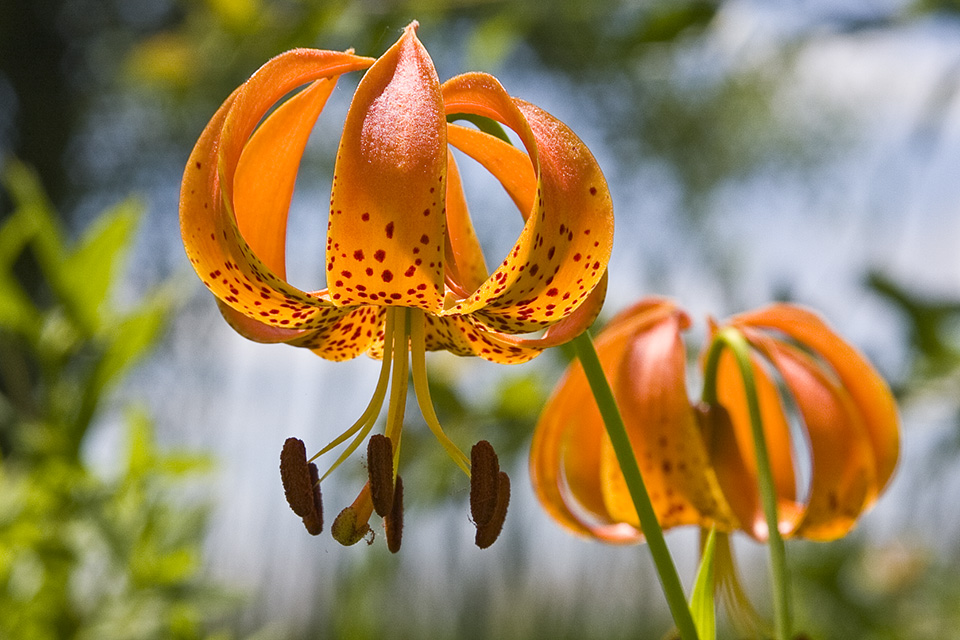
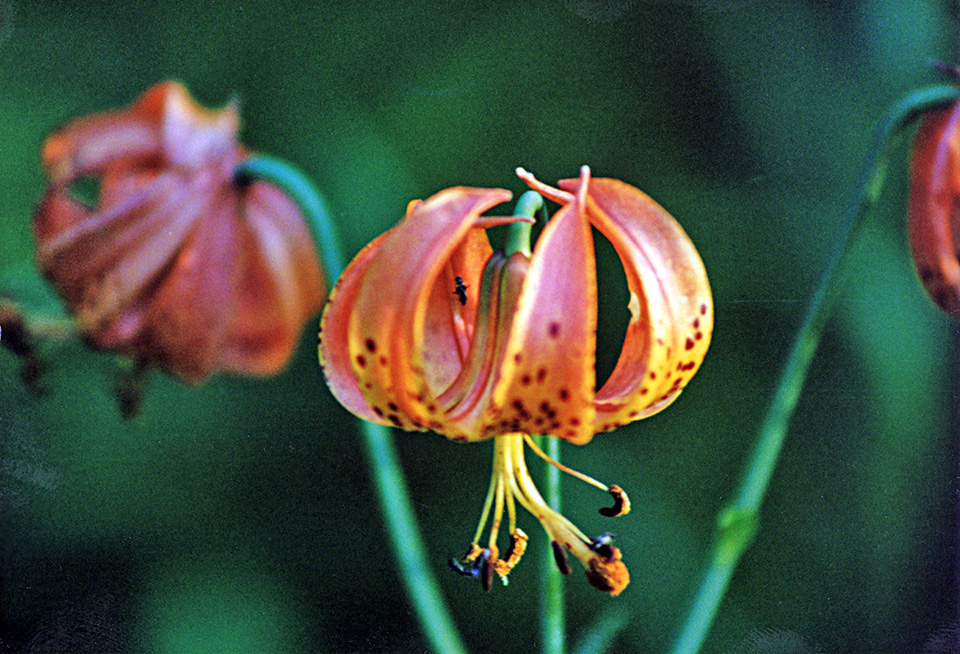
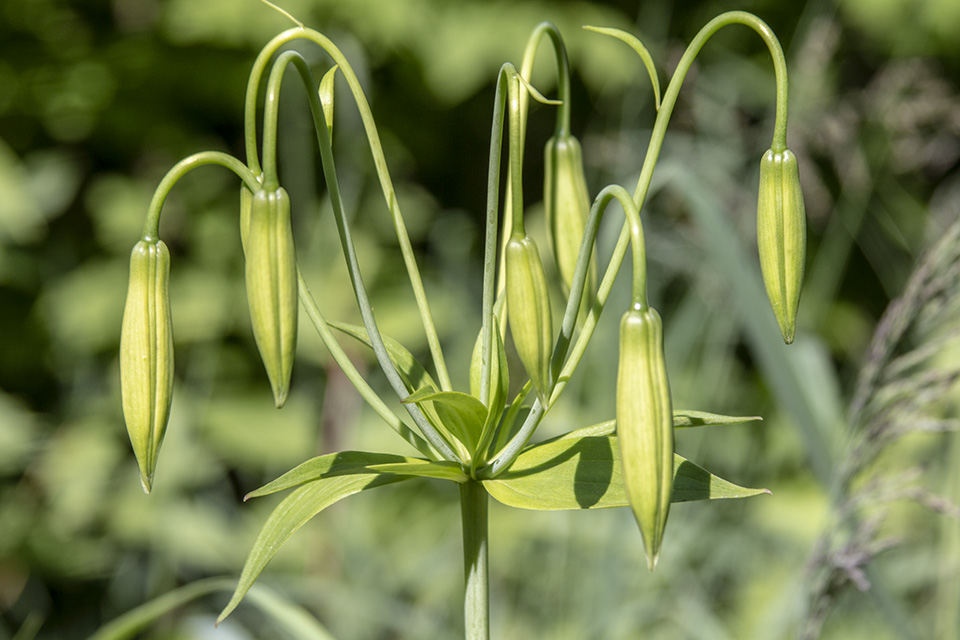
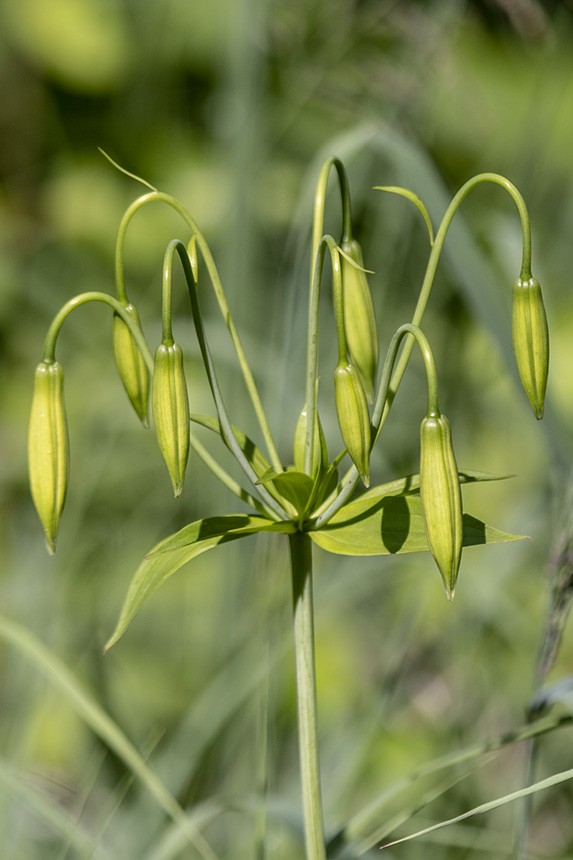
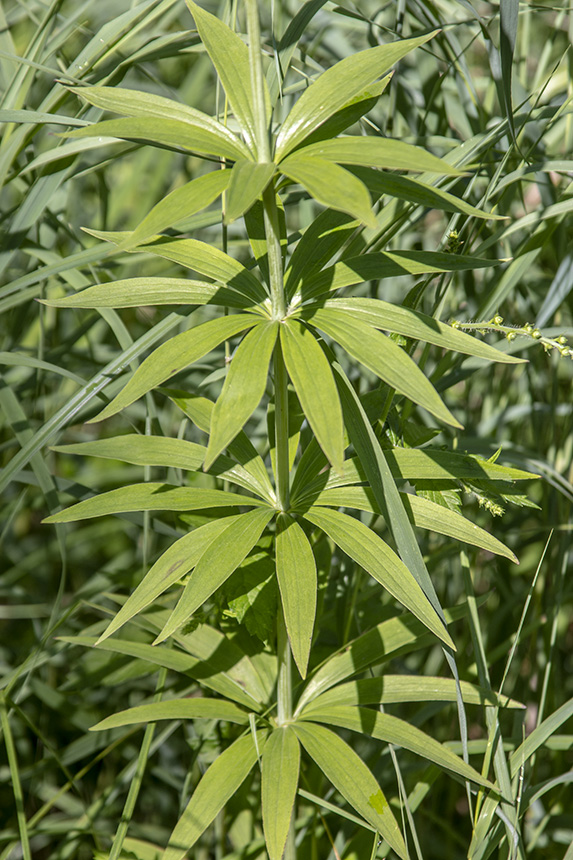
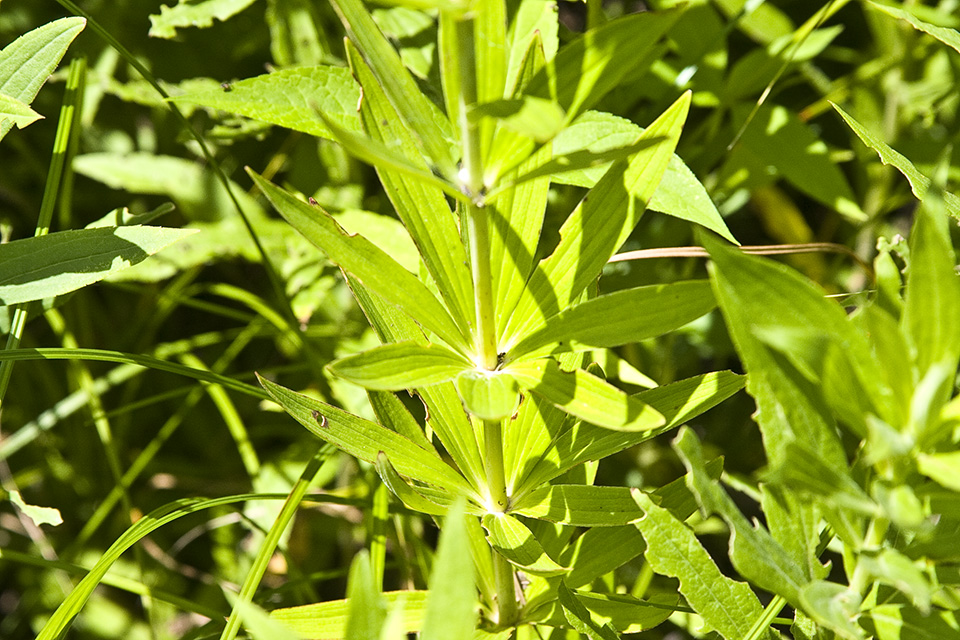
Michigan lily is an erect, hairless, unbranched perennial rising from a yellowish, unbranched bulb and underground horizontal stem (rhizome). The stem is hairless, round, and unbranched below the inflorescence. The leaves appear in whorls of 3 to 7 along the stem. There may also be leaves on the upper stem appearing singly, in pairs, or in partial whorls. The leaves are 1¾″ to 5″ long, ¼″ to 1″ wide, narrowly lance-shaped, and taper to both ends. The tips droop when the sky is overcast, and become horizontal or ascending in the sun. They are stalkless, untoothed, hairless, and have parallel venation. The underside of the leaves are rough to the touch due to minute, pointed projections on the outermost cellular layer along the veins and margins. The inflorescence is a terminal cluster of 1 to 6 flowers arising from a single point at the top of the stem (umbel). The flowers hang downward at the end of 3″ to 5″ long flower stems that spread upward. One or more flower stems may also appear from upper leaf axils. The large flowers are 2½″ to 3″ wide, Turk’s-cap shaped, and are not fragrant. They consist of 6 tepals, 3 inner tepals (petals) that are similar in appearance but somewhat wider and shorter than the 3 outer tepals (sepals). The tepals spread outward and bend backward to their base. They are reddish-orange with a yellowish-orange throat and purple or maroon spots near the throat. The stamens project well beyond the tepals and curve outward. The fruit is a 3-celled seed capsule. |
Height |
3′ to 6′ |
Flower Color |
Reddish-orange with maroon spots |
Similar Species |
Orange daylily (Hemerocallis fulva) is shorter, 2′ to 4′ at maturity. It has a basal rosette of grass-like leaves and no leaves on the flowering stem. The inflorescence consists of a few small, elongated clusters of flowers, not umbels, at the end of each scape branch. The flowers are up to 4″ wide, funnel-shaped, tannish-orange with a yellow throat separated by a red stripe. They do not have spots near the throat. They are semi-erect or horizontal—they do not hang downward. They last only one day. Tiger lily (Lilium lancifolium) has a central stalk that is densely covered with long, tangled, white hairs, especially near the top. It has only alternate leaves. There are 1 to 3 small dark purple bulblets in the axils of the upper leaves. The inflorescence is a terminal, branched, elongated, cluster, not an umbel. The flowers are up to 4″ wide and uniformly orange to reddish-orange—they do not have yellow or yellowish throats. They have purple-brown spots except near the tips, not just near the throat. Wood lily (Lilium philadelphicum var. andinum) is much shorter, 1′ to 3′ at maturity. The leaves are scattered, more or less alternate, except the uppermost, which are in a whorl. The inflorescence is 1 to 3 flowers. The flowers are bell shaped and erect—they do not hang downward. The tepals are spoon-shaped, clawed, erect, and flaring, and bend backward slightly toward their tips. The tips come to a blunt point. They do not touch near the base. They are bright orange or reddish-orange with a yellow throat and purple spots near the throat. |
Habitat |
Moist to wet. Tallgrass prairies, meadows, streambanks, swamps, bogs, bottoms, woodland edges, roadside and railroad ditches. Full or partial sun. |
Ecology |
Flowering |
| July to August |
Faunal Associations |
Michigan lily is pollinated primarily by swallow-tail butterflies. |
Pests and Diseases |
|
Use |
|
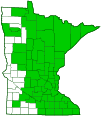
Distribution |
||
|
Sources |
|
| 5/13/2025 | ||
Nativity |
||
Native |
||
Occurrence |
||
Uncommon |
||
Taxonomy |
|
Kingdom |
|
Subkingdom |
Pteridobiotina |
Phylum |
Tracheophyta (Vascular Plants) |
Class |
Liliopsida (Monocots) |
Order |
Liliales (Lilies, Supplejacks, and Allies) |
Family |
Liliaceae (Lily) |
Subfamily |
Lilioideae (true liliy) |
Tribe |
Lilieae (true lilies and allies) |
Genus |
Lilium (true lilies) |
Section |
Pseudolirium |
Subordinate Taxa |
|
|
|
Synonyms |
|
Lilium canadense ssp. michiganense Lilium canadense var. umbelliferum Lilium michiganense var. umbelliferum Lilium michiganense var. uniflorum Lilium superbum |
|
Common Names |
|
American turk’s-cap lily lily-royal Michigan lily swamp lily turk’s-cap turk’s-cap lily |
|
Glossary
Axil
The upper angle where the leaf stalk meets the stem.
Rhizome
A horizontal, usually underground stem. It serves as a reproductive structure, producing roots below and shoots above at the nodes.
Sepal
An outer floral leaf, usually green but sometimes colored, at the base of a flower.
Tepal
Refers to both the petals and the sepals of a flower when they are similar in appearance and difficult to tell apart. Tepals are common in lilies and tulips.
Umbel
A flat-topped or convex umbrella-shaped cluster of flowers or buds arising from more or less a single point.
Visitor Photos |
||
Share your photo of this plant. |
||
This button not working for you? |
||
Greg Watson |
 |
MinnesotaSeasons.com Photos |
||
 |
 |
|
Inflorescence |
||
|
||
|
||
Plant |
|
|
 |
 |
|
Flower |
Flower |
|
 |
 |
|
Flower |
||
|
||
|
||
Flower |
|
|
 |
 |
|
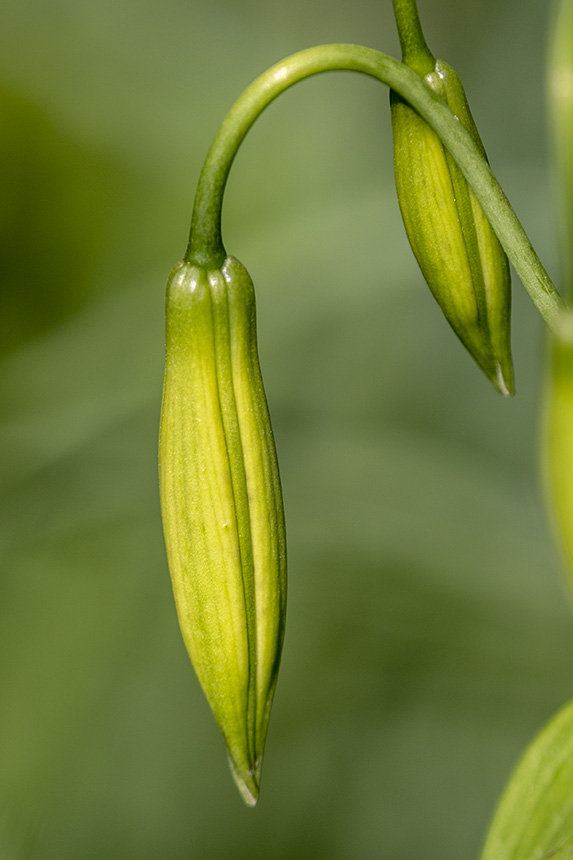
Budding inflorescence |
Budding inflorescence |
|
 |
 |
|
Budding inflorescence |
Bud |
|
 |
|
|
| Bud | ||
|
Leaves |
|
 |
 |
|
Leaves |
Leaves |

Slideshows |
|

Visitor Videos |
||
Share your video of this plant. |
||
This button not working for you? |
||
|
Other Videos |
||
June 21, 2012 Michiganense |
About
Published on Jul 2, 2012 Lilium michiganense in bloom |
Michigan Lilies |
About
Uploaded on Jun 14, 2011 At the Bluff Spring Fen Nature Preserve in Elgin, Illinois on July 5, 2009. |

Visitor Sightings |
||
Report a sighting of this plant. |
||
This button not working for you? |
||
| Greg Watson 6/30/2021 |
Location: along the Root River State Trail near the Houston, MN Trailhead |
|

| Kathy & Douglas Wood 1994 to present |
Location: 3835 Pine Point Road, Sartell MN 56377 We live on 11 acres of 100+ year old white and red pines, balsam fir and mixed deciduous along the Mississippi River. The lilies have been here since before we moved here 25 years ago. Several years ago I transplanted some from our woods to a spot along our garage as the deer were eating them off every year and I feared for their survival. They number several dozen now and should bloom in the next week or two. One of my favorite flowers! |
|
MinnesotaSeasons.com Sightings |
||
|
Created: 10/7/2005 Last Updated: © MinnesotaSeasons.com. All rights reserved. |