



orange daylily
(Hemerocallis fulva)
Conservation • Wetland • Description • Habitat • Ecology • Use • Distribution • Taxonomy
Conservation Status |
|
|||||||
| IUCN Red List | not listed |
|||||||
| NatureServe | NNA - Not applicable SNA - Not applicable |
|||||||
| Minnesota | not listed |
|||||||
Wetland Indicator Status |
||||||||
| Great Plains | FACU - Facultative upland |
|||||||
| Midwest | UPL - Obligate upland |
|||||||
| Northcentral & Northeast | UPL - Obligate upland |
|||||||
Description |
||
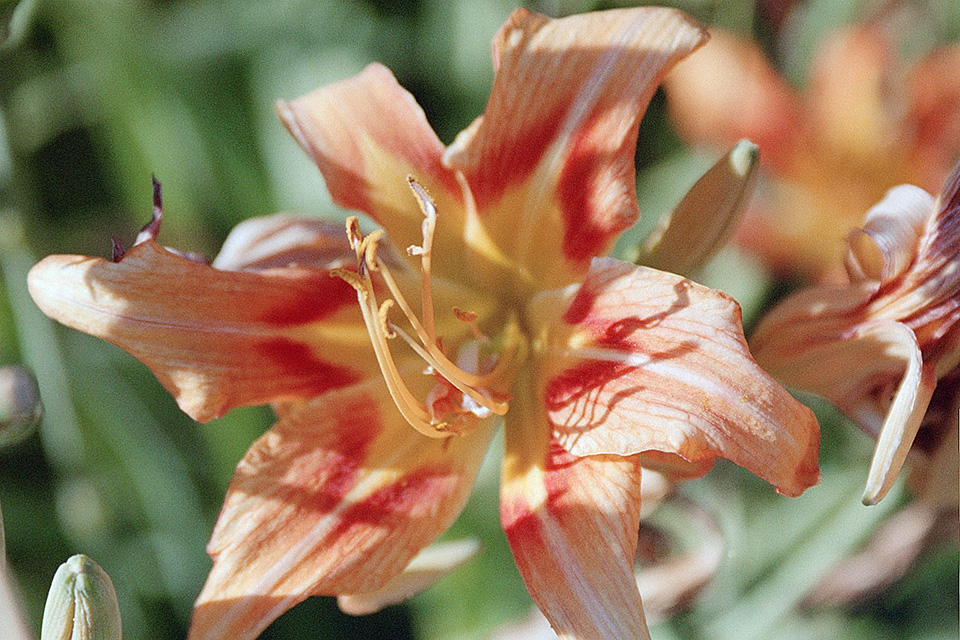
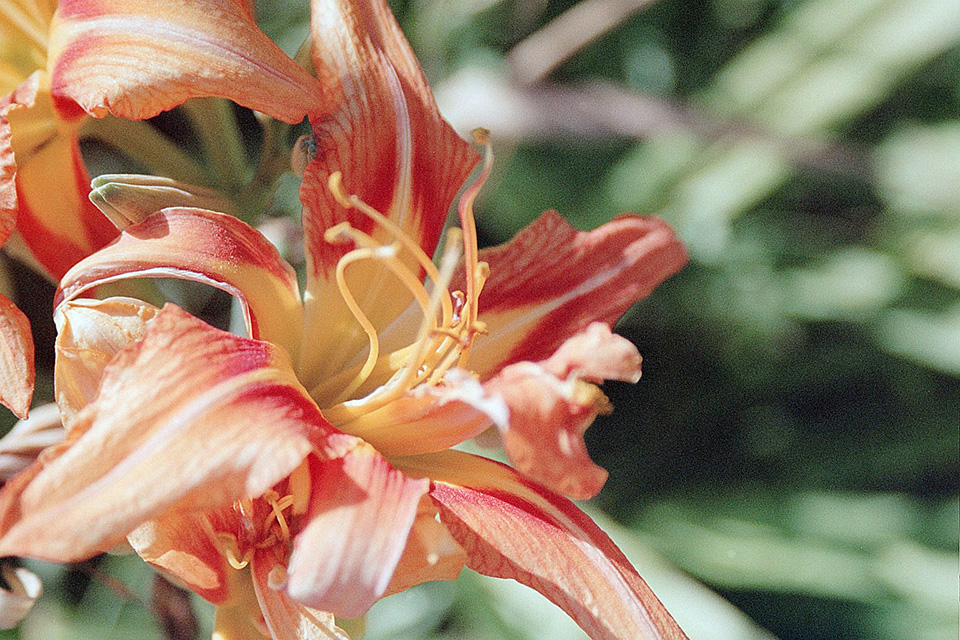
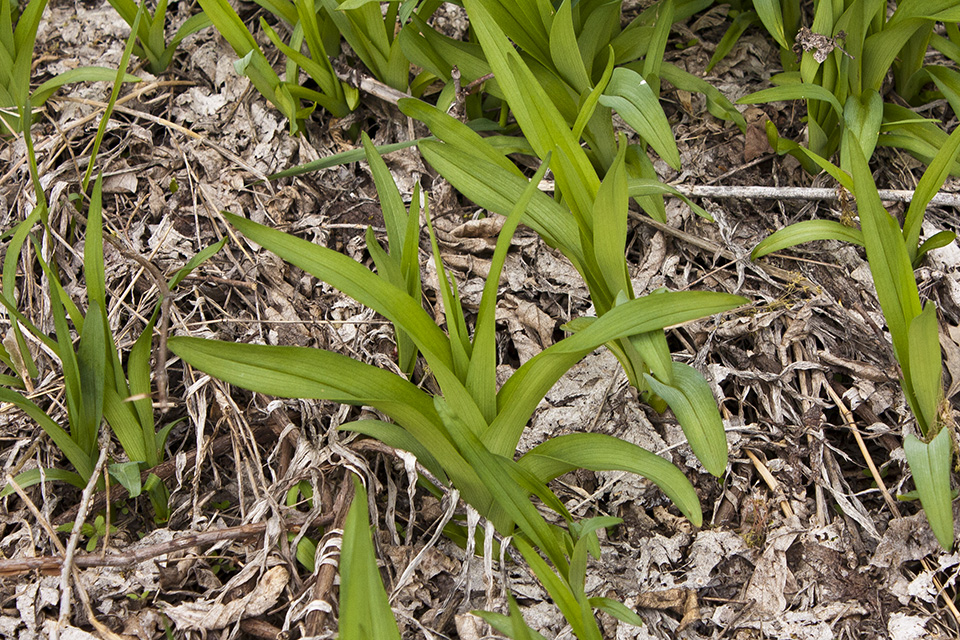
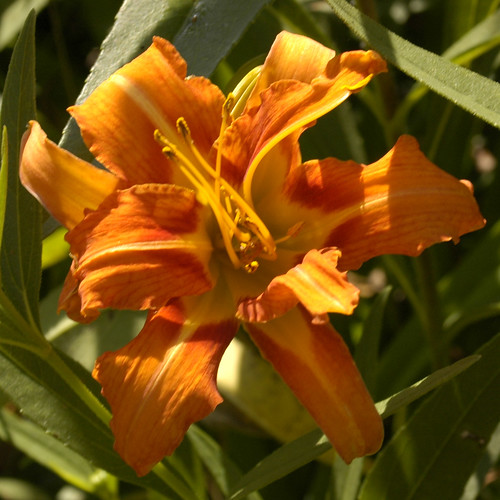
Orange daylily is an erect, long-lived perennial rising from fleshy, fibrous roots and rhizomes. It often forms dense clumps that exclude other species. Grasslike, linear, 1′ to 3′ long, yellowish-green leaves form a basal rosette. They are stalkless, hairless, and linear, tapering gradually to a point. They bend downward around the middle. There is no central stem. One or more hairless flowering stalks (scapes) rise from the center of the basal rosette. They are leafless except for a few small bracts, and unbranched except near the top. The inflorescence consists of a few small, elongated clusters of flowers at the end of each scape branch. The large flowers are up to 4″ wide, funnel-shaped, and are not fragrant. They are semi-erect or horizontal—they do not hang downward. They consist of 6 tepals, 3 inner tepals (petals), with wavy margins, that are similar in appearance but somewhat broader than the 3 outer tepals (sepals), with smooth margins. The tepals spread outward and bend backward toward their tips. They are tannish-orange with a yellow throat separated by a band of red. They do not have spots near the throat. The flowers bloom during the day and last only a single day. The fruit rarely developes, but when it does it is a 3-celled seed capsule. The seeds are infertile. The plant reproduces from root or rhizome fragments. |
||
Height |
||
2′ to 4′ |
||
Flower Color |
||
Tannish-orange with a yellow throat and a red stripe |
||
Similar Species |
||
Michigan lily (Lilium michiganense) is taller, 3′ to 6′ at maturity, with a leafy central stalk. The leaves are whorled except near the top, where they are single, in pairs, or in partial whorls. The inflorescence is an umbel. The flowers are 2½″ to 3″ wide, Turk’s-cap shaped, with tepals that bend backward to their base. They are reddish-orange with yellowish-orange throat and purple or maroon spots near the throat. They last more than one day. Tiger lily (Lilium lancifolium) is taller, 3′ to 6′ at maturity, with a leafy central stalk. The flowers hang downward at the end of stout, widely spreading flower stems. They are Turk’s-cap shaped, reddish-orange with yellowish-orange throat and purple or maroon spots near the throat. They last more than one day. Wood lily (Lilium philadelphicum var. andinum) is shorter, 1′ to 3′ at maturity. It has 1 to 3 flowers at the top of a leafy stem. The leaves are 2″ to 4″ long. The flowers are 2½″ wide, widely bell shaped, and erect. The tepals are spoon-shaped, erect, and flaring, and bend backward slightly toward their tips. They do not touch near the base. They are bright orange or reddish-orange with yellow throat and purple spots near the throat. They last more than one day. |
||
Habitat |
||
Gardens, woodland edges, open forests, stream banks, roadsides. Full or partial sun. |
||
Ecology |
||
Flowering |
||
June to August |
||
Pests and Diseases |
||
|
||
Use |
||
|
||
Distribution |
||||
|
Sources |
|||
| 5/24/2023 | ||||
Nativity |
||||
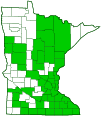
Native to Asia and India. Introduced, escaped from cultivation, and naturalized in North America. |
||||
Occurrence |
||||
|
||||
Taxonomy |
|||
| Kingdom | Plantae (Plants) | ||
| Subkingdom | Pteridobiotina | ||
| Phylum | Tracheophyta (Vascular Plants) | ||
| Class | Liliopsida (Monocots) | ||
Order |
Asparagales (Agaves, Orchids, Irises, and Allies) | ||
Family |
Asphodelaceae (asphodels) | ||
| Subfamily | Hemerocallidoideae (daylilies and allies) | ||
Genus |
Hemerocallis (daylilies) | ||
The genus Hemerocallis was formerly placed in the family Liliaceae. Under the APG I system in 1998 Hemerocallis became the only genus in the family Hemerocallidaceae. With the APG II system in 2003 it was an option to group Asphodelaceae sensu stricto, Hemerocallidaceae and Xanthorrhoeaceae, into a single family with the name Xanthorrhoeaceae. When the APG III system was published in 2009 the combined family was kept but the option was dropped. The family kept the name Xanthorrhoeaceae. The APG IV system, published in 2016, chose to preserve the name Asphodelaceae because it has priority, having been used earlier than Xanthorrhoeaceae. Hemerocallis is now in the family Asphodelaceae. |
|||
Subordinate Taxa |
|||
Seven varieties of orange daylily are recognized worldwide. Only the nominate variety, var. fulva, occurs in North America. When the nominate infraspecies is the only one occurring in North America, North American taxonomies usually drop the infraspecies epithet. Consequently, Hemerocallis fulva var. fulva becomes simply Hemerocallis fulva in North America. |
|||
Synonyms |
|||
Hemerocallis lilioasphodelus var. fulvus |
|||
Common Names |
|||
fulvous day-lily fulvous daylily orange day lily orange day-lily orange daylily tawny day-lily tawny daylily |
|||
Glossary
Linear
Long, straight, and narrow, with more or less parallel sides, like a blade of grass.
Rhizome
A horizontal, usually underground stem. It serves as a reproductive structure, producing roots below and shoots above at the nodes.
Scape
An erect, leafless stalk growing from the rootstock and supporting a flower or a flower cluster.
Sepal
An outer floral leaf, usually green but sometimes colored, at the base of a flower.
Tepal
Refers to both the petals and the sepals of a flower when they are similar in appearance and difficult to tell apart. Tepals are common in lilies and tulips.
Visitor Photos |
|||||
Share your photo of this plant. |
|||||
| This button not working for you? Simply email us at info@MinnesotaSeasons.com. Attach one or more photos and, if you like, a caption. |
|||||
|
|||||
MinnesotaSeasons.com Photos |
|||||
Plant |
|||||
 |
|||||
Flower |
|||||
 |
 |
||||
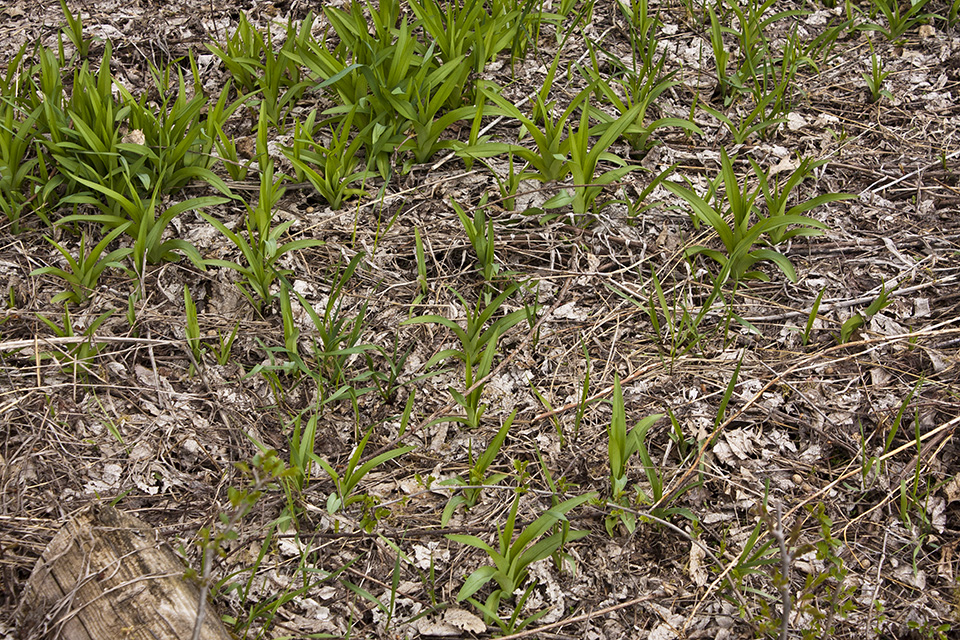
Early Spring |
|||||
 |
 |
||||

Slideshows |
||
| Hemerocallis fulva ORANGE DAY LILY Frank Mayfield |
||
|
||
Visitor Videos |
|||
Share your video of this plant. |
|||
| This button not working for you? Simply email us at info@MinnesotaSeasons.com. Attach a video, a YouTube link, or a cloud storage link. |
|||
Other Videos |
|||
| Orange Day Lily Hemerocallis fulva wvoutdoorman |
|||
About
Published on Jun 26, 2012 Orange Day Lily Hemerocallis fulva |
|||
| orange day lily mileswales |
|||
About
Published on Jul 7, 2012 its orange see some more of my time lapse videos: |
|||
| Incredible secrets of the daylily! capecast |
|||
About
Uploaded on Jun 23, 2010 On today's CapeCast: They're orange, they're edible and they're everywhere! Find out how old school daylilies became king of the flowers on Cape with Roberta Clark, Barnstable County horticulturist. |
|||
| ...elfi's wilder Garten....Taglilie... elfi isiskristall |
|||
About
Published on Jun 15, 2014 ....Gelbrote Taglilie (Hemerocallis fulva) im "Wild-Garten"...Juni 2014 |
|||

Visitor Sightings |
|||||
Report a sighting of this plant. |
|||||
| This button not working for you? Simply email us at info@MinnesotaSeasons.com. Be sure to include a location. |
|||||
|
|||||
MinnesotaSeasons.com Sightings |
|||||
|
Created: Last Updated: © MinnesotaSeasons.com. All rights reserved. |