American Lady - Species Profile
Conservation • Description • Habitat • Ecology • Distribution • Taxonomy

Conservation Status
IUCN Red List
not listed
NatureServe
N5 - Secure
S5B - Secure Breeding
Minnesota
not listed
Description
American Lady is a medium- to large-sized, brushfooted butterfly. It has a wingspan of 1¾″ to 2⅝″. Females are very slightly larger but cannot be distinguished in the field. The summer form is larger and brighter orange, the winter form is paler and has smaller black marks.
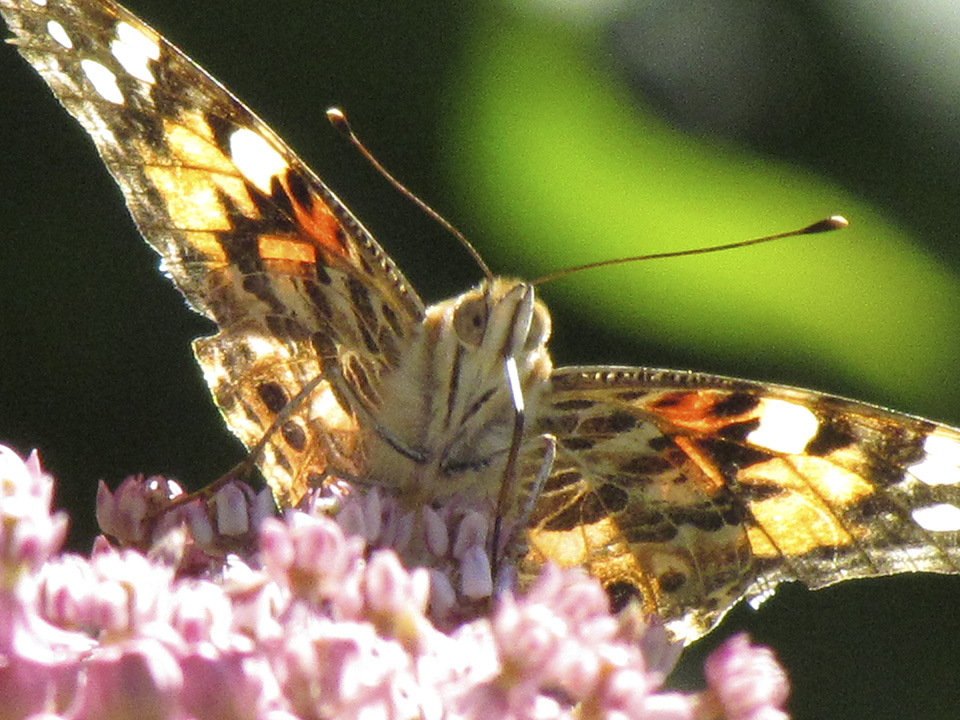
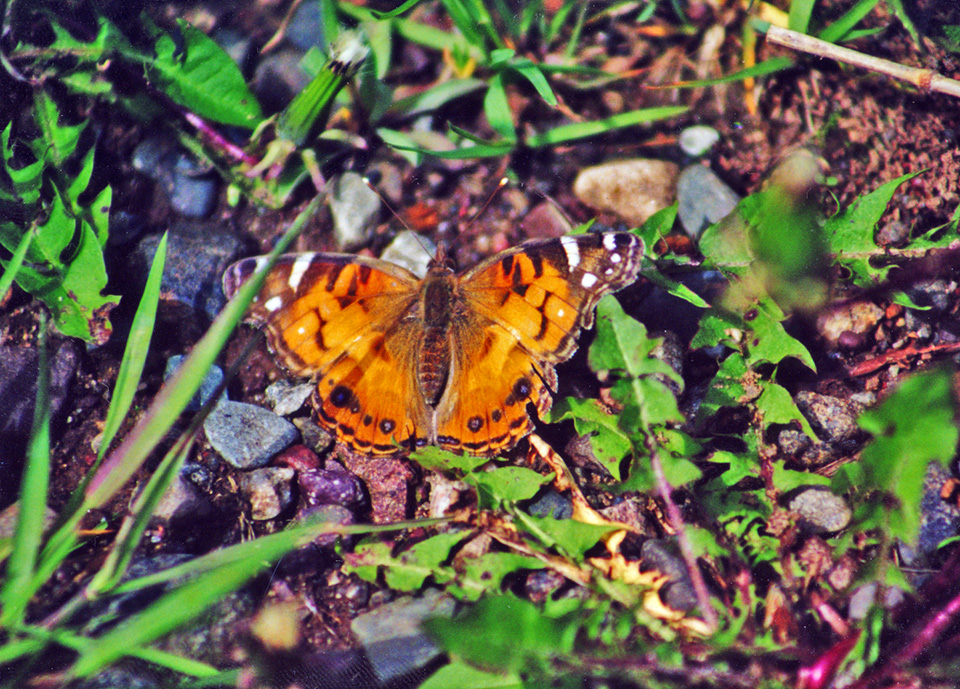
The outer edge of the forewing is slightly scalloped with an elongated, squared off tip (apex). The upperside of the forewing is orange with an orangish-brown patch at the base; three irregular, black, disconnected, median spots; and a jagged, black, median to postmedian line. The margin has a broad, black border with a row of white, crescent-shaped marks (lunules) and a black and white fringe. The apical area is black with a large, elongated, postmedian, pale orange spot at the leading (costal) edge and a curved row of four smaller, round, submarginal, white spots. Most individuals have a small white spot in the cubital cell. In some individuals the spot is minute or missing.
The hindwing is rounded and slightly scalloped with a black-and-white fringe. The upper side of the hindwing is orange with a brownish-orange patch at the base and four bands of black spots: a marginal band of six mostly disconnected spots; a submarginal band of six flattened, mostly connected spots, the inner spot (closest to the body) with a blue center; a postmedian band of four round, often connected spots, usually one or more with blue centers; and a median band of four faint, irregular, more or less connected spots.
The underside of the forewing is pinkish-orange near the base and grayish-brown in the apical area, with white and black markings mirroring those on the upper surface.
The underside of the hindwing is irregularly banded and mottled at the base with light and dark brown edged with white. There is a broad, pale, median band and a broader, brown, postmedian band. In the postmedian band there are two large, brown eyespots with black borders and blue centers. There is a submarginal row of eight flattened, connected, blue spots rimmed with black; and two thin, black, marginal lines. White, cobweb-like lines extend from the base outward, ending in the postmedian band.
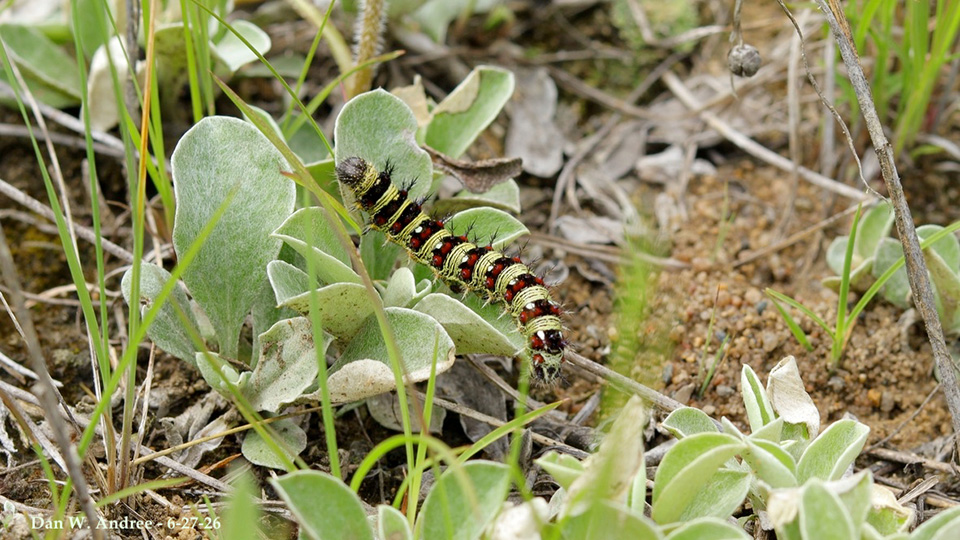
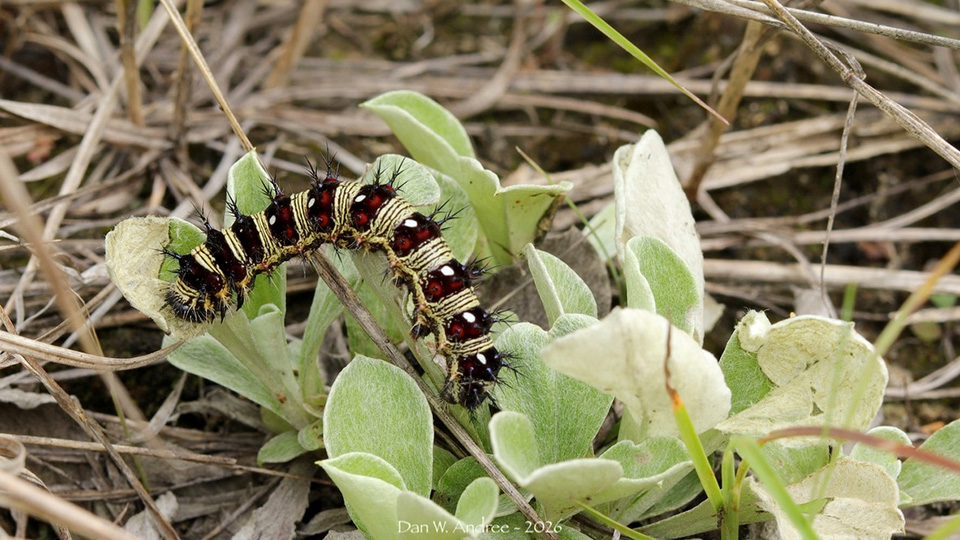
The caterpillar is up to 1 9 ⁄16″ long and is somewhat variable in color. Though fierce looking, they are harmless to the touch. The thorax and abdomen are black with a series of fine, white or greenish-yellow bands at the leading and trailing edge of each thoracic and abdominal segment. Most individuals have a row of subdorsal white spots on abdominal segments 2 through 8. On the thorax and each abdominal segment there is a long, thick, stiff, branched spine (scolus) in the middorsal, subdorsal, and supraspiracular, supraspiracular regions. The expanded, wart-like base of each scolus is red. The head is black and is densely covered with long, straight, unbranched, white hair-like structures (seta) but no scoli. The base of the leg-like structure (proleg) is densely hairy.
Mature caterpillars are found from May to June and from July onward.
Size
Wingspan: 1¾″ to 2⅝″
Similar Species
Painted lady (vanessa cardui) is less orange above. The large spot in the apical area of the upperside of the forewing is always white. The submarginal white spots in the apical area are larger. The black medial band creates an isolated orange spot. There is no white spot in the cubital cell. The postmedial spots on the hindwing are smaller and disconnected, and on the winter form do not have blue centers. There are four eyespots on the underside of the hindwing, and those eyespots are much smaller. There is no pale median band inward from the eyespots.
Habitat
Fields, meadows, flood plains, parks, vacant lots, forest clearings, power line right-of-ways, beach dunes, and other open places with low vegetation.
Ecology
Season
Two or three broods: May to mid-June and mid-July to early October.
Behavior
Late stage caterpillars create solitary shelters by folding upward the sides of the leaf and securing it with silk.
Life Cycle
The male perch on vegetation, on a hilltop when available, waiting for a receptive female to fly by. After mating, the female lays yellowish-green eggs singly on the upperside of host plant leaves. The larva molts four times before pupating. There are two or three generations each year. The last generation adult migrates south in early October, overwinters in a warmer area, returns north in early May, and dies by mid-June.
Larva Food/Hosts
Mostly field pussytoes (Antennaria neglecta), Parlin’s pussytoes (Antennaria parlinii), pearly everlasting (Anaphalis margaritacea), plantain-leaved pussytoes (Antennaria plantaginifolia), rabbit-tobacco (Pseudognaphalium obtusifolium), but sometimes also burdock (Arctium spp.), wormwood (Artemisia spp.), and ironweed (vernoni spp.).
Adult Food
Flower nectar
Distribution

Sources
6, 7, 21, 22, 24, 27, 30, 75, 82, 83.
Biodiversity occurrence data published by: Minnesota Biodiversity Atlas (accessed through the Minnesota Biodiversity Atlas Portal, bellatlas.umn.edu. Accessed 7/9/2026).
Vanessa virginiensis (Drury, 1773) in Bánki, O., Roskov, Y., Döring, M., Ower, G., Hernández Robles, D. R., Plata Corredor, C. A., Stjernegaard Jeppesen, T., Örn, A., Pape, T., Hobern, D., Garnett, S., Little, H., DeWalt, R. E., Miller, J., Orrell, T., Aalbu, R., Abbott, J., Abreu, C., Acero P, A., et al. (2026). Catalogue of Life (2026-06-19 XR). Catalogue of Life Foundation, Amsterdam, Netherlands. https://doi.org/10.48580/dgy8b
Quinn, Edward. M., and Ron Danielson. April 27, 2009. A Survey of Lepidoptera in Three Priority Areas of the Minnesota State Parks System. https://files.dnr.state.mn.us/eco/nongame/projects/consgrant_reports/2009
/2009_quinn_danielson.pdf.
Occurrence
Taxonomy
Order
Lepidoptera (Butterflies and Moths)
Superfamily
Papilionoidea (Butterflies)
Family
Nymphalidae (Brush-footed Butterflies)
Subfamily
Nymphalinae (Checkerspots, Anglewings, Peacocks, and Allies)
Tribe
Nymphalini (Ladies, Anglewings, and Allies)
Genus
Vanessa (Ladies and Related Admirals)
Subordinate Taxa
Synonyms
Cynthia simmsi
Cynthia virginiensis
Papilio cardui virginiensis
Papilio huntera
Papilio virginiensis
Pyrameis dallasi
Pyrameis fulvia
Pyrameis huntera
Pyrameis iole
Pyrameis virginiensis
Vanessa ahwashtee
Vanessa huntera
Vanessa massachusettensis
Common Names
American Lady
American Painted Lady