White Admiral - Species Profile
Conservation • Description • Habitat • Ecology • Distribution • Taxonomy

Conservation Status
IUCN Red List
not listed
NatureServe
N5 - Secure
S5 - Secure
Minnesota
not listed
Description
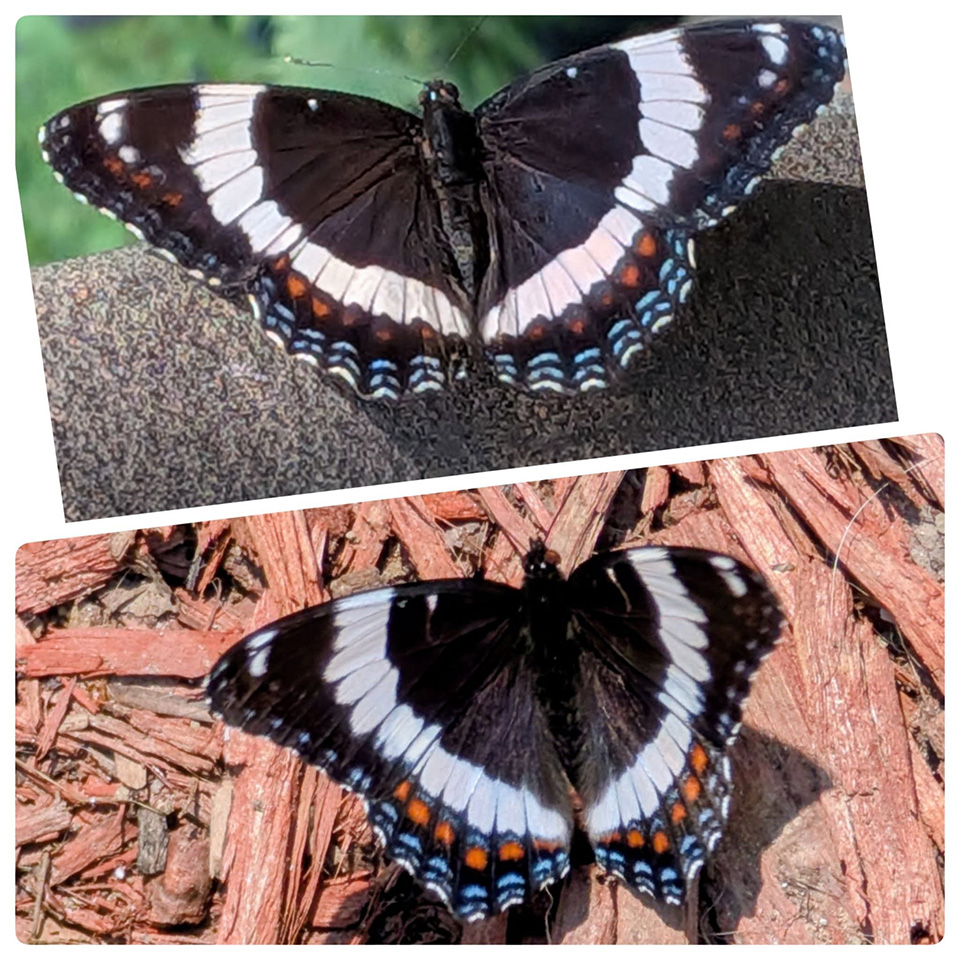
White Admiral is a large brush-footed butterfly with a 3″ to 3½″ wingspan. The male and female are identical in appearance but the female is slightly larger than the male.
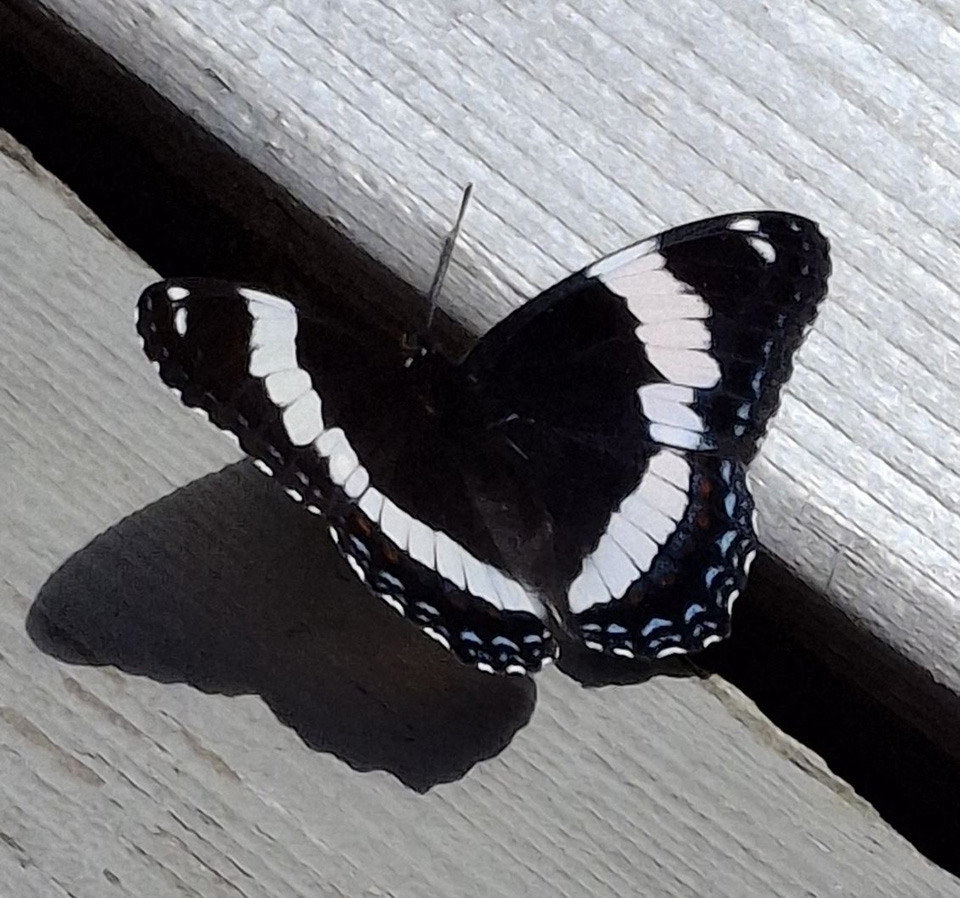
The upperside of both wings is dark bluish-black with a broad, white, postmedial band. The forewing is rounded at the tip. It has a few white spots near the apex and a row of light blue, crescent-shaped, marginal spots. The hindwing has a row of reddish-orange submarginal spots and two rows of light blue, crescent-shaped, marginal spots.
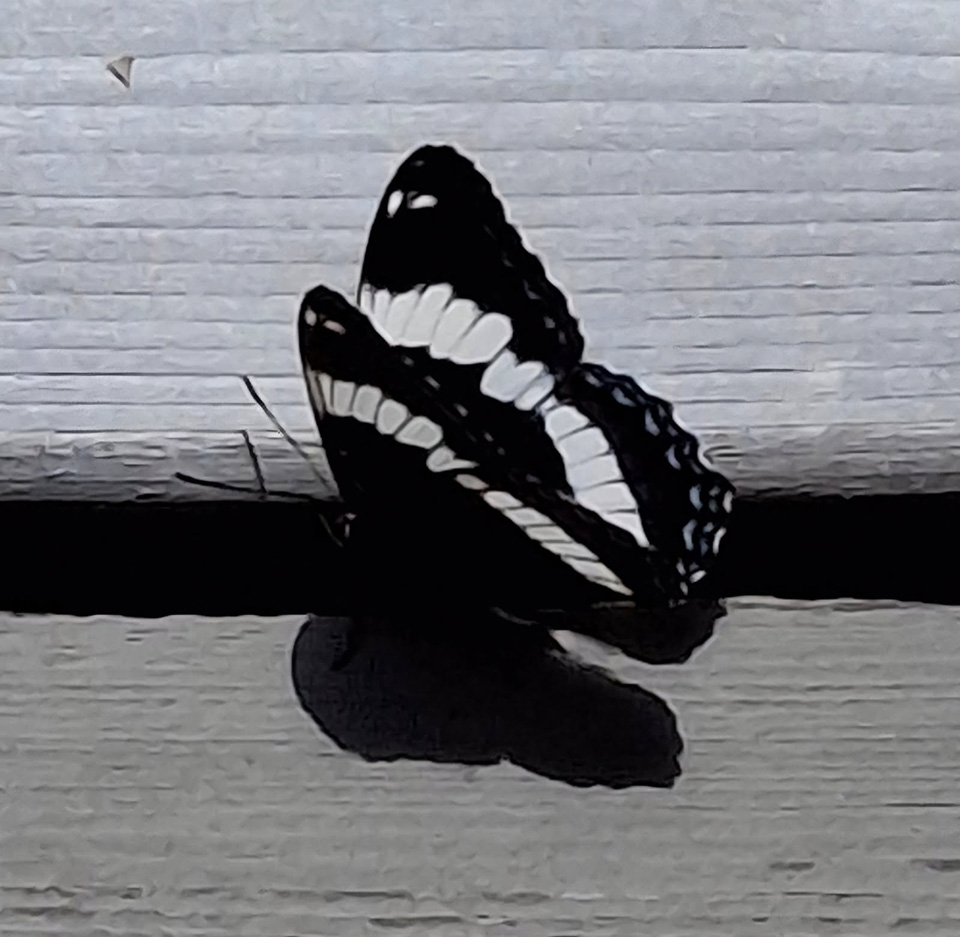
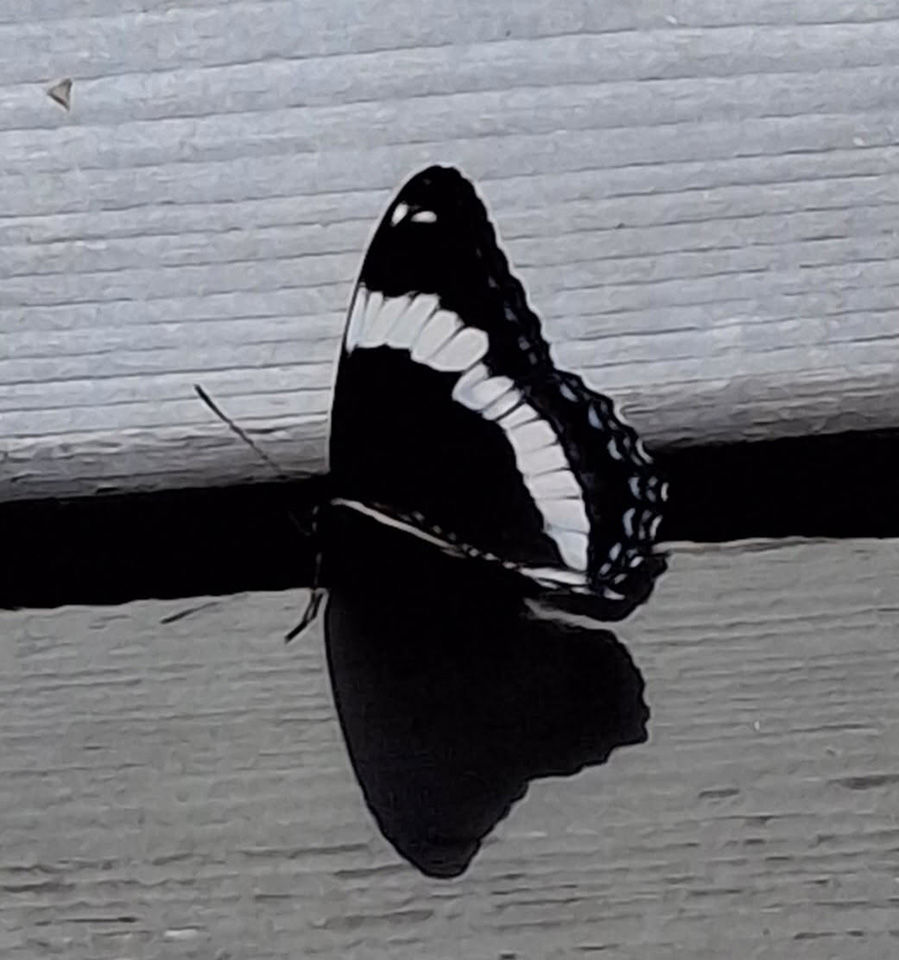
The underside of both wings is dark brown with the white band, submarginal spots, and subapical spots carried through from the upperside. Both wings also have orangish-red and blue spots near the leading edge and two rows of light blue, crescent-shaped, marginal spots.
The caterpillar is up to 2″ long. It is a bird dropping mimic. The thorax and abdomen are mottled medium and dark olive green. A pair of long, black, spiny, branched projections (scoli) extend over the head from a hump on the second thoracic segment. There is a pair of large, greenish-yellow humps on the on the upper (dorsal) side of the second abdominal segment. Each hump is tipped with a small cluster of short white spines. There are similar, smaller humps on the seventh and eighth abdominal segments. A white subspiracular stripe extends from the second to the last abdominal segment. A white “saddle” on the dorsal surface from the fourth through sixth abdominal segments extends down the sides near the middle and merges with the subspiracular stripe. The head is brown and has a pair of short, brown scoli. The prolegs are brown.
Mature caterpillars are found from late May onward.
Size
3″ to 3½″ wingspan
Similar Species
No similar species
Habitat
Forest edges and openings of deciduous broad-leaf forests and or mixed evergreen forests dominated by aspen or birch; roadsides, trails.
Ecology
Season
Two broods: Late May to August; and a partial generation August to early September
Behavior
Adult butterflies are often seen sunning themselves on gravel roads.
Life Cycle
In the fall the third stage caterpillar of the second brood forms a shelter (hibernaculum) by rolling a leaf and tying it with silk. It overwinters in the hibernaculum.
The range of this subspecies overlaps that of the Red-spotted Purple in the lower third of the state. Where the ranges overlap the subspecies interbreed and produce offspring with intergrading characteristics.
Larva Food/Hosts
Usually leaves of birch, willow, quaking aspen, and chokecherry, but also American basswood, plains cottonwood, hawthorn, oak, serviceberry, and other trees.
Adult Food
Sap flows, rotting fruit, aphid honeydew, carrion, dung; rarely flower nectar.
Distribution

Sources
Biodiversity occurrence data published by: Minnesota Biodiversity Atlas (accessed through the Minnesota Biodiversity Atlas Portal, bellatlas.umn.edu. Accessed 6/22/2026).
Limenitis arthemis arthemis (Drury, 1773) in Bánki, O., Roskov, Y., Döring, M., Ower, G., Hernández Robles, D. R., Plata Corredor, C. A., Stjernegaard Jeppesen, T., Örn, A., Pape, T., Hobern, D., Garnett, S., Little, H., DeWalt, R. E., Miller, J., Orrell, T., Aalbu, R., Abbott, J., Abreu, C., Acero P, A., et al. (2026). Catalogue of Life (2026-05-15 XR). Catalogue of Life Foundation, Amsterdam, Netherlands. https://doi.org/10.48580/dgxsq
Occurrence
Common
Taxonomy
Order
Lepidoptera (Butterflies and Moths)
Superfamily
Papilionoidea (Butterflies)
Family
Nymphalidae (Brush-footed Butterflies)
Subfamily
Limenitidinae (Admirals and Allies)
Tribe
Limenitidini
Genus
Limenitis
Species
Limenitis arthemis (Red-spotted Admiral)
Subordinate Taxa
Synonyms
Basilarchia arthemis arthemis
Common Names
American White Admiral
White Admiral