


Emperor moths
(Subfamily Saturniinae)
Overview • Description • Distribution • Taxonomy
Overview
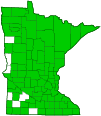
Saturniinae is a subfamily of emperor and giant silk moths (family Saturniidae). They are commonly known as emperor moths or wild silk moths. There are currently 1,391 recognized Saturniinae species in 76 genera, most of them in 2 tribes, worldwide, 17 to 21 species in 8 to 10 genera in 2 tribes in North America north of Mexico, and at least 5 species in 4 genera in 2 tribes in Minnesota.
Emperor moth adults do not feed and they are short lived. They are mostly active at night, often not until a few hours after sunset, and they are attracted to lights. Some rest with their wings spread flat. Many rest with their wings tightly closed over their abdomen. When disturbed, they drop to the ground, mimicking a falling leaf.
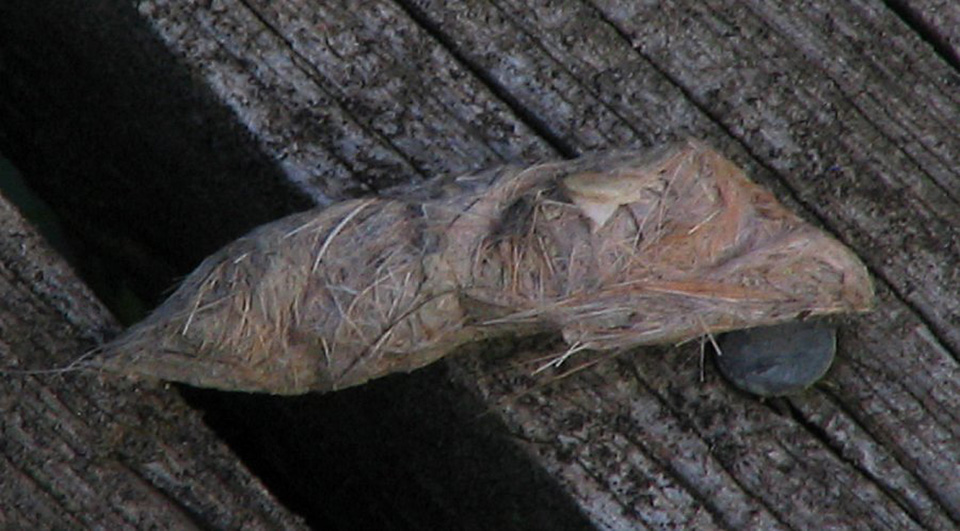
Mature caterpillars overwinter as pupae in a strong, silken cocoon, emerging as adults the following spring.
All attempts to create a silk industry using North American silk moths have failed. The primary source of silk for textiles is domesticated silkmoth (Bombyx mori), as it has been for more than 4,000 years.
Description
Emperor moths are striking, large to very large moths. Their large size may have evolved as a defense against small bats and birds.
On males, the antennae are feathery with two branches on both sides of each segment (quadripectinate). The branches (rami) are long, slender, and straight or only slightly curved. They are well separated at the base, and they continue nearly to the end of the antenna. On the female, the antennae are also quadripectinate except in the genus Saturnia, which does not occur in Minnesota. The rami are much shorter than those on the male.
The wings are broad, membranous, and flat, with very little structural relief or curling. They are essentially flat sheets attached to the body, which contribute to their large surface area and often striking appearance. They have colorful patterns that often include eyespots. There is always a color patch near the tip (apex) of the forewing. It may be a patch nearly at the tip, as in the polyphemus moth, a streak, as in the luna moth, or an eyespot, as in the cecropia moth.
On the legs, the spurs on the fourth segment (tibia) are short and are concealed by hairs on the leg.
The caterpillars are large, robust, and greenish. In some species, hairs (setae) or short spines rise from the tips of pairs of brightly colored raised projections (tubercles). The tubercles may be elongated, knob-like, or almost flat, plate-like. On the eighth abdominal segment the tubercles are united into a single middorsal tubercle. The setae and spines do not sting.
Distribution |
||
|
Sources Biodiversity occurrence data published by: Minnesota Biodiversity Atlas (accessed through the Minnesota Biodiversity Atlas Portal, bellatlas.umn.edu, 12/8/2025). |
|
| 12/8/2025 | ||
Taxonomy
Order
Lepidoptera (Butterflies and Moths)
Superfamily
Bombycoidea (Hawk, Sphinx, Silk, Emperor, and Allied Moths)
Family
Saturniidae (Emperor and Giant Silk Moths)
Subordinate Taxa
The family Saturniinae formerly included five tribes, Attacini, Bunaeini, Micragonini, Saturniini, and Urotini. A recent phylogenetic study of the Family Saturniidae (Reiger et al., 2008) confirmed what was already known from previous morphological studies, that the African tribe Urotini was paraphyletic with respect to tribes Bunaeini and Micragonini. The three tribes are no longer recognized, and the 28 genera formerly assigned to them are now ranked directly within the Subfamily Saturniinae. The two remaining tribes, Attacini and Saturniini, encompass all of the native North American emperor moth genera.
Tribe Attacini 

Tribe Saturniini
Synonyms
Common Names
emperor moths
giant silkmoths
giant silkworm moths
silkmoths
Glossary
Seta
A stiff, hair-like process on the outer surface of an organism. In Lepidoptera: A usually rigid bristle- or hair-like outgrowth used to sense touch. In mosses: The stalk supporting a spore-bearing capsule and supplying it with nutrients. Plural: setae. Adjective: setose.
Tibia
The fourth segment of an insect leg, after the femur and before the tarsus (foot). The fifth segment of a spider leg or palp. Plural: tibiae.
Tubercle
On plants and animals: a small, rounded, raised projection on the surface. On insects and spiders: a low, small, usually rounded, knob-like projection. On slugs: raised areas of skin between grooves covering the body.
Visitor Photos
Share your photo of this insect.
This button not working for you?
Simply email us at info@MinnesotaSeasons.com.
Attach one or more photos and, if you like, a caption.
Bobbi Johnson |
| |
MinnesotaSeasons.com Photos
|

Slideshows

Visitor Videos
Share your video of this insect.
This button not working for you?
Simply email us at info@MinnesotaSeasons.com.
Attach a video, a YouTube link, or a cloud storage link.
Other Videos

Visitor Sightings
Report a sighting of this insect.
This button not working for you?
Simply email us at info@MinnesotaSeasons.com.
Be sure to include a location.
Bobbi Johnson
Fall 2025

Location: Silver Bay, MN
Minnesota Seasons Sightings