


Tachinid fly
(Zelia vertebrata)
Conservation • Description • Habitat • Ecology • Distribution • Taxonomy
Conservation Status |
|
||||
| IUCN Red List | not listed |
||||
| NatureServe | not listed |
||||
| Minnesota | not listed |
||||
Description
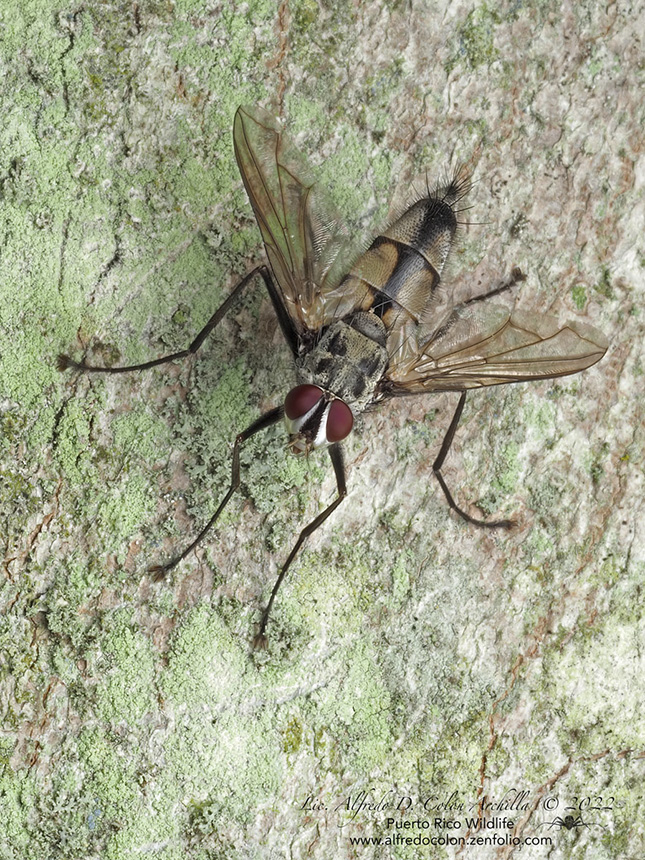
Zelia vertebrata is a medium-sized tachinid fly. It occurs in the United States east of the Great Plains, in southern Quebec and Ontario Canada, and in Mexico.
Adults are active from May to September, usually during the day. They are often seen on low vegetation or on the ground in open, forested areas. The larvae are internal parasites of beetle larvae in the families Cerambycidae (Longhorn Beetles), Passalidae (Bess Beetles), Scarabaeidae (Scarabs), and Tenebrionidae (Darkling Beetles).
Adults are about ½″ (12 mm) in length. They are easily identified by the slightly elongated abdomen, the pattern on the abdomen, and the lack of strong bristles in the first and second abdominal segments.
The head is mostly covered with a silvery white dusting (pruinescence). There are two large compound eyes on the sides of the head and three small simple eyes (ocelli) in a triangle on top of the head. A black, longitudinal stripe extends from the ocelli to the plate on the face above the upper lip (clypeus). The compound eyes are hairless. They do not meet at the top of the head on either sex. On the front of the head there is a plate (orbital plate) next to the inner margin of the compound eye. On the female, each orbital plate has a single forward-directed, sensory hair (orbital seta). On males, there are no orbital setae. The face has no elevated longitudinal ridge (facial carina). The tube-like mouthpart (proboscis) is stout and relatively short, not as long as the head is high. The antennae are short, and they are inserted below the middle of the compound eye. They are thickened only at the base. The third antennal segment has a forward-pointing bristle (arista) on the upper surface. The arista is short and feathery (plumose), with long hairs from the base to the tip.
The abdomen is slightly elongated, and it is strongly pointed in the rear, especially in males. The upper sides (tergites) are dark, blackish gray with extensive pruinose patterns. T1 and T2 are fused together, appearing as a single short segment, which is mostly dark on the upper side. T3 and T4 each have a pair of large, distinct, median spots. In the male, the spots are typically light yellowish-brown, and in the female they are typically silvery. T5 is mostly silvery white but terminates in a black tip on both sexes. The abdominal pattern of pruinosity is said to resemble a bone in the spinal column (vertebra) of vertebrates. This is the feature that gives the fly its species epithet, vertebrata.
The wings are clear with brown veins and light brownish tinting on the leading edge (costal margin) and along the veins. The media (M) vein ends at the wing margin.
Size
Total length: about ½″ (12 mm)
Similar Species
Habitat
Open, forested areas
Ecology
Season
May to September
Behavior
Life Cycle
Larva Food/Hosts
Beetle larvae in the families Cerambycidae, Passalidae, Scarabaeidae, and Tenebrionidae
Adult Food
Distribution |
||
|
Sources |
|
| 12/6/2025 | ||
Occurrence |
||
|
||
Taxonomy
Order
Suborder
Brachycera
Infraorder
Cyclorrhapha
Zoosection
Schizophora
Zoosubsection
Calyptratae (Calyptrate Flies)
Superfamily
Oestroidea (Bot Flies, Blow Flies, and Allies)
Family
Subfamily
Dexiinae
Tribe
Dexiini
Genus
Zelia
Subordinate Taxa
Synonyms
Dexia gracilis
Dexia vertebrata
Zelia rostrata
Common Names
This species has no common name. The common name for the family Tachinidae is tachinid flies, and it is applied here for convenience.
Glossary
Carina
An elevated keel or ridge.
Clypeus
On insects, a hardened plate on the face above the upper lip (labrum).
Costal margin
The leading edge of the forewing of insects.
Ocellus
Simple eye; an eye with a single lens. Plural: ocelli.
Proboscis
The tube-like protruding mouthpart(s) of a sucking insect.
Pruinescence
A waxy or powdery dust or bloom that covers the underlying coloration and gives a dusty or frosty appearance. Adjective: pruinose.
Seta
A stiff, hair-like process on the outer surface of an organism. In Lepidoptera: A usually rigid bristle- or hair-like outgrowth used to sense touch. In mosses: The stalk supporting a spore-bearing capsule and supplying it with nutrients. Plural: setae. Adjective: setose.
Tergite
The upper (dorsal), hardened plate on a segment of the thorax or abdomen of an arthropod or myriapod.
Visitor Photos
Share your photo of this insect.
This button not working for you?
Simply email us at info@MinnesotaSeasons.com.
Attach one or more photos and, if you like, a caption.
Alfredo Colon |
||
 |
 |
|
MinnesotaSeasons.com Photos
|

Slideshows

Visitor Videos
Share your video of this insect.
This button not working for you?
Simply email us at info@MinnesotaSeasons.com.
Attach a video, a YouTube link, or a cloud storage link.
Other Videos

Visitor Sightings
Report a sighting of this insect.
This button not working for you?
Simply email us at info@MinnesotaSeasons.com.
Be sure to include a location.
Alfredo Colon
8/8/2022

Location: Albany, NY
Minnesota Seasons Sightings