


Thread-waisted wasp
(Ammophila pictipennis)
Conservation • Description • Habitat • Ecology • Distribution • Taxonomy
Conservation Status
IUCN Red List
not listed
NatureServe
not listed
Minnesota
not listed
Description
Ammophila pictipennis is a medium-sized, solitary, ground-nesting, thread-waisted wasp. It occurs in the United States east of the Great Plains, in southern Ontario Canada, and in eastern Mexico. Adults are found from June to October in fields. They feed on flower nectar. Larvae feed on larvae of owlet moths, especially cutworms, including armyworm, lesser black-letter dart, yellow-striped armyworm, and corn earworm.
Adults are ¾″ to 1″ (20 to 25 mm) in length. The base of the abdomen is contracted into a thin stalk, making the body appear “thread-waisted”. This is the feature that gives the family Sphecidae its common name.
The head is dull black. There are two large compound eyes, one on each side of the head; and three small simple eyes (ocelli) in a triangular pattern at the top of the head between the compound eyes. The antennae are thread-like, black, and about as long as the head and thorax combined. They are not elbowed.
The thorax (mesosoma) is entirely dull black, with no silver markings. It has three segments, but the first segment of the abdomen is fused to the thorax, giving the thorax the appearance of having four segments. The upper plate on the first segment (pronotum) is short and collar-like. There is a short, rounded lobe on each side of the pronotum that does not reach the plate at the base of the wings (tegula).
The abdomen consists of a large first segment (propodeum) that is fused to the thorax; a relatively long, narrow, stalk-like second segment (petiole); and the bulbous remainder (gaster). The gaster is bent downward at the end of the petiole. The rear part of the petiole and the first two segments of the gaster are orange. The remainder of the gaster is dull black.
The wings are orange on the basal half, grading to black on the rear half. As the wasp ages, the black area gradually fades to orange. The forewing has three submarginal cells. There are two lobes at the base of the hindwing. The inner lobe (vannal lobe) is large.
The legs are long, slender, and black. The fourth segment (tibia) on the middle leg has two spurs at the tip.
Size
¾″ to 1″ (20 to 25 mm)
Similar Species
Habitat
Fields
Ecology
Season
June to October
Behavior
Adults will sometimes grip the stalk of a plant at night and hold its body out at right angles to the stem.
The wings are held over the body when at rest.
Life Cycle
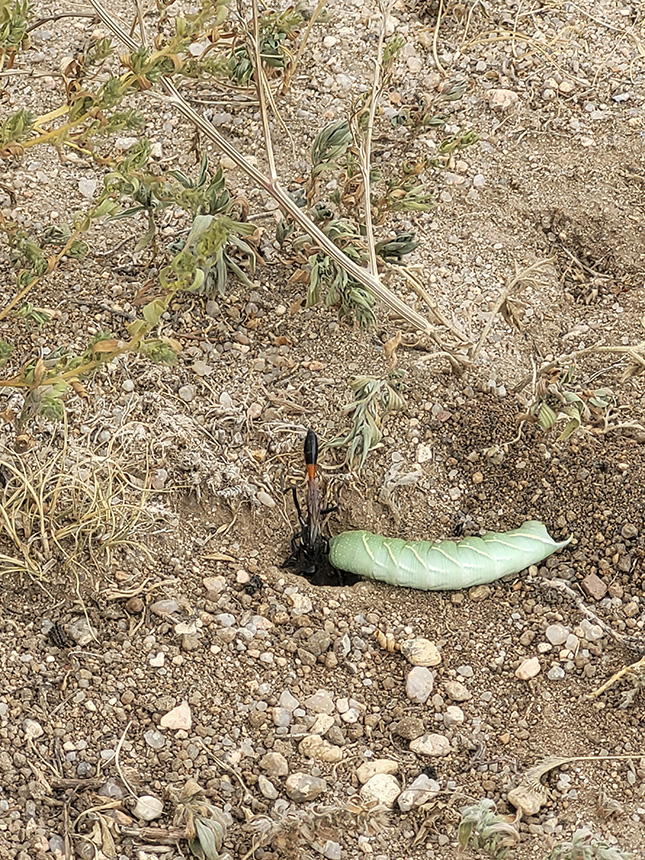
The female digs a nest with a single cell in sand, provisions it with a single paralyzed caterpillar, and lays a single egg.
Larva Food/Hosts
Larvae of owlet moths (family Noctuidae), especially cutworms, including armyworm, lesser black-letter dart, yellow-striped armyworm, and corn earworm.
Adult Food
Flower nectar
Distribution
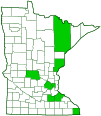
Occurrence
Fairly common
Taxonomy
Order
Hymenoptera (Ants, Bees, Wasps, and Sawflies)
Suborder
Apocrita (Narrow-waisted Wasps, Ants, and Bees)
Infraorder
Aculeata (Ants, Bees, and Stinging Wasps)
Superfamily
Apoidea (Bees and Apoid Wasps)
Family
Sphecidae (Thread-waisted Wasps)
Subfamily
Ammophilinae
Tribe
Ammophilini
Genus
Ammophila (Thread-waisted Sand Wasps)
Subordinate Taxa
Synonyms
Ammophila anomala
Ammophila extremitata pictipennis
Sphex extremitata pictipennis
Sphex nigropilosus
Sphex pictipennis
Common Names
This species has no common name. The common name of the family Sphecidae is thread-waisted wasps, and it is applied here for convenience.
Glossary
Gaster
The bulbous part of the abdomen of ants, bees, and wasps. In ants it usually begins at segment three.
Mesosoma
In Hymenoptera: the front part of the body, consisting of all three segments of the thorax and the first segment of the abdomen, to which the wings are attached.
Ocellus
Simple eye; an eye with a single lens. Plural: ocelli.
Pronotum
The exoskeletal plate on the upper side of the first segment of the thorax of an insect.
Tegula
A small, hardened, plate, scale, or flap-like structure that overlaps the base of the forewing of insects in the orders Lepidoptera, Hymenoptera, Diptera, and Homoptera. Plural: tegulae.
Tibia
The fourth segment of an insect leg, after the femur and before the tarsus (foot). The fifth segment of a spider leg or palp. Plural: tibiae.
Visitor Photos
Share your photo of this insect.
This button not working for you?
Simply email us at info@MinnesotaSeasons.com.
Attach one or more photos and, if you like, a caption.
Kelz67
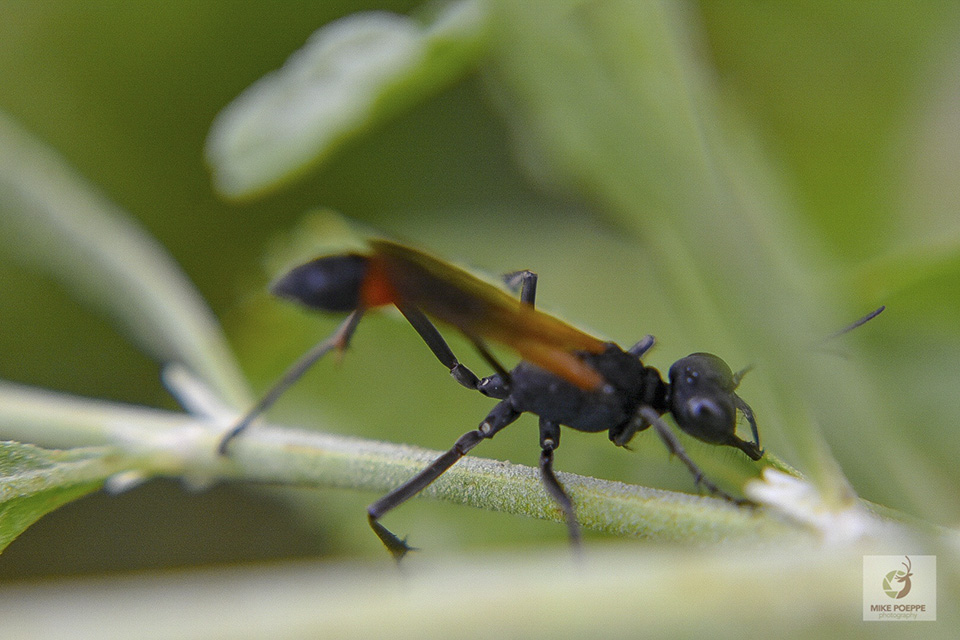
Mike Poeppe
Minnesota Seasons Photos

Slideshows

Visitor Videos
Share your video of this insect.
This button not working for you?
Simply email us at info@MinnesotaSeasons.com.
Attach a video, a YouTube link, or a cloud storage link.
Other Videos
THREAD-WAISTED WASP carrying caterpillar. Ammophila pictipennis
Rob Curtis
Thread-waisted Wasp (Ammophila pictipennis) with its caterpillar prey
Timothy Ng

Visitor Sightings
Report a sighting of this insect.
This button not working for you?
Simply email us at info@MinnesotaSeasons.com.
Be sure to include a location.
Kelz67
9/19/2022
Location: Calhan, CO
Mike Poeppe
8/7/2021
Location: west of Houston, MN
... after the rain today
Minnesota Seasons Sightings