


Two-marked treehopper complex
(Enchenopa binotata complex)
Conservation • Description • Habitat • Ecology • Distribution • Taxonomy
Conservation Status |
|
|||
| IUCN Red List | not listed |
|||
| NatureServe | NNR - Unranked |
|||
| Minnesota | not listed |
|||
Description
Enchenopa binotata is a species complex, a group of nine species that are identical in appearance (as adults) while remaining reproductively separate. Species evolved to exploit individual host plant species while remaining geographically combined (sympatric speciation). Adults are often found on non-host plants, further complicating identification. All nine species are referred to by the binomial name Enchenopa binotata.
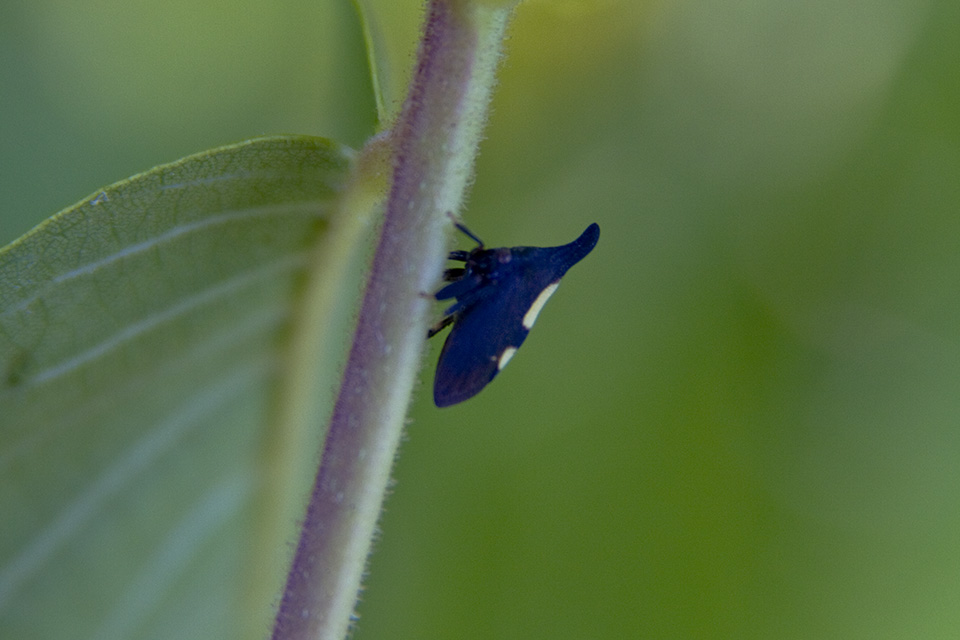
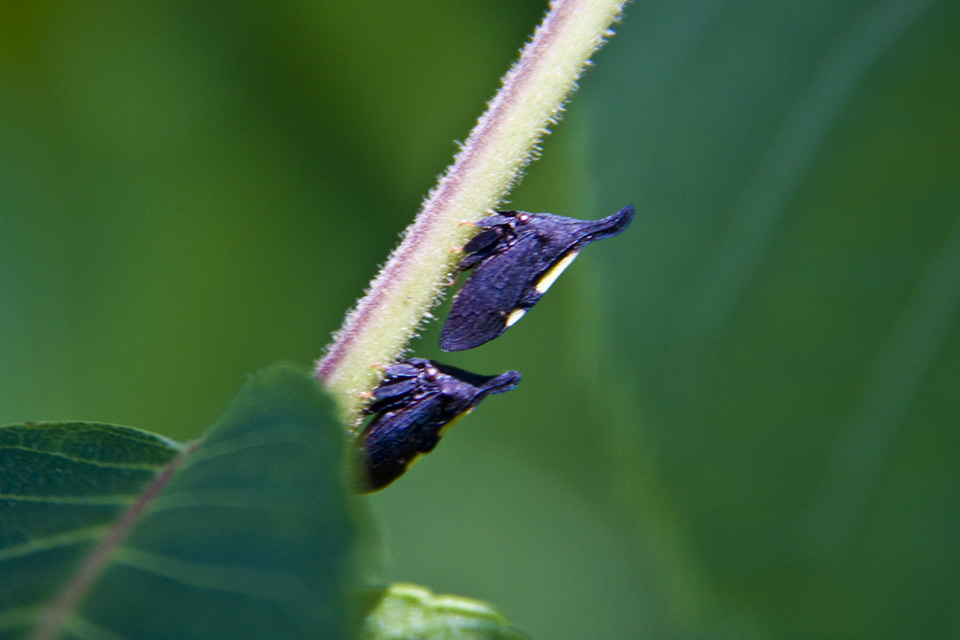
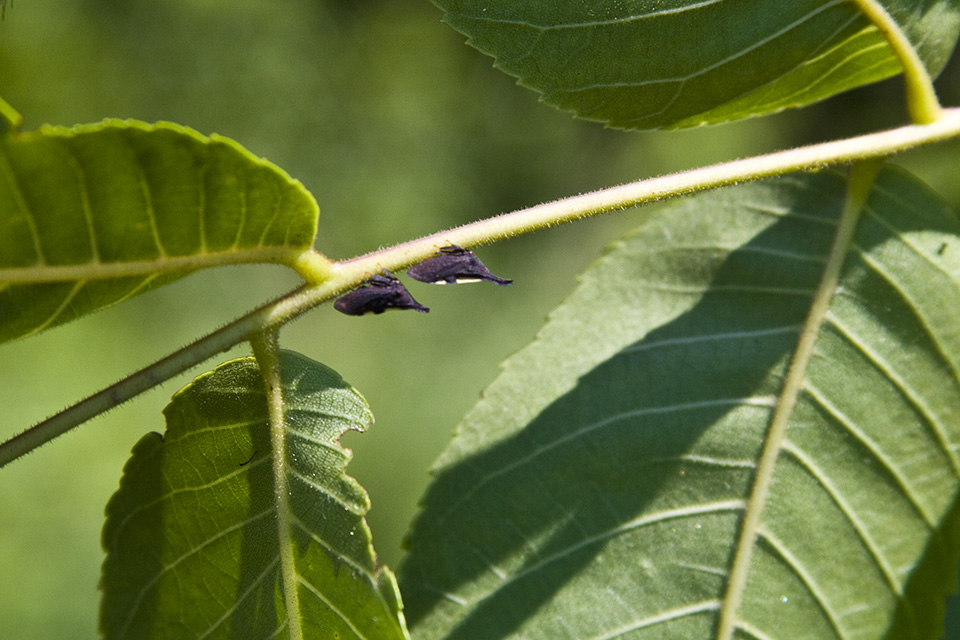
Two-marked treehopper is a small, 3 ⁄16″ to ¼″ long jumping insect. Like other treehoppers, it has the overall appearance of a thorn.
The wings, pronotum, and legs are dark brown. The eyes are brown. The pronotum covers the thorax and abdomen, projects forward like a horn, and is slightly expanded at the tip. It has yellow spots near the center of the dorsal (upper) ridge. The first two pairs of legs are broad and flattened.
Size
3 ⁄16″ to ¼″
Similar Species
Habitat
Ecology
Season
Behavior
Adults are often seen in groups on a twig. They are usually in single file with their heads all pointing in the same direction. They puncture the twig and extract the sap.
Life Cycle
The female deposits her eggs in a mass under the bark of a branch, then covers them with a foamy, white secretion (egg froth). The egg froth contains a chemical that attracts other females and signals them to deposit their eggs. Ten or more egg masses are often deposited on a single branch.
Offspring overwinter as eggs. Eggs hatch the following spring. Nymphs produce sugary secretions that attract ants. Attendance by ants in the late season significantly reduces mortality.
Nymph Food
Each of the nine species of this species complex inhabits a single host plant species. Six species are found in Minnesota: American bittersweet, black locust. black walnut, butternut, common hop-tree, and nannyberry.
Adult Food
Adults are often found on non-host plants.
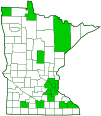
Distribution |
||
|
Sources |
|
| 10/5/2025 | ||
Occurrence |
||
|
||
Taxonomy
Order
Hemiptera (True bugs, Hoppers, Aphids, and Allies)
Suborder
Auchenorrhyncha (true hoppers)
Infraorder
Cicadomorpha (spittlebugs, cicadas, leafhoppers and treehoppers)
Superfamily
Membracoidea (leafhoppers and treehoppers)
Family
Membracidae (typical treehoppers)
Subfamily
Membracinae
Tribe
Membracini
Genus
Enchenopa
Subordinate Taxa
Synonyms
Membracis binotata
Common Names
twomarked treehopper
two-marked treehopper
two-spotted treehopper
Glossary
Pronotum
The exoskeletal plate on the upper side of the first segment of the thorax of an insect.
Visitor Photos
Share your photo of this insect.
This button not working for you?
Simply email us at info@MinnesotaSeasons.com.
Attach one or more photos and, if you like, a caption.
Jamal Hamka |
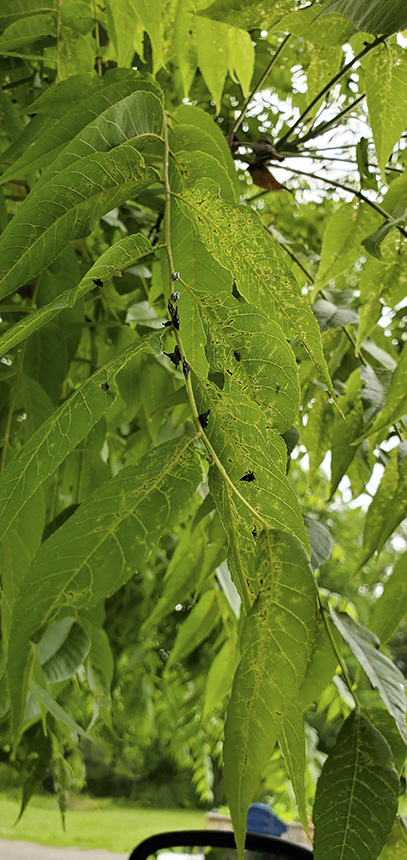 |
Hello, found this page while trying to identify the pictured bug. |
MinnesotaSeasons.com Photos
 |
 |
|
 |

Slideshows
Enchenopa binotata (Two-spotted Treehopper)
Allen Chartier

Visitor Videos
Share your video of this insect.
This button not working for you?
Simply email us at info@MinnesotaSeasons.com.
Attach a video, a YouTube link, or a cloud storage link.
Other Videos

Visitor Sightings
Report a sighting of this insect.
This button not working for you?
Simply email us at info@MinnesotaSeasons.com.
Be sure to include a location.
Jamal Hamka
6/22/2021
Location: Salem Twp, Michigan 48170
Hello, found this page while trying to identify the pictured bug.

Minnesota Seasons Sightings