



American highbush cranberry
(Viburnum opulus var. americanum)
Conservation • Wetland • Description • Habitat • Ecology • Use • Distribution • Taxonomy
|
|
||||||||||||||||||||||||
Description |
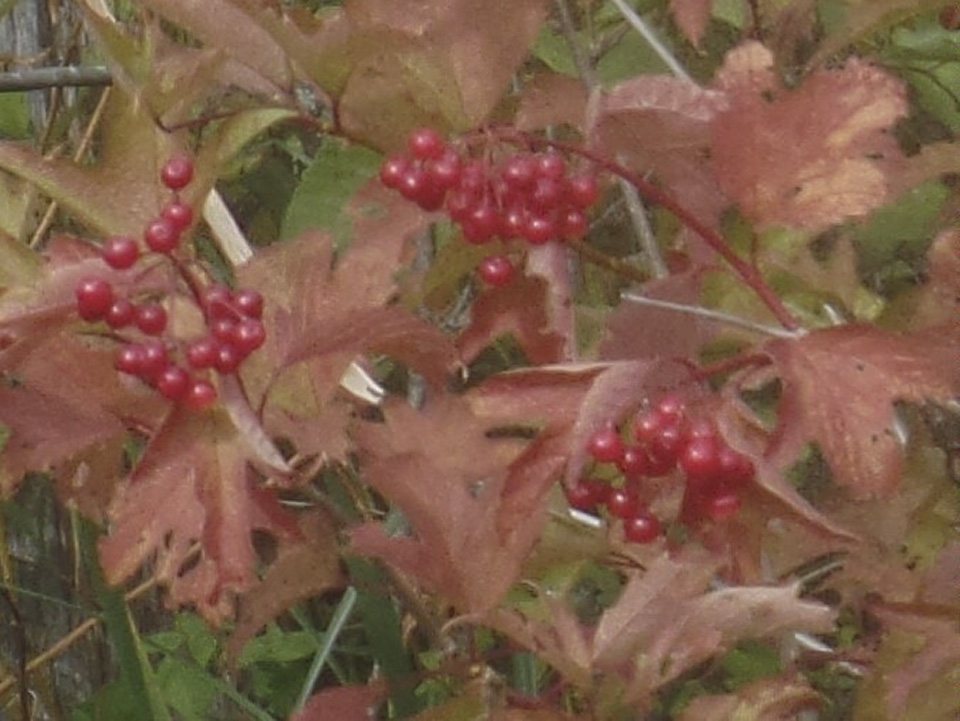
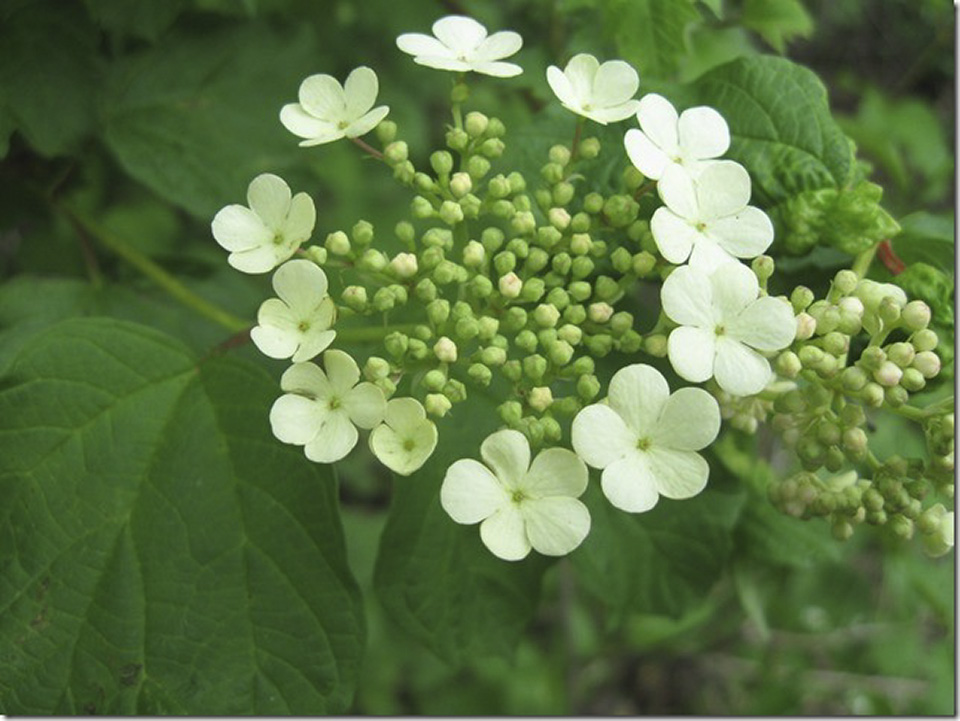
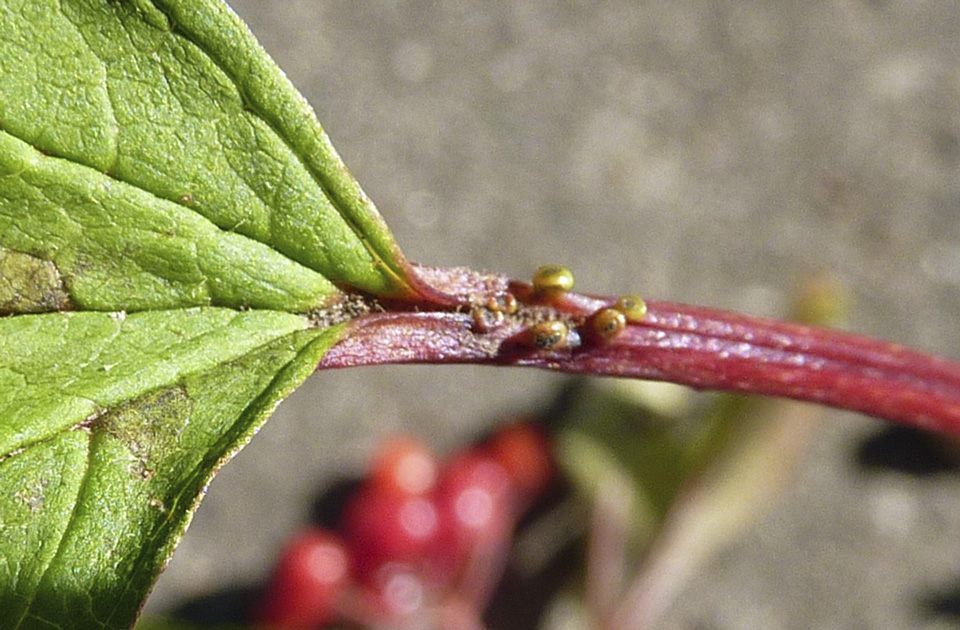
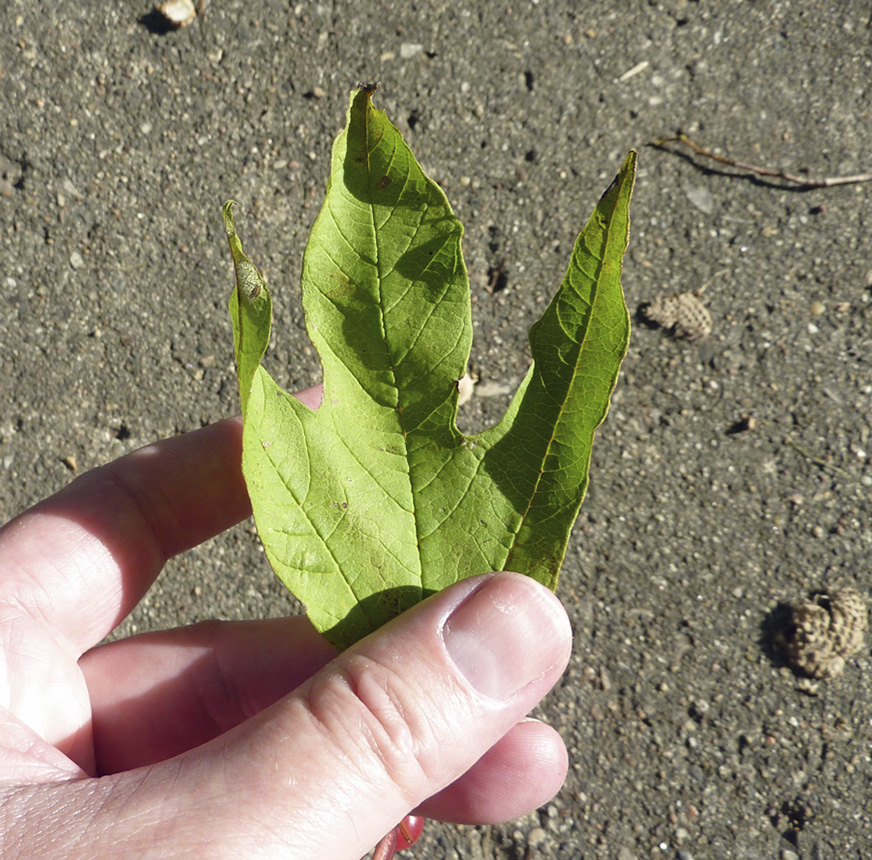
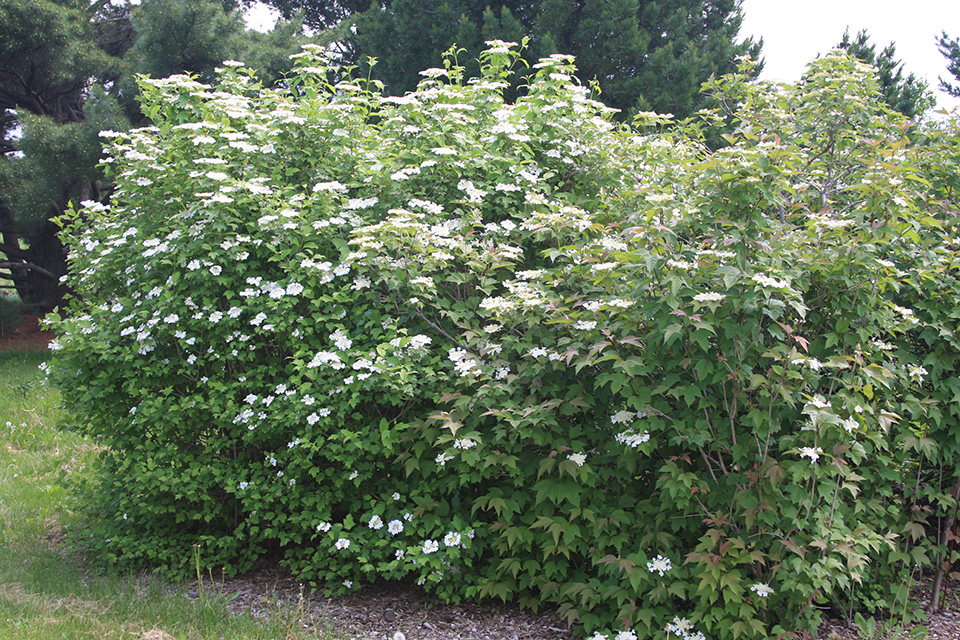
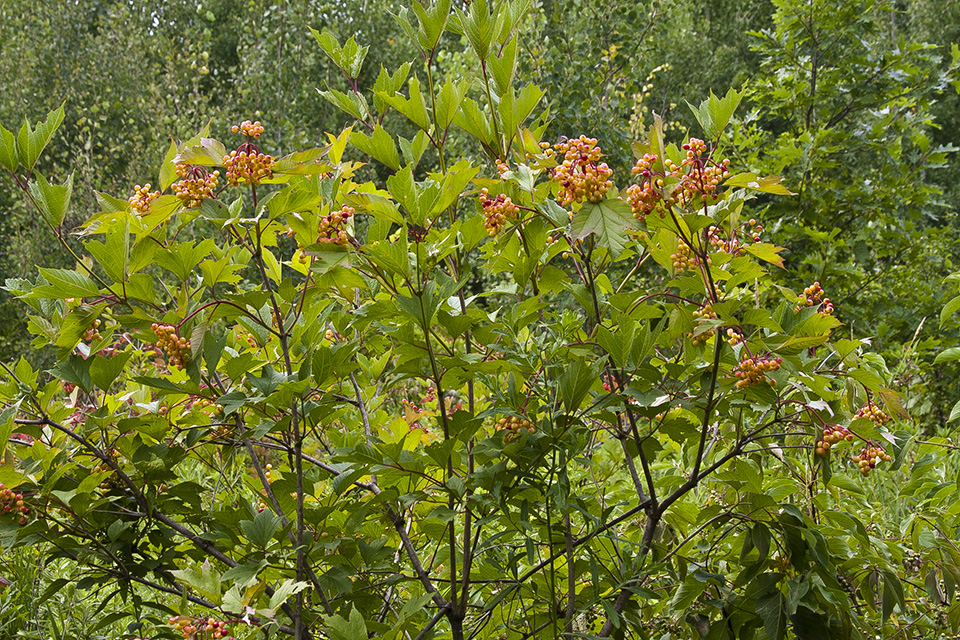
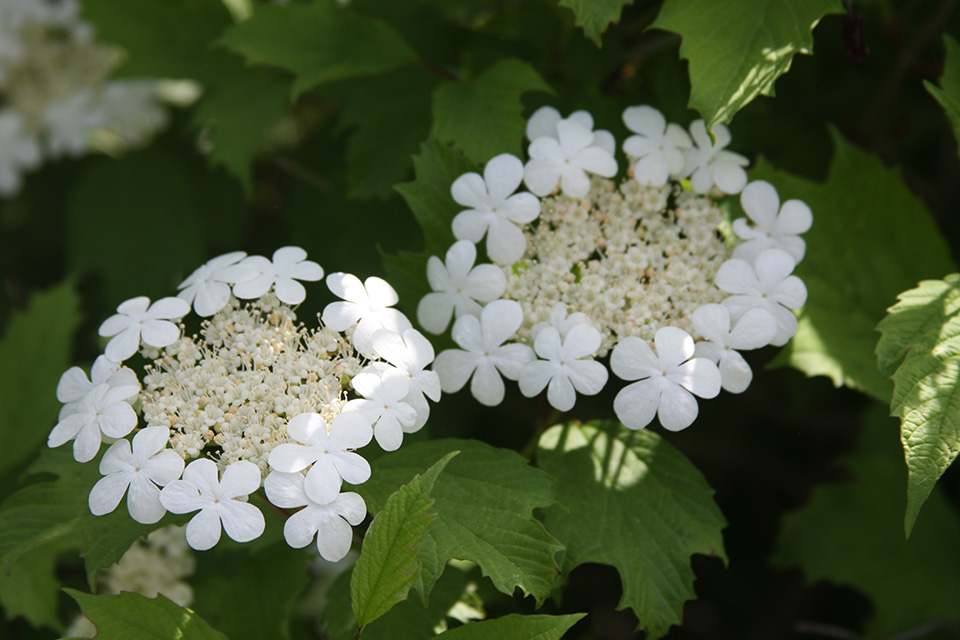
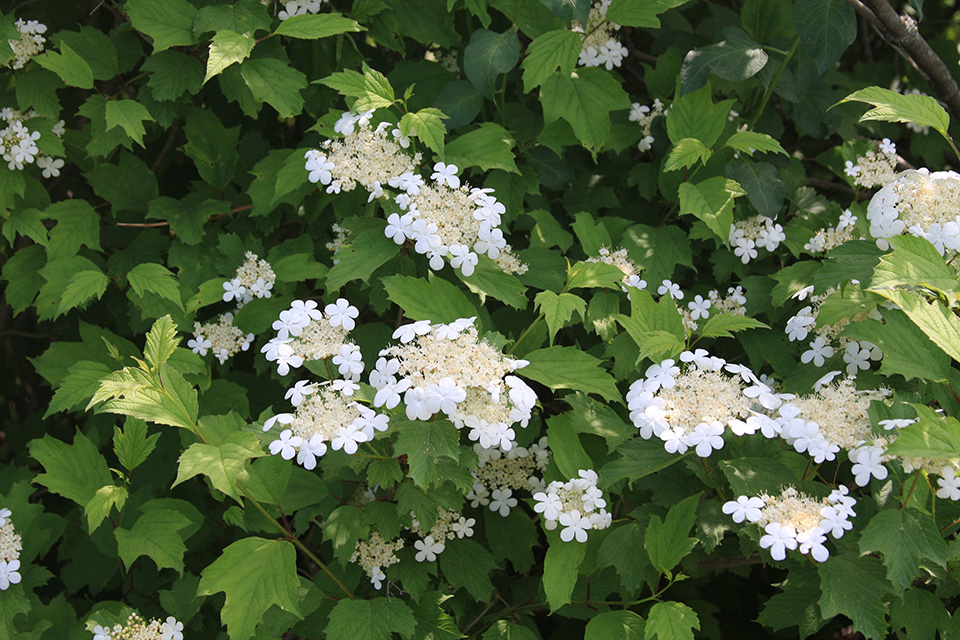
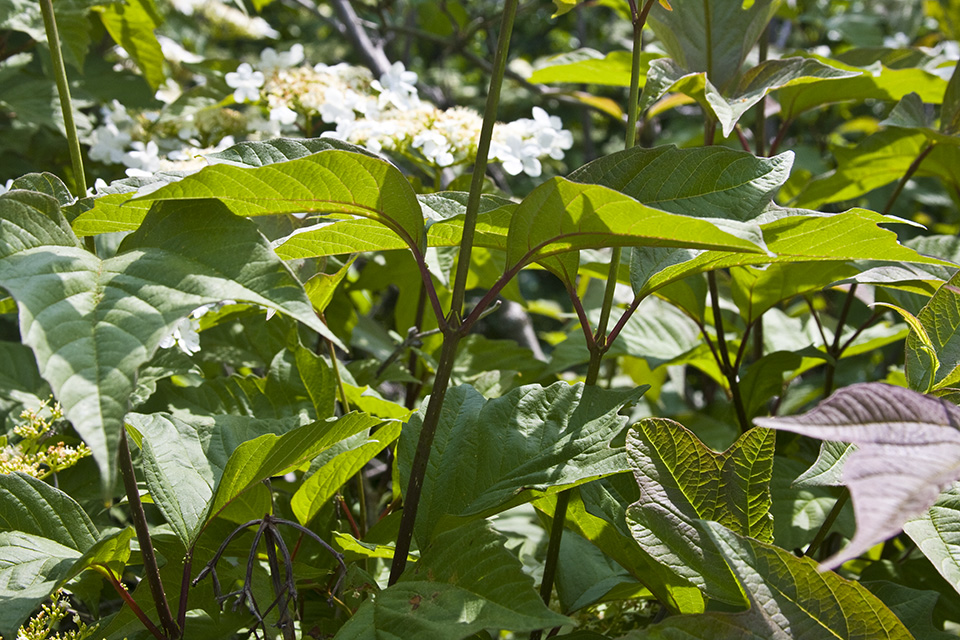
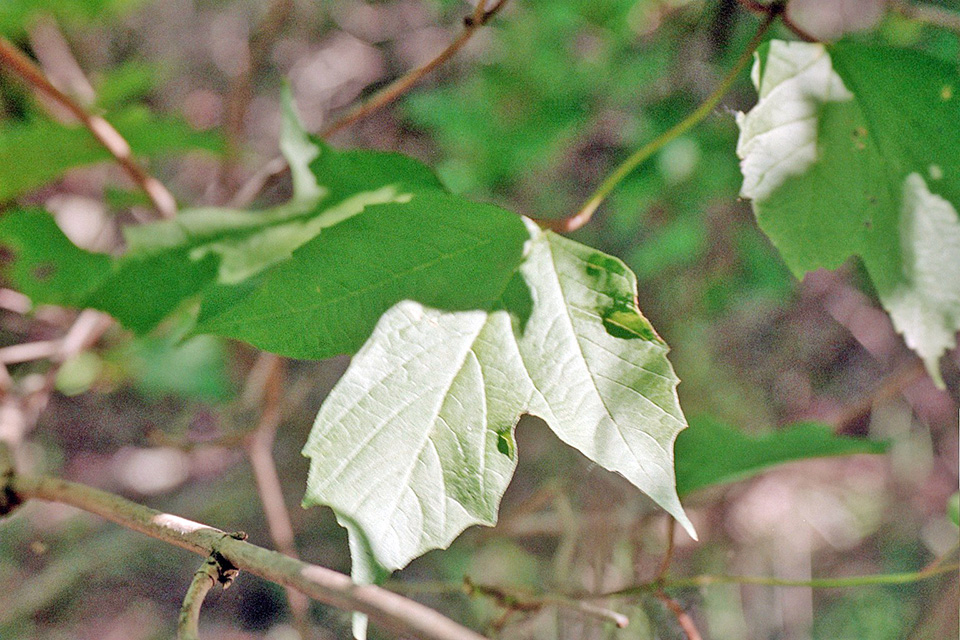
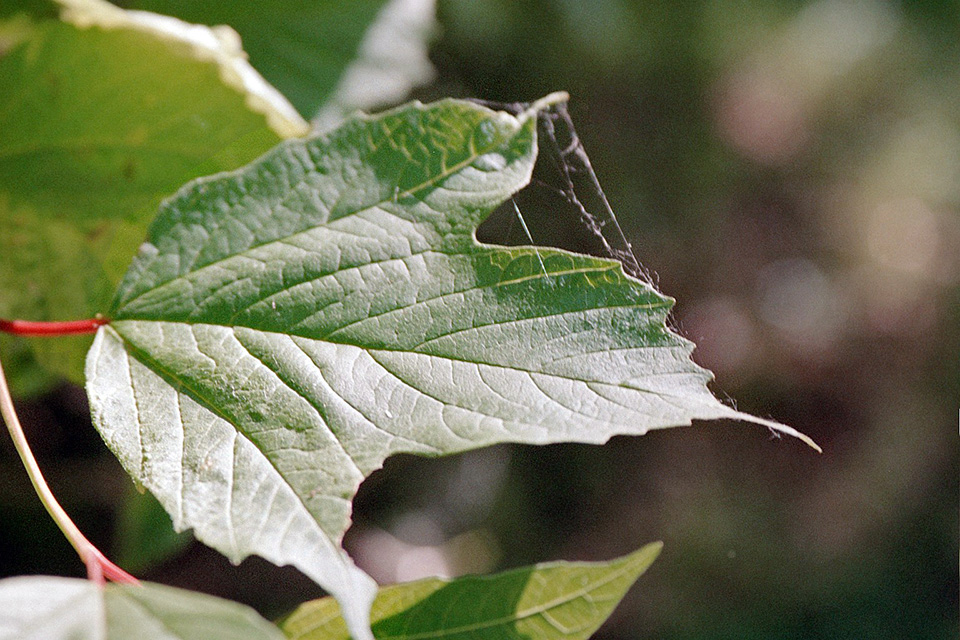
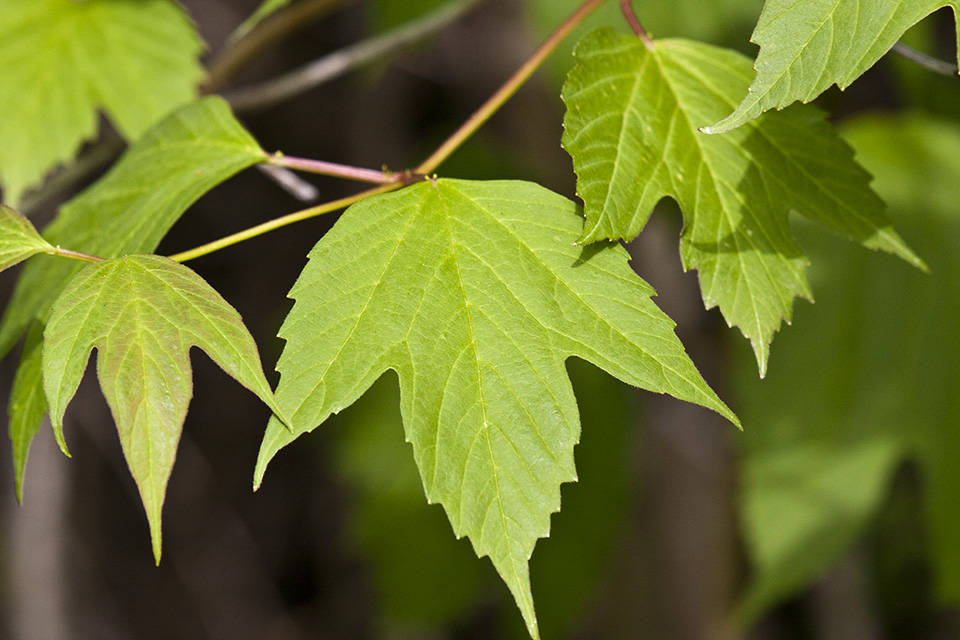
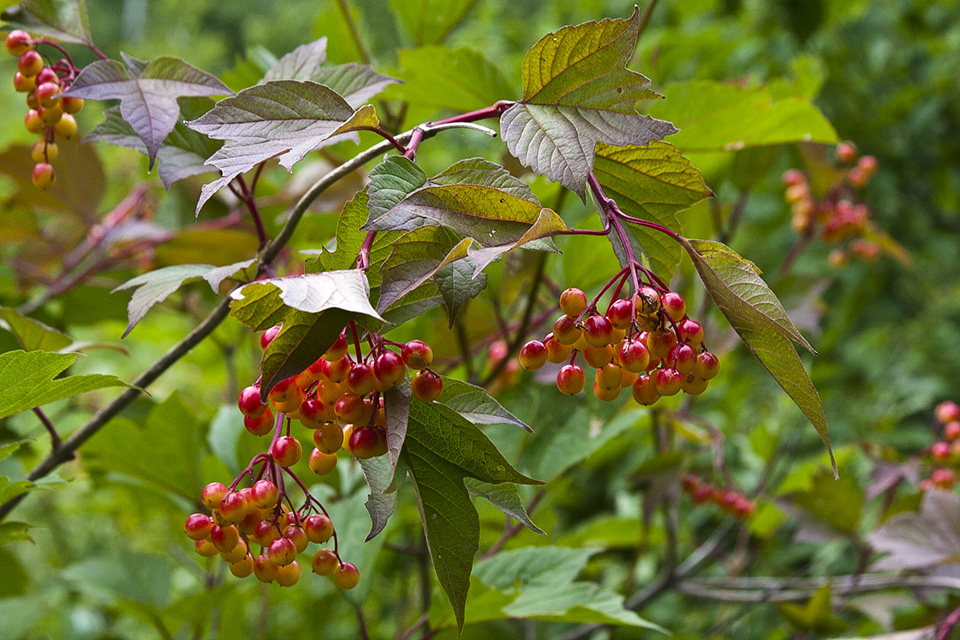
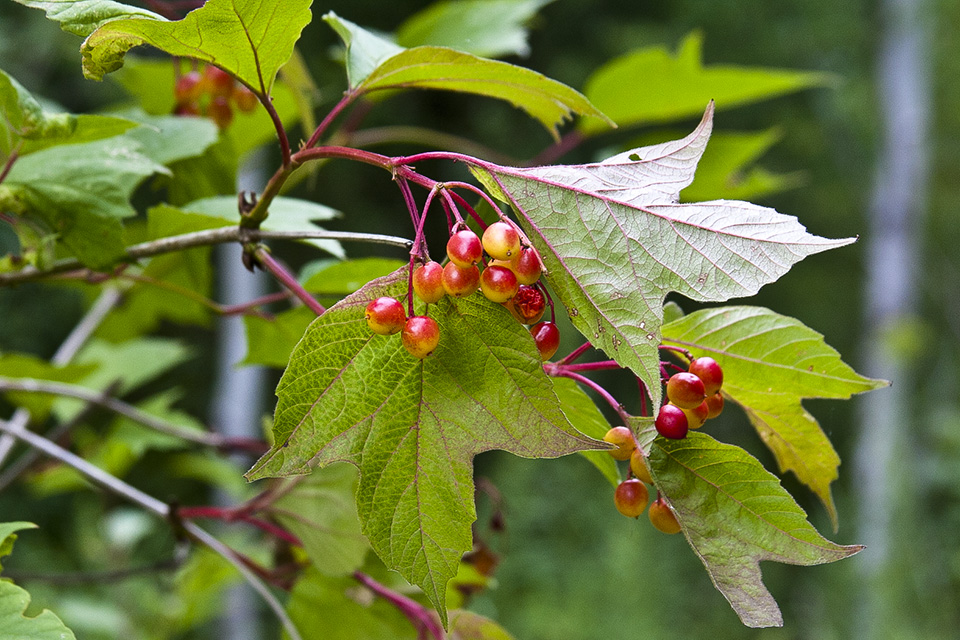
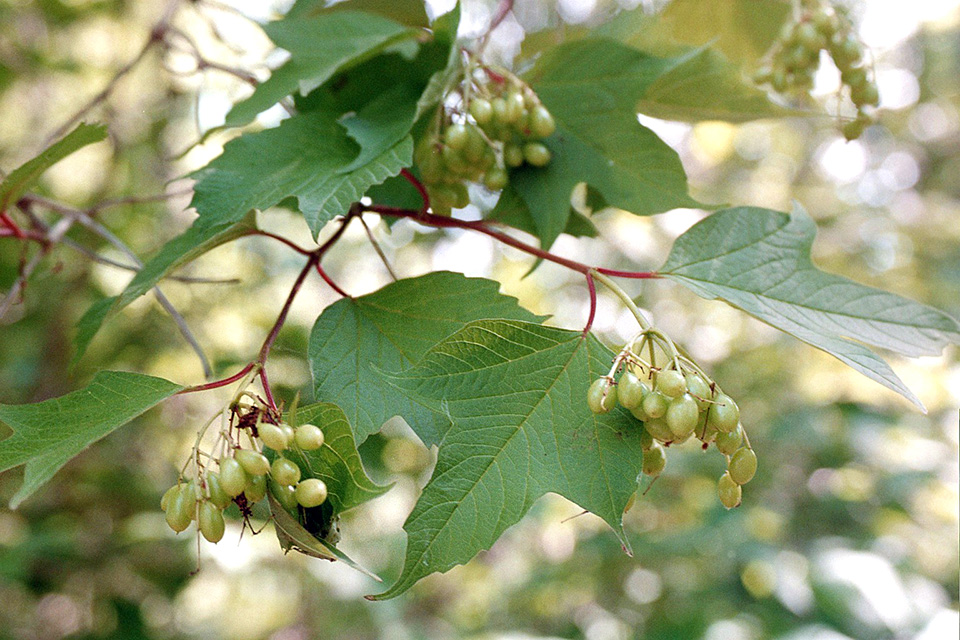
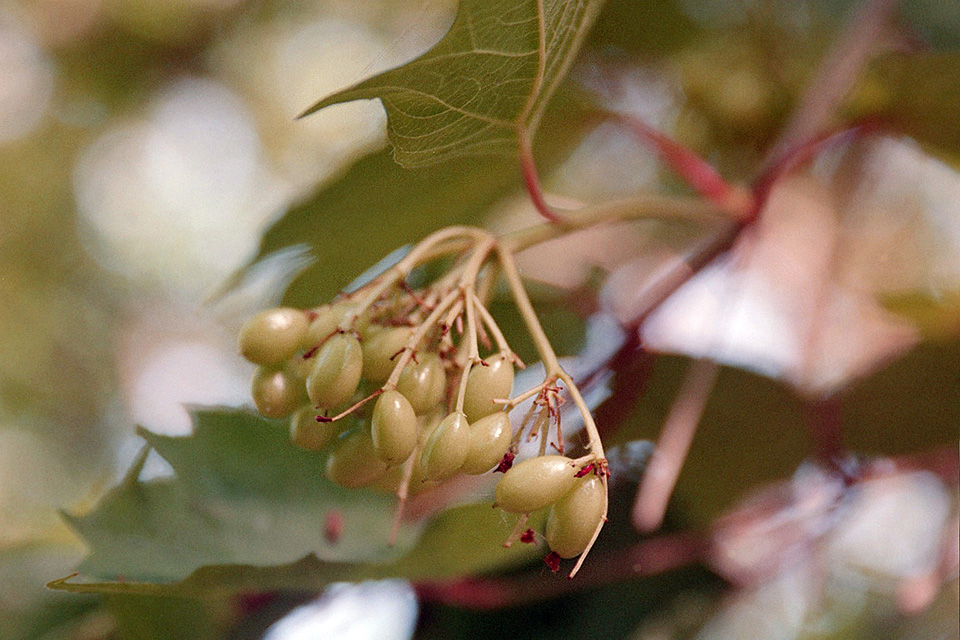
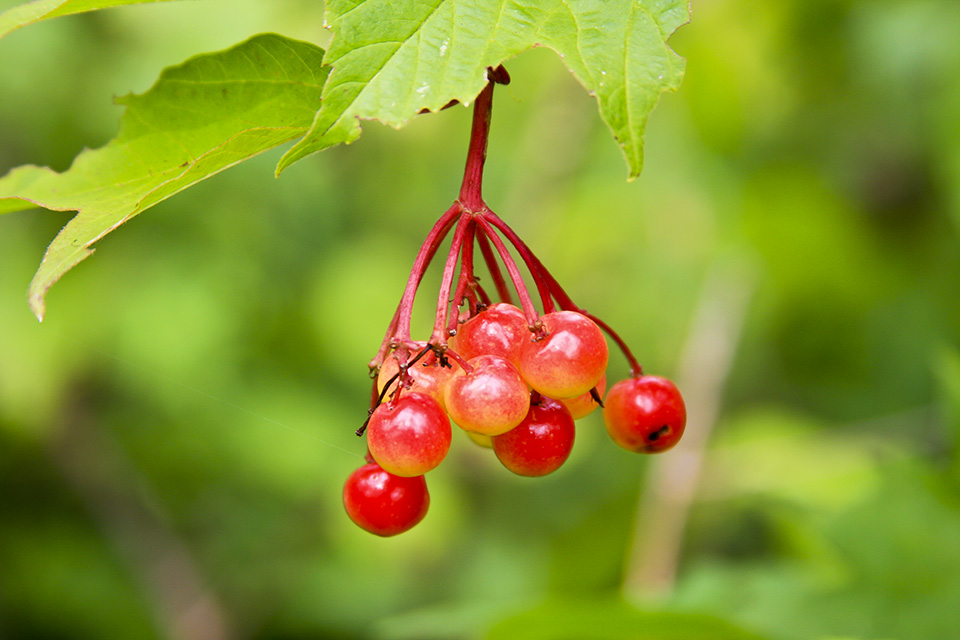
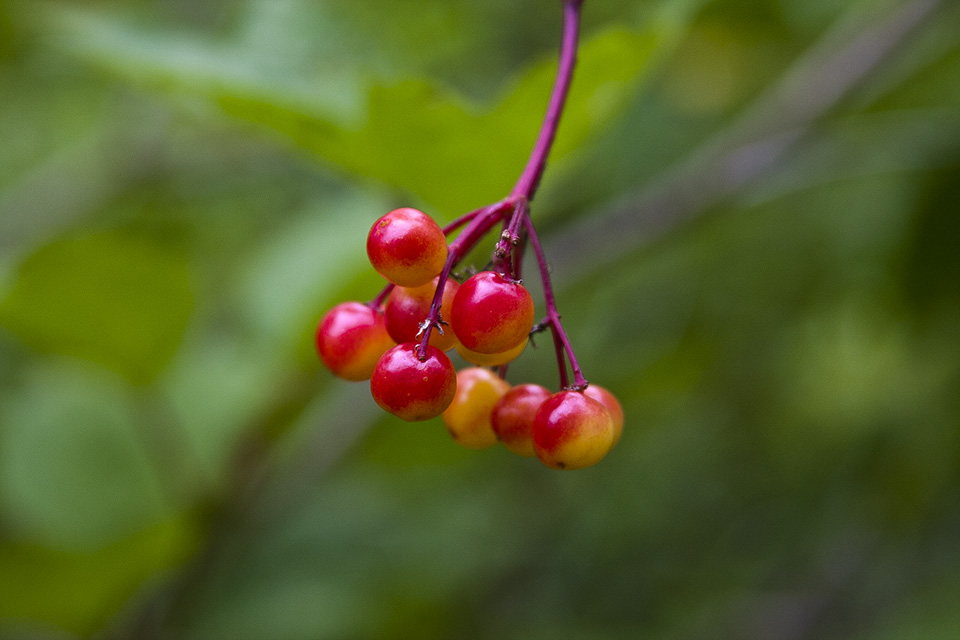
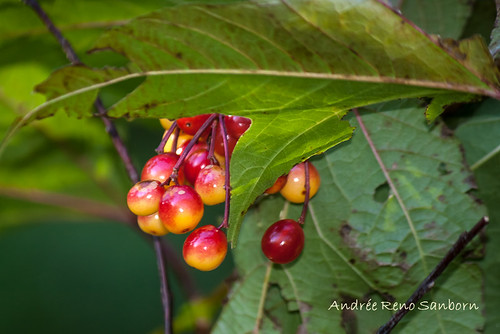
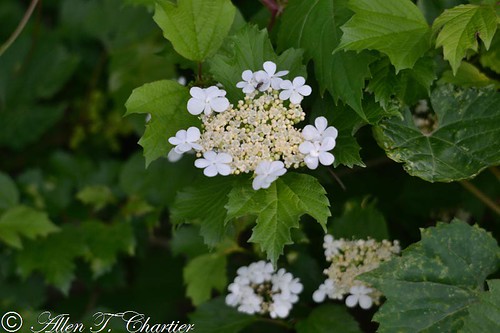
American highbush cranberry is a relatively fast-growing, short-lived, tall shrub. It can be up to 16′ tall and up to 2⅜″ in diameter at breast height, but is usually no more than 12′ in height. It rises on multiple stems from scattered, deep, anchoring roots and shallow, spreading, fibrous, soil-binding roots. Shrubs reproduce vegetatively by layering or tip rooting. In layering, shrubs produce stems that lie on the ground with only the tips ascending (decumbent). A decumbent stem roots at a node, produces an aerial stem, and eventually detaches, forming a new plant. In addition, lower branches may droop to the ground, root at the tip, and send up a new shoot. Vegetative reproduction occasionally results in a thicket. The stems are upright, slightly spreading, or sometimes arching. Twigs are moderately stout. First year twigs are green to reddish-green and hairless, with white, conspicuously raised bumps (lenticels). Second-year twigs are yellowish-brown to grayish-brown, round in cross section, and hairless, with widely scattered, small, round lenticels. The pith is white and solid. The leaf scars are narrow, crescent-shaped, and slightly raised. Each leaf scar has three bundle scars. The terminal bud is stalked, greenish-red, mostly hairless, short, plump, oblong egg-shaped, and somewhat flattened. It is not sticky. It is covered by two scales that are fused into a tube at the base and for part of their length, free and overlapping toward the tip. Lateral buds are about half as long and globe-shaped to egg-shaped. The bark is gray or grayish-brown, relatively smooth, and not peeling. On older stems the bark occasionally becomes somewhat fissured. The leaves are opposite, undivided (simple), and deciduous. They are attached to the twig on a ¾″ to 1⅜″ long leaf stalk (petiole). The petiole is green or greenish-red and channeled on the upper (ventral) side. The channel has relatively long, coarse hairs, at least where the blade is attached. The petiole is otherwise hairless. It is not winged. There are 2 or 4 projecting, 1 ⁄64″ to 1 ⁄32″ in diameter glands near the attachment of the leaf blade. The glands are slender, circular in cross section, and flat or rounded (convex) on the top. There is a pair of leaf-like, smooth, 1 ⁄32″ to 3 ⁄16″ in long appendages (stipules) at the base of the petiole. The stipules are deciduous and fall off early in the season. The glands may disappear or become deformed late in the season. The leaf blades are relatively thin, papery (firm), broadly egg-shaped in outline, shallowly to moderately 3-lobed, 2″ to 4¾″ long, and 2⅜″ to 4⅜″ wide. They are broadly rounded, broadly tapered, or nearly squared off at the base. The lobes are angled or short-tapered to a sharply-pointed tip. The leaf blades are palmately veined with three main veins, each one extending from the petiole at the base of the blade to the tip of one of the lobes. Each main vein has several pinnate secondary veins. The secondary veins are straight or slightly arched, and most reach the margin and end in a tooth. The veins are depressed on the upper surface of the blade, raised on the lower surface. The upper surface is dark green, has a slightly wrinkled appearance, and is sparsely hairy or almost hairless. The lower surface is pale green and sparsely hairy or moderately to densely hairy along the main veins. The margins may be untoothed or sparingly toothed. Leaves near the branch tips are often narrow and unlobed. The leaves turn yellow, orange, red or dark reddish-purple in the fall. The inflorescence is a dense, rounded, flat-topped, 2⅜″ to 5″ in diameter, branched cluster (cyme). It is borne on a ⅝″ to 2″ long stalk (peduncle) at the end of a four-leaved shoot that rises from a lateral bud at the end of a second-year twig. The cymes have 6 to 8 main branches emanating from the tip of the shoot. Each cyme has 100 or more small fertile flowers and an outer ring or 5 to 10 much larger sterile flowers. The fertile flowers are ⅛″ to ¼″ in diameter. There are five sepals, five petals, five stamens, and one style. The sepals are green, fused for most of their length into a minute cup (calyx), and separated at the tip into five minute, egg-shaped lobes. The petals are pale yellow to creamy white, egg-shaped to elliptical, and 1 ⁄16″ to ⅛″ long. The stamens have white filaments and bright yellow anthers. They are 1 ⁄16″ to ⅛″ long, longer than the petals. The style is thick, short, light green, and tipped with a three-lobed stigma. The sterile flowers on the margin are flat and ½″ to 1 3 ⁄16″ in diameter. The flowers have an unpleasant scent. They appear in late May to late June after the leaves. The fruit arrangement (infructescence) is a heavy, drooping cluster. Each fruit is an edible, juicy, cranberry-like, ellipse-shaped to nearly spherical, ¼″ to ½″ in diameter drupe. It contains one seed. It is green initially, turning yellowish as it matures, eventually becoming translucent orange or bright red when ripe. The calyx and stigma persist in fruit, forming a dried tip at the end (apex) of the drupe. The peduncles turn red as the fruit matures. The fruit ripens in early August to early September, often remaining on the plant through the winter. |
Height |
3′ to 16′ |
Flower Color |
White |
Similar Species |
European cranberrybush (Viburnum opulus var. opulus) leaf petioles have up to 8 projecting glands. The glands are larger, elliptical in cross section, and indented (concave) on the top with a conspicuous ear-like rim. The channel on the petiole is hairless of has scattered, short, fine hairs. The leaves are smaller, no more than 3⅛″ long and wide. The leaf margins are coarsely toothed. The drupes are bitter. |
Habitat |
Moist to wet. Woodlands, especially openings and edges; shrub swamps; tamarack swamps; alder thickets; edges of lakes and ponds; streambanks. Moderately shade tolerant. |
Ecology |
Flowering |
Late May to late June |
Pests and Diseases |
|
Toxicity |
The fruit is edible in small quantities but it is mildly toxic. It may cause vomiting and diarrhea if large amounts are eaten. |
Use |
|
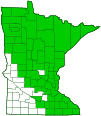
Distribution |
||
|
Sources Biodiversity occurrence data published by: Minnesota Biodiversity Atlas (accessed through the Minnesota Biodiversity Atlas Portal, bellatlas.umn.edu, 5/13/2025). |
|
| 5/13/2025 | ||
Nativity |
||
Native |
||
Occurrence |
||
Common |
||
Taxonomy |
|
Kingdom |
|
Subkingdom |
Pteridobiotina |
Phylum |
Tracheophyta (Vascular Plants) |
Class |
|
Order |
Dipsacales (Honeysuckles, Moschatels, and Allies) |
Family |
Viburnaceae (Elder) |
Genus |
Viburnum (Viburnums) |
Species |
Viburnum opulus (Guelder Rose) |
Family Currently (2023), some sources, including USDA PLANTS and NatureServe, place the genera Sambucus and Viburnum in the Caprifoliaceae family. Some sources, including ITIS and NCBI, place them in the Adoxacea family. Almost all other sources, including APG IV, World Flora Online, Plants of the World Online, GRIN, GBIF, and iNaturalist, place the two genera in the Viburnaceae family. Species |
|
Subordinate Taxa |
|
|
|
Synonyms |
|
Viburnum americanum Viburnum opulus ssp. trilobum Viburnum trilobum |
|
Common Names |
|
American cranberrybush American cranberrybush viburnum American highbush cranberry highbush cranberry |
|
American highbush cranberry is a deciduous shrub, not a true cranberry (Vaccinium Oxycoccos), which is an evergreen dwarf shrub. |
|
Glossary
Calyx
The group of outer floral leaves (sepals) below the petals, occasionally forming a tube.
Cyme
A branched, flat-topped or convex flower cluster in which the terminal flower opens first and the outermost flowers open last.
Decumbent
Reclining on the ground but with the tips ascending.
Drupe
A fleshy fruit with a single hard, stone-like core, like a cherry or peach.
Layering
A method of propagation where a stem or branch comes into permanent contact with the soil, sprouts roots, and then detaches from the main plant.
Lenticel
A corky, round or stripe-like, usually raised, pore-like opening in bark that allows for gas exchange.
Palmate
Similar to a hand. Having more than three lobes or leaflets that radiate from a single point at the base of the leaf.
Peduncle
In angiosperms, the stalk of a single flower or a flower cluster; in club mosses, the stalk of a strobilus or a group of strobili.
Petiole
On plants: The stalk of a leaf blade or a compound leaf that attaches it to the stem. On ants and wasps: The constricted first one or two segments of the rear part of the body.
Pinnately veined
With the veins arranged like the vanes of a feather; a single prominent midvein extending from the base to the tip and lateral veins originating from several points on each side.
Pith
The spongy cells in the center of the stem.
Simple leaf
A leaf that is not divided into leaflets, though it may be deeply lobed or cleft.
Stipule
A small, leaf-like, scale-like, glandular, or rarely spiny appendage found at the base of a leaf stalk, usually occurring in pairs and usually dropping soon.
Winged leaf stalk
A leaf stalk with a leaf-like or membrane-like extension along both sides.
Visitor Photos |
||
Share your photo of this plant. |
||
This button not working for you? |
||
Dan W. Andree |
||
 |
||
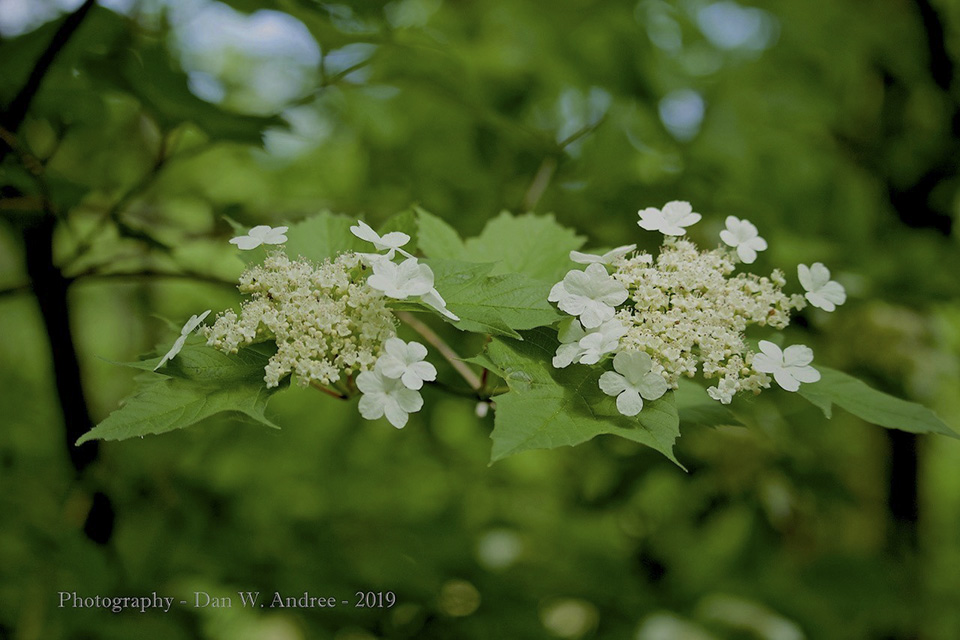
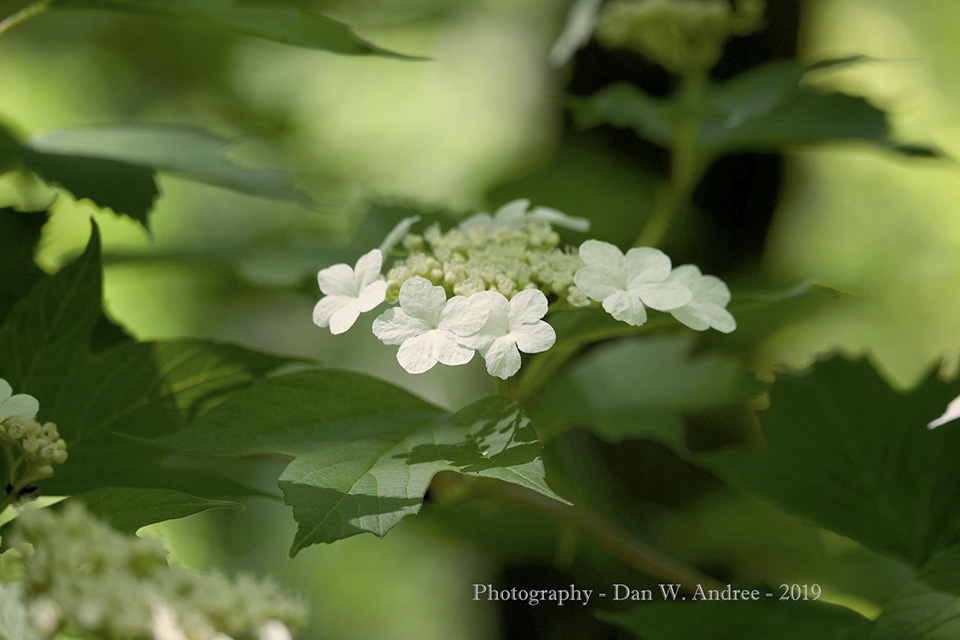
High bush cranberry blooming? I came across this what I think is some kind of high bush cranberry blooming. It was along a small stream bank in Norman County, Mn. |
||
Wild Highbush Cranberry Blossoms... |
||
 |
 |
|
Luciearl |
||
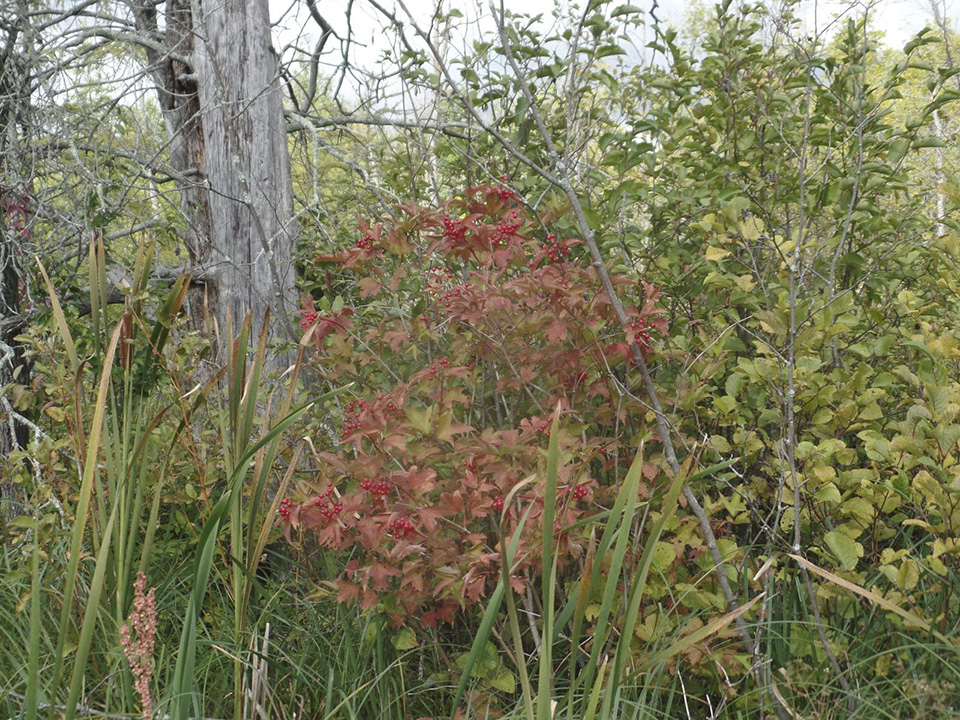
Growing in a nearby Tamarack swamp |
||
 |
 |
|
Barb Parrish |
 |
Joe Frisk |
||
 |
 |
|
James Gordon |
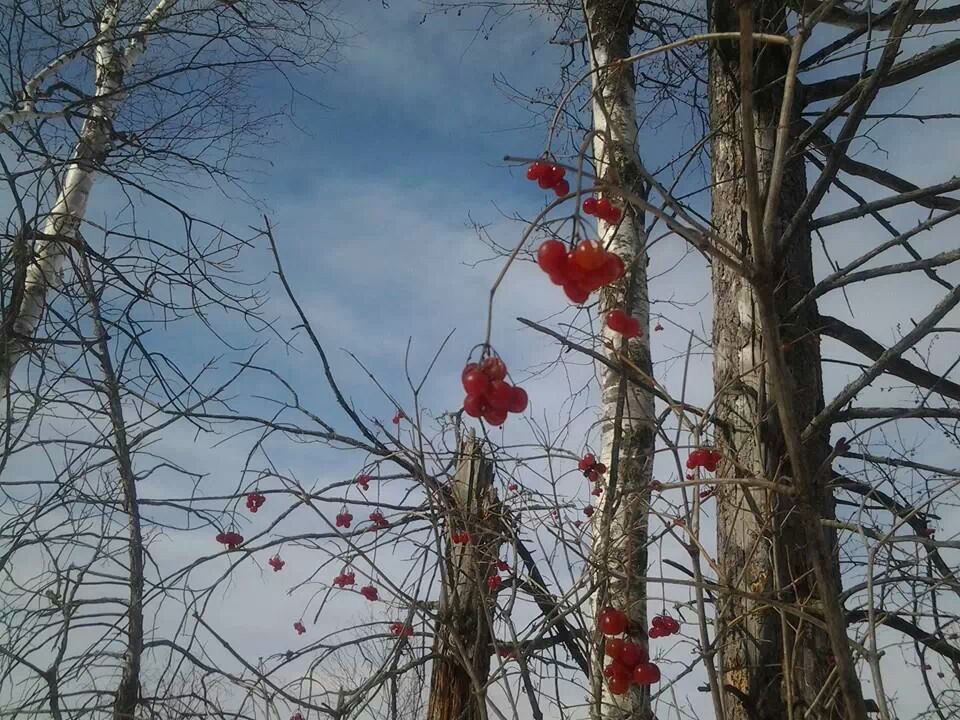 |
Winter hardy high bush cranberry found in Wright County, MN. March, 2014. |
MinnesotaSeasons.com Photos |
||
 |
 |
|
Plant |
Plant |
|
 |
||
Inflorescence |
|
|
 |
 |
|
Inflorescence |
Inflorescence |
|
 |
 |
|
Inflorescence |
Stem |
|
 |
 |
|
Leaves |
Leaves |
|
|
 |
|
Leaves |
Leaves |
|
 |
 |
|
Infructescence |
Infructescence |
|
 |
 |
|
Fruit |
Fruit |
|
 |
 |
|
Fruit |
Fruit |

Slideshows |
Guelder Rose (Viburnum opulus) |
|
Viburnum trilobum (American Highbush-Cranberry) |
|
Visitor Videos |
||
Share your video of this plant. |
||
This button not working for you? |
||
|
Other Videos |
||
1385 Three Viburnum opulus Guelder Rose covered with snow |
About
Published on Jan 19, 2014 Three Viburnum opulus Guelder Rose covered with thick white snow on a winter season Copyright© |
Highbush Cranberry with John Latimer |
About
Uploaded on Nov 25, 2009 KAXE Phenologist John Latimer talks about the Highbush Cranberry, which last through the winter. John talks about how the plant helps the birds, and the birds help the plant through the change of seasons. Get more on The Phenology Page at KAXE.org |
Nancy Today: Highbush cranberries ASMR 'Sounds of Nature' |
About
Uploaded on Jun 16, 2008 These are highbush cranbery bushes which will bear cranberries later in the summer. |

Visitor Sightings |
||
Report a sighting of this plant. |
||
This button not working for you? |
||
| Dan W. Andree 6/5/2025 |
Location: Norman Co. Mn. I came across this what I think is some kind of high bush cranberry blooming. It was along a small stream bank in Norman County, Mn. |
 |
| Luciearl 9/7/2020 |
Location: Lake Shore, MN Growing in a nearby Tamarack swamp |
|
| Dan W. Andree 6/10/2019 |
Location: Rural Norman Co. Mn. Wild Highbush Cranberry Blossoms... |
|
| Barb Parrish 5/18/2016 |
Location: Bloomington, Palmer Road, edge of marshland |
|
| Joe Frisk 9/5/2015 |
Location: Freeborn County |
|
| Jim Gordon March, 2014 |
Location: Collinwood County Park, Cokato, Mn. Collinwood lake. |
|
MinnesotaSeasons.com Sightings |
||
|
Created: 8/13/2008 Last Updated: © MinnesotaSeasons.com. All rights reserved. |