Black Swallowtail - Species Profile
Conservation • Description • Habitat • Ecology • Distribution • Taxonomy

Conservation Status
IUCN Red List
not listed
NatureServe
N5 - Secure
S5 - Secure
Minnesota
not listed
Description
Black Swallowtail is a mimic of the unpalatable Pipevine Swallowtail (Battus philenor). It is the state butterfly of Oklahoma.
Adults have a wingspan of 3¼″ to 4¼″. Females are larger than males.
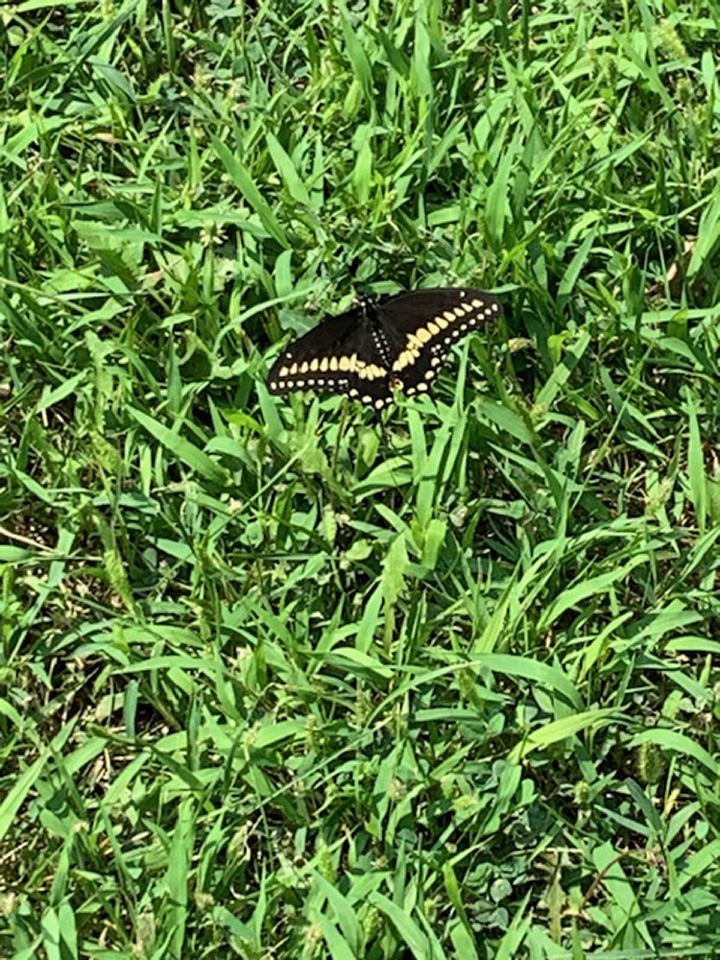
The upper side of the forewing is black with two rows of yellow spots, one on the submarginal band, one on the median band. Both rows of spots extend to the forward (costal) margin of the wing. There is also a narrow, interrupted, yellow border on the outer margin, and a single yellow spot in the area just below the tip (subapical area). On the male, the medial spots are large and closely spaced. On the female they are narrow and widely spaced.
The upper side of the hindwing is black with a marginal row of yellow spots, a postmedial row of iridescent blue spots, a median row of yellow spots, and a narrow, interrupted, yellow border on the outer margin. There is also a single eye-spot on the trailing margin near the tail. The eyespot is orange with a black pupil and a yellow border. On the male, the blue postmedial spots are small, and the yellow medial spots are large and closely spaced. On the female the blue postmedial spots are large, and the yellow medial spots are narrow and widely spaced. The hindwings have “tails”.
The underside of the forewing is black with yellow markings mirroring those on the upper side. The underside of the hindwing is black with markings mirroring those on the upper side except that many of the yellow spots are partially or completely replaced with orange spots.
The eyes are black.
The mature (fifth instar) caterpillar is variable in color and up to 2″ long. It appears smooth but is actually densely covered with minute hairs. The background color is usually green but may be white, yellow, brown and white, or black. The color is determined by the wavelength of light reaching the larva when it is in the first instar stage. This color polymorphism allows the caterpillar to match the background color of the host site. The thorax is swollen and the head is held beneath the thorax. The thorax of the green form caterpillar is green with 2 black stripes in an inverted “v” pattern and 3 black spots. Each abdominal segment is green with a broad, horizontal black band. In each black band there are 6 yellow spots. There is also a narrow black band in the fold between abdominal segments. The legs are greenish-white with 2 black spots. Mature caterpillars are found from June onward.
The pupa may be green or brown. The color varies between individuals of a local population, achieving a balance that ensures maximum survival.
There is a Y-shaped gland (osmeterium) in the middle of the upper (dorsal) portion of the first abdominal segment of the caterpillar. Normally, the osmeterium is held internally and is not visible. It secretes a chemical that produces a foul odor and repels predators. The secreted chemical may also be toxic to predators. When disturbed, the caterpillar will extend (evert) the gland, turning it inside-out, and attempt to smear the predator with the chemical.
Size
Wingspan: 3¼″ to 4¼″
Similar Species
Eastern tiger swallowtail (Papilio glaucus) has a black form female that looks similar. However, it has only one row of yellow spots on the upper side of the forewing and there is no yellow subapical spot.
Habitat
Ecology
Season
Two broods: mid-May to mid-June and mid-July to early September
Behavior
Life Cycle
Mating usually takes place on a hilltop. The female lays small yellow eggs singly on a leaf or flower of a host plant. She will lay 30 to 50 eggs per day, eventually laying 200 to 440 eggs. The larva hatches 4 to 9 days later. Over the next 10 to 30 days it molts 4 times before pupating. It overwinters as a chrysalis.
Larva Food/Hosts
Queen Anne’s lace, wild parsnip, spotted water hemlock, bland sweet cicely, American cow parsnip, and other members of the Apiaceae (carrot) family.
Adult Food
Flower nectar, especially clover.
Distribution

Sources
7, 21, 24, 27, 30, 75, 82, 83.
Biodiversity occurrence data published by: Minnesota Biodiversity Atlas (accessed through the Minnesota Biodiversity Atlas Portal, bellatlas.umn.edu. Accessed 8/9/2026).
Papilio polyxenes Fabricius, 1775 in Bánki, O., Roskov, Y., Döring, M., Ower, G., Hernández Robles, D. R., Plata Corredor, C. A., Stjernegaard Jeppesen, T., Örn, A., Pape, T., Hobern, D., Garnett, S., Little, H., DeWalt, R. E., Miller, J., Orrell, T., Aalbu, R., Abbott, J., Abreu, C., Acero P, A., et al. (2026). Catalogue of Life (2026-07-17 XR). Catalogue of Life Foundation, Amsterdam, Netherlands. https://doi.org/10.48580/dgykv
Quinn, Edward. M., and Ron Danielson. April 27, 2009. A Survey of Lepidoptera in Three Priority Areas of the Minnesota State Parks System. https://files.dnr.state.mn.us/eco/nongame/projects/consgrant_reports/2009
/2009_quinn_danielson.pdf.
Occurrence
Common
Taxonomy
Order
Lepidoptera (Butterflies and Moths)
Superfamily
Papilionoidea (Butterflies)
Family
Papilionidae (Swallowtails and Parnassians)
Subfamily
Papilioninae (Swallowtails)
Tribe
Papilionini (Fluted Swallowtails)
Genus
Papilio (Common Swallowtails)
Subgenus
Papilio
Subordinate Taxa
Black Swallowtail (Papilio polyxenes americus)
Black Swallowtail (Papilio polyxenes sadalus)
Central American Black Swallowtail (Papilio polyxenes stabilis)
Desert Black Swallowtail (Papilio polyxenes rudkini)
Eastern Black Swallowtail (Papilio polyxenes asterius) 
Synonyms
Papilio americus
Papilio mediocauda
Papilio rudkini
Common Names
Black Swallowtail