garden yellowrocket - Species Profile
Conservation • Weed • Wetland • Description • Habitat • Ecology • Use • Distribution • Taxonomy

Conservation Status
IUCN Red List
not listed
NatureServe
NNA - Not applicable
SNA - Not applicable
Minnesota
not listed
Weed Status
Garden yellowrocket is listed as an invasive or noxious weed in five states, including Michigan. It is not listed in Minnesota.
Wetland Indicator Status
Great Plains
FACU - Facultative upland
Midwest
FAC - Facultative
Northcentral & Northeast
FAC - Facultative
Description
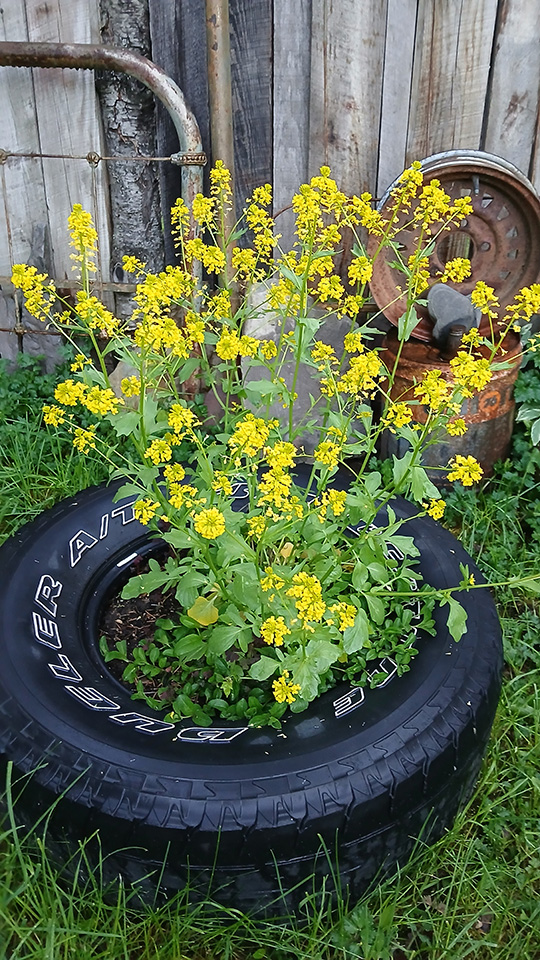
Garden yellowrocket, also known as yellow rocket, or in the UK as winter cress, is an exotic, 8″ to 32″ tall, erect, biennial or short-lived perennial forb that rises from a stout taproot. In it’s first year it forms a rosette of basal leaves up to 1′ across. In the second year it produces one or more flowering stalks. This is one of the first flowers to bloom in the spring. It blooms a second time in late fall.
The stems are erect, angled, and usually unbranched below the inflorescence. They are usually hairless but are sometimes sparsely covered near the base with unbranched, nonglandular hairs.
The leaves are alternate, dark green, hairless, and shiny on the upper surface. Basal leaves are up to 6″ long and 2″ wide and are attached to the stem with a ¾″ to 3″ long leaf stalk. They are divided into 1 to 4 pairs of small lateral lobes and a large terminal lobe. The lateral lobes are oblong, two to four times longer than broad with nearly straight sides or egg-shaped and attached at the narrow end. The terminal lobe is considerably larger, egg-shaped or nearly circular. The margins are wavy or bluntly toothed.
Lower stem leaves resemble the basal leaves but are progressively smaller as they ascend the stem. A pair of ear-like basal lobes clasp the main stem.
Upper stem leaves are egg-shaped or nearly circular and may be lobed, toothed, or entire. The margins are strongly wavy or bluntly toothed. They attach to the main stem without a stalk and sometimes clasp the stem at the base. They are not covered with a whitish, waxy coating (glaucous).
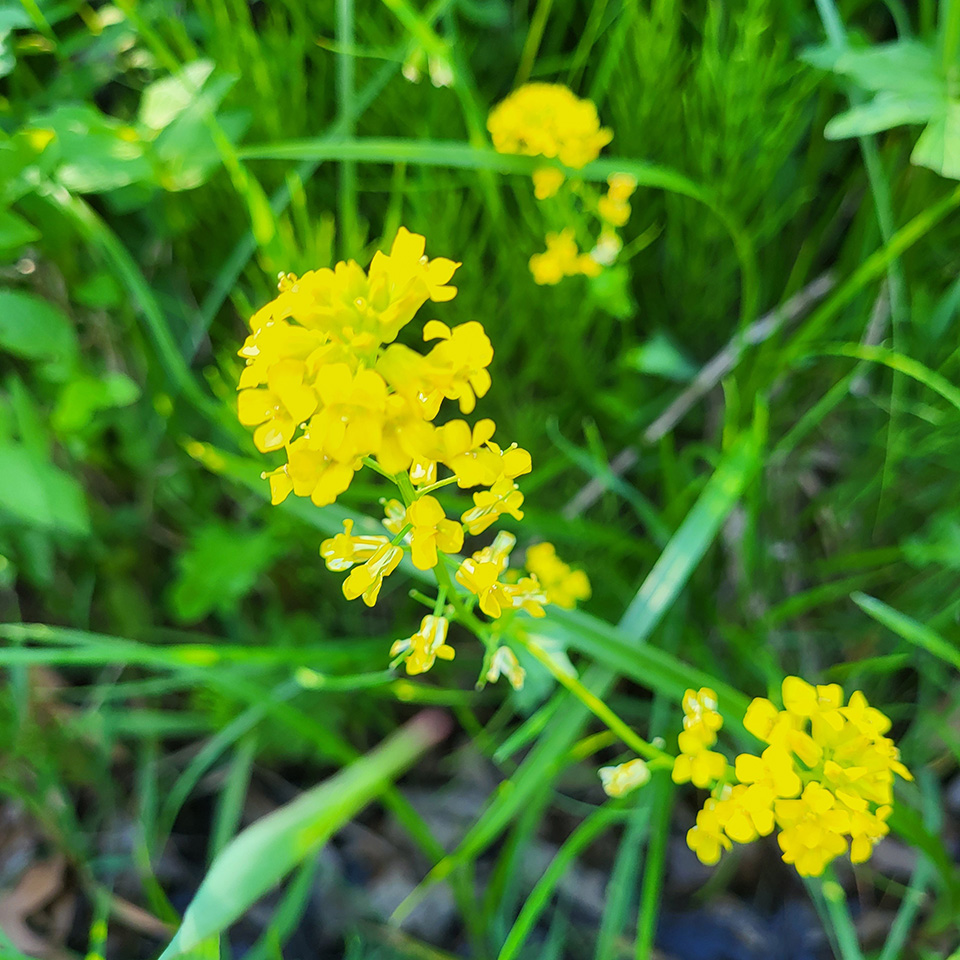
The inflorescence is a terminal, branched, elongated, crowded cluster.
The flowers have four yellow petals, are ½″ wide, and are stalked.
The fruit is an ascending or spreading, ½″ to 1½″ long, narrow, curved pod that is roundish in cross-section. The fruits develop below the inflorescence.
Height
8″ to 32″
Flower Color
Yellow
Similar Species
Early winter cress (Barbarea verna) has basal leaves with 4 to 7 pairs of lateral lobes. It is an eastern and west coast species and does not occur in Minnesota.
Northern winter cress (Barbarea orthoceras) is a native species. The petals are smaller, the flowers are ¼″ wide, and the flower stalks are thick and somewhat club-shaped.
Habitat
Moist. Fields, pastures, roadsides, and other disturbed sites.
Ecology
Flowering
April to June, September
Defense Mechanisms
This and other mustards (family Brassicaceae) produce chemical compounds when cells are damaged that are toxic to most animals, fungi, and bacteria.
Toxicity
Yellow rocket contains glucobarbarin, a chemical that deters animals from eating it. It is toxic to horses but not to dogs and cats.
Pests and Diseases
Use
Young leaves can be picked in the early spring and eaten raw in salads or chopped and cooked like spinach. As the weather warms, older leaves become strongly bitter. They must be boiled in two changes in water to reduce the bitterness.
Distribution

Sources
Biodiversity occurrence data published by: Minnesota Biodiversity Atlas (accessed through the Minnesota Biodiversity Atlas Portal, bellatlas.umn.edu. Accessed 5/18/2026).
Midwest Herbaria Portal. 2026. https://midwestherbaria.org/portal/index.php. Accessed 5/18/2026.
Barbarea vulgaris (L.) W.T.Aiton in GBIF Secretariat (2023). GBIF Backbone Taxonomy. Checklist dataset https://doi.org/10.15468/39omei accessed via GBIF.org. Accessed 5/18/2026.
EDDMapS. 2013. Early Detection & Distribution Mapping System. The University of Georgia - Center for Invasive Species and Ecosystem Health. Available online at www.eddmaps.org/. Accessed 5/18/2026.
Nativity
Native to Northern Africa, Asia and Europe. Introduced and naturalized in the United States.
Occurrence
Common
Taxonomy
Kingdom
Subkingdom
Pteridobiotina
Phylum
Tracheophyta (Vascular Plants)
Class
Order
Brassicales
Family
Brassicaceae
Subfamily
Brassicoideae
Supertribe
Camelinodae
Tribe
Cardamineae
Genus
Barbarea (Wintercresses)
Subordinate Taxa
Four varieties have been described. The varieties define points along a continuum. This makes assigning a specimen to a variety a somewhat subjective matter. Flora of North America suggests that “it is better not to recognize any infraspecific taxa in North America.”
Synonyms
Arabis barbarea
Barbarea abortiva
Barbarea altaica
Barbarea arcuata
Barbarea arcuata var. pinnatisecta
Barbarea arcuata var. pubescens
Barbarea augustana
Barbarea barbarea
Barbarea barbarea ssp. brachycarpa
Barbarea barbarea var. longisiliquosa
Barbarea ceretana
Barbarea croatica
Barbarea hirsuta
Barbarea hispanica
Barbarea iberica
Barbarea intermedia var. pyrenaica
Barbarea kayseri
Barbarea lepuznica
Barbarea linnaei
Barbarea lyrata
Barbarea macrophylla
Barbarea praecox var. vicina
Barbarea pseudostricta
Barbarea pyrenaica
Barbarea rivularis
Barbarea rupestris
Barbarea sibirica
Barbarea sicula
Barbarea stolonifera
Barbarea stricta
Barbarea sylvestris
Barbarea taurica
Barbarea vicina
Barbarea vulgaris ssp. arcuata
Barbarea vulgaris ssp. europaea
Barbarea vulgaris ssp. lepuznica
Barbarea vulgaris ssp. macrophylla
Barbarea vulgaris ssp. pyrenaica
Barbarea vulgaris ssp. rivularis
Barbarea vulgaris ssp. sibirica
Barbarea vulgaris ssp. sylvestris
Barbarea vulgaris ssp. taurica
Barbarea vulgaris ssp. vulgaris
Barbarea vulgaris var. arcuata
Barbarea vulgaris var. brachycarpa
Barbarea vulgaris var. doellii
Barbarea vulgaris var. gracilis
Barbarea vulgaris var. hirsuta
Barbarea vulgaris var. longisiliquosa
Barbarea vulgaris var. macrophylla
Barbarea vulgaris var. patens
Barbarea vulgaris var. rivularis
Barbarea vulgaris var. sibirica
Barbarea vulgaris var. sylvestris
Barbarea vulgaris var. typica
Barbarea vulgarus var. arcuata
Barbarea vulgarus var. brachycarpa
Barbarea vulgarus var. longisiliquosa
Barbarea vulgarus var. sylvestris
Campe barbarea
Campe barbarea var. hirsuta
Campe rivularis
Campe stricta var. taurica
Campe vulgaris
Cheiranthus ibericus
Cheiranthus laevigatus
Crucifera arcuata
Crucifera barbaraea
Crucifera barbarea
Eruca barbarea
Erysimum arcuatum
Erysimum barbarea
Erysimum barbarea var. patens
Erysimum lucidum
Erysimum lyratum
Erysimum lyrifolium
Sisymbrium barbarea
Common Names
bitter wintercress
bittercress
common winter cress (UK)
garden yellow rocket
garden yellowrocket
garden yellow-rocket
herb-barbaras
rocket cress
winter cress (UK)
winter-cress (UK)
wound rocket
yellow-rocket
yellow rocket
yellow rocketcress