


End band net-winged beetle
(Calopteron terminale)
Conservation • Description • Habitat • Ecology • Distribution • Taxonomy
Conservation Status |
|
||||
| IUCN Red List | not listed |
||||
| NatureServe | NNR - Unranked |
||||
| Minnesota | not listed |
||||
Description |
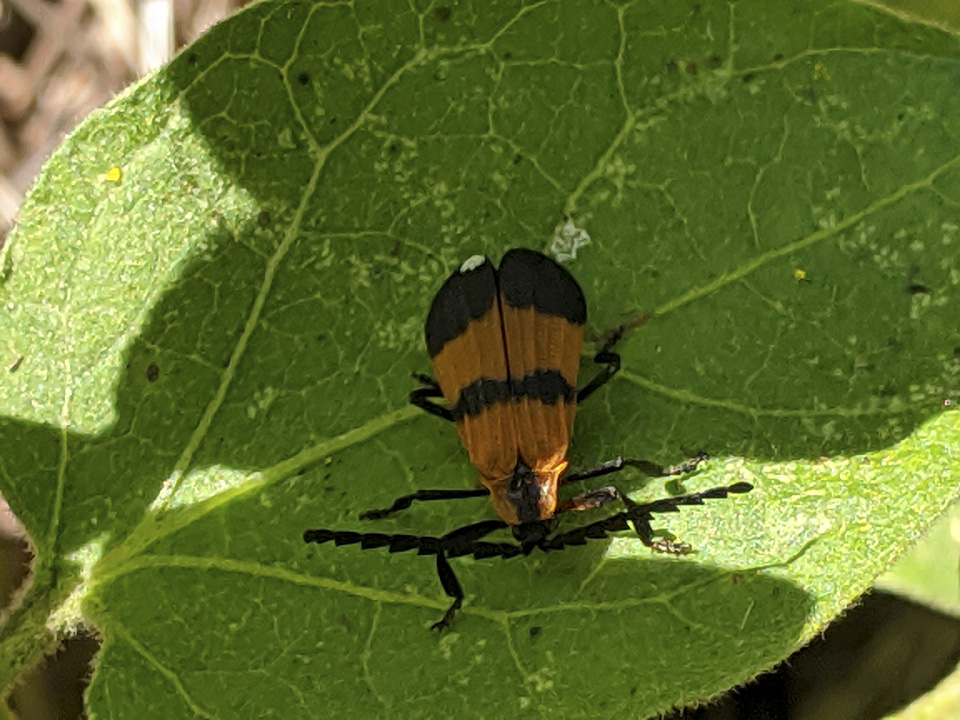
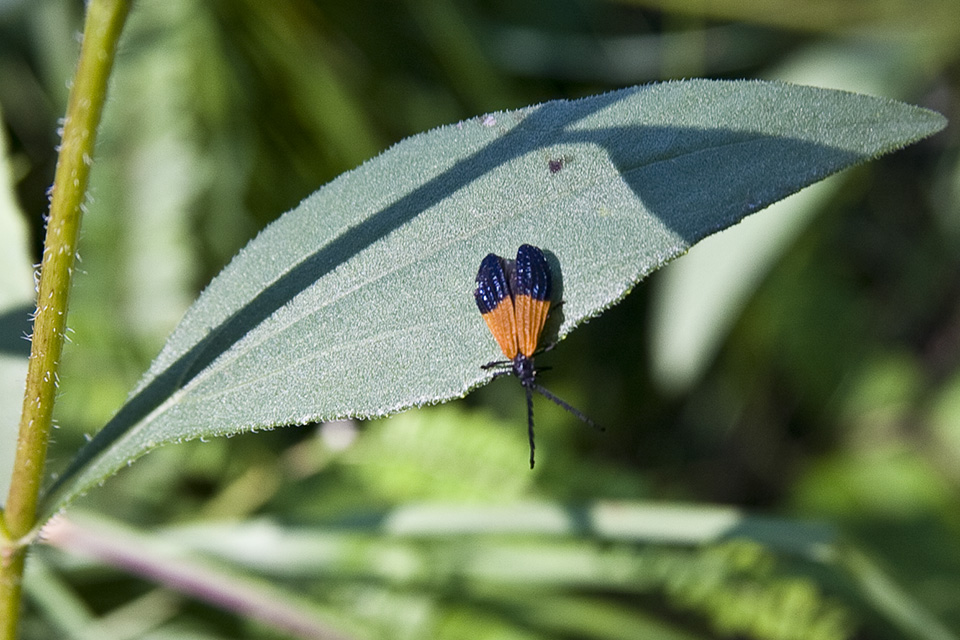
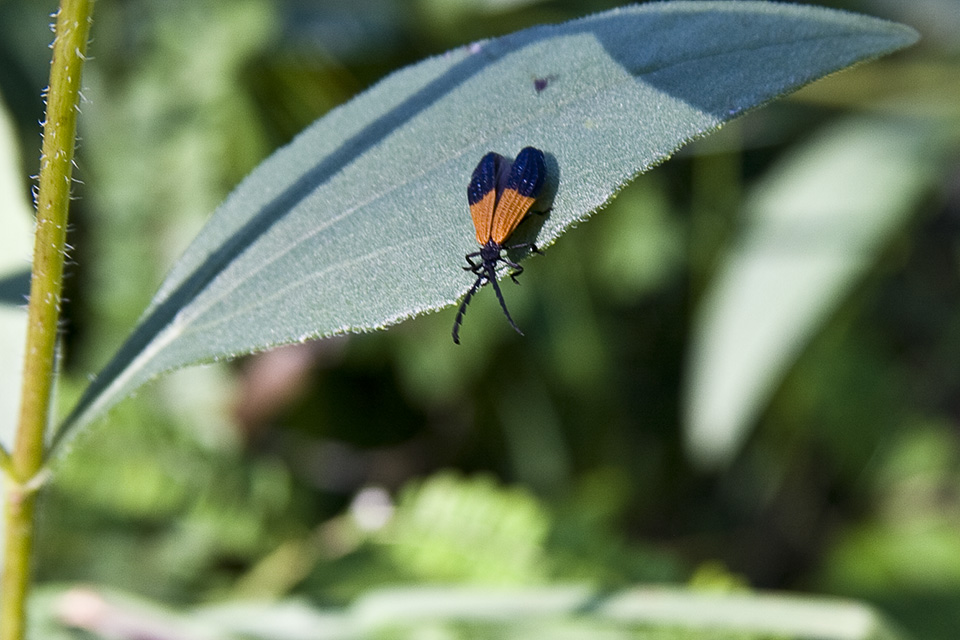
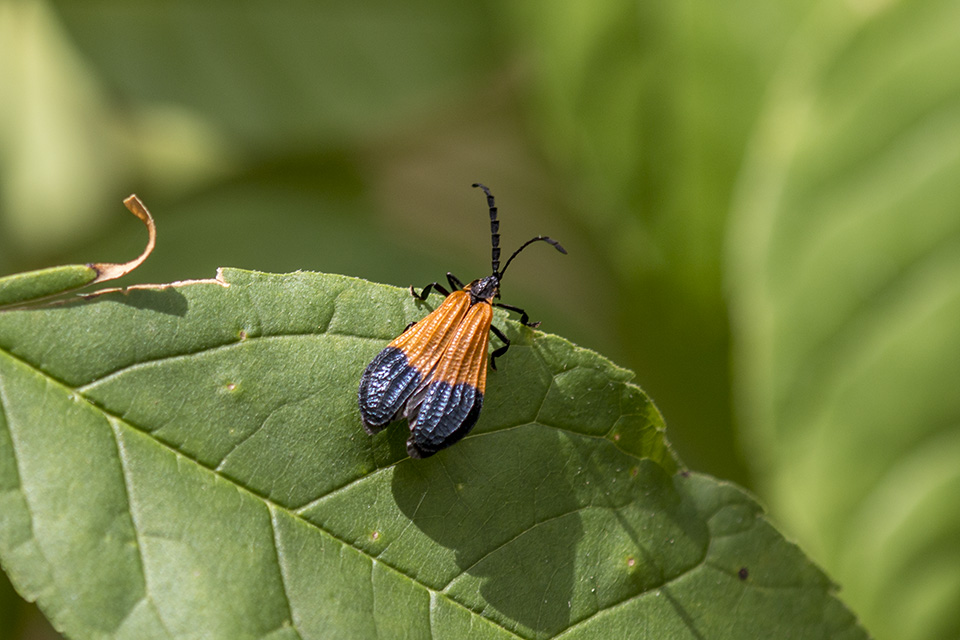
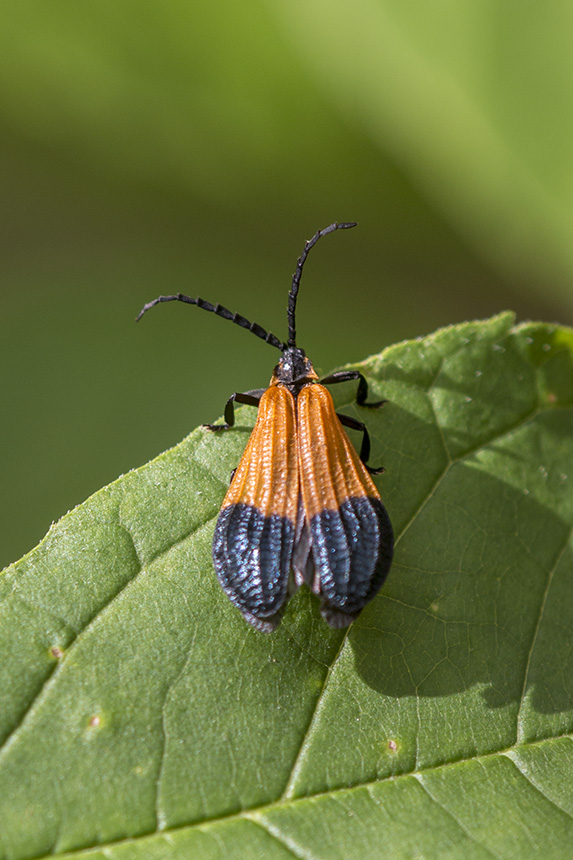
End band net-winged beetle is a medium sized, colorful, net-winged beetle. It is usually found resting on vegetation in moist woods. The body is 5 ⁄16″ to ⅝″ long. Males are smaller than females. The antennae are black, long, thick, and saw-toothed. The eyes protrude. The exoskeletal plate covering the thorax (pronotum) covers most of the head. It has yellow-orange markings on the sides. The hardened forewings (elytra) are broadest toward the rear and extend beyond the body. The basal half of the wing (near the head) is yellowish-orange, the lower half, the “band”, is bluish-black. There is sometimes also a median black band. When present, it is narrow compared to other net-winged beetles. When viewed from the side the elytra are wavy, with a depression just before the terminal black band. They have pronounced longitudinal ridges and a network of less distinct cross ridges. All of the ridges are equal in height. |
Size |
Total length: 5 ⁄16″ to ⅝″ |
Similar Species |
Habitat |
Deciduous forests |
Ecology |
Season |
August to September |
Behavior |
|
Life Cycle |
Females deposit eggs on dead or dying trees. |
Larva Food |
Small insects and mites |
Adult Food |
Juices of decaying vegetable matter. |
Distribution |
||
|
Sources |
|
| 9/19/2025 | ||
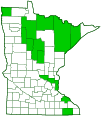
Occurrence |
||
|
||
Taxonomy |
|
Order |
Coleoptera (Beetles) |
Suborder |
Polyphaga (Water, Rove, Scarab, Long-horned, Leaf, and Snout Beetles) |
Infraorder |
Elateriformia |
Superfamily |
Elateroidea (click, firefly and soldier beetles) |
Family |
Lycidae (net-winged beetles) |
Subfamily |
Lycinae |
Tribe |
Calopterini |
Genus |
Calopteron |
Subordinate Taxa |
|
|
|
Synonyms |
|
|
|
Common Names |
|
end band net-wing beetle end band net-winged beetle end-band net-winged beetle |
|
Glossary
Elytra
The hardened or leathery forewings of beetles used to protect the fragile hindwings, which are used for flying. Singular: elytron.
Pronotum
The exoskeletal plate on the upper side of the first segment of the thorax of an insect.
Visitor Photos
Share your photo of this insect.
This button not working for you?
Simply email us at info@MinnesotaSeasons.com.
Attach one or more photos and, if you like, a caption.
Jeremy Smith |
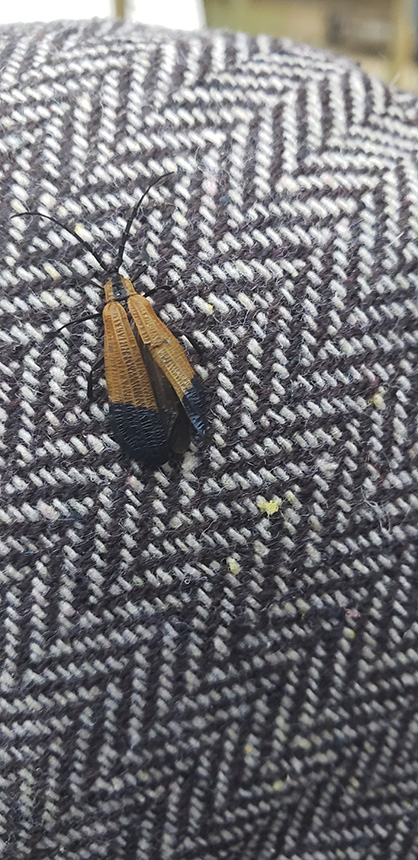 |
I am in Mississippi and found this specimen. Looked it up and appears to be native to you all. Is this an end banded net winged beetle? |
Dave Mathews |
 |
Luciearl |
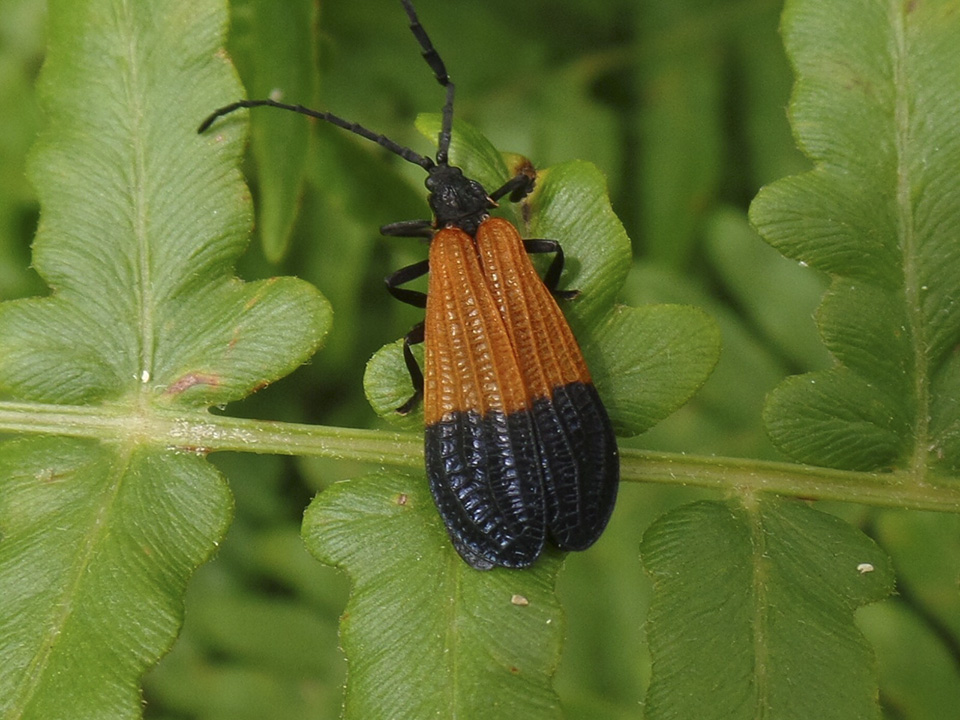 |
Net-winged beetle Found in my woods. I learn something new every time I go there. |
MinnesotaSeasons.com Photos
 |
 |
|
 |
 |
|
|

Slideshows
Calopteron terminale
Allen Chartier

Visitor Videos
Share your video of this insect.
This button not working for you?
Simply email us at info@MinnesotaSeasons.com.
Attach a video, a YouTube link, or a cloud storage link.
Other Videos
Net-winged beetle, Calopteron terminale
MJBugs

Visitor Sightings
Report a sighting of this insect.
This button not working for you?
Simply email us at info@MinnesotaSeasons.com.
Be sure to include a location.
Jeremy Smith
10/6/2020
Location: Mississippi
Dave Mathews
8/30/2020
Location: Anoka County
Luciearl
7/26/2018
Location: Fairview Township
Found in my woods. I learn something new every time I go there.
Minnesota Seasons Sightings