Green-legged grasshoppers
(Melanoplus supersp. viridipes)
Information
Overview • Description • Distribution • Taxonomy
Overview
Melanoplus is the largest genus of grasshoppers in the world. It is currently subdivided into numerous species groups. The green-legged grasshoppers form a group that currently includes 13 species. It is variously referred to as Complex Melanoplus viridipes, Melanoplus viridipes-species-group, and Viridipes group, but the official scientific name is Melanoplus supersp. viridipes.
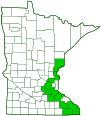
Green-legged grasshoppers occur in the United States from Vermont to northern Georgia, west to eastern Minnesota and Missouri, and in southern Ontario Canada. Of the 13 species, only one, green-legged spur-throat grasshopper (Melanoplus viridipes), is known to occur in Minnesota.
Green-legged grasshoppers are among the first grasshoppers to mature in the spring. Adults are active from May to mid-August. Like other short-winged grasshoppers, they do not fly.
Description
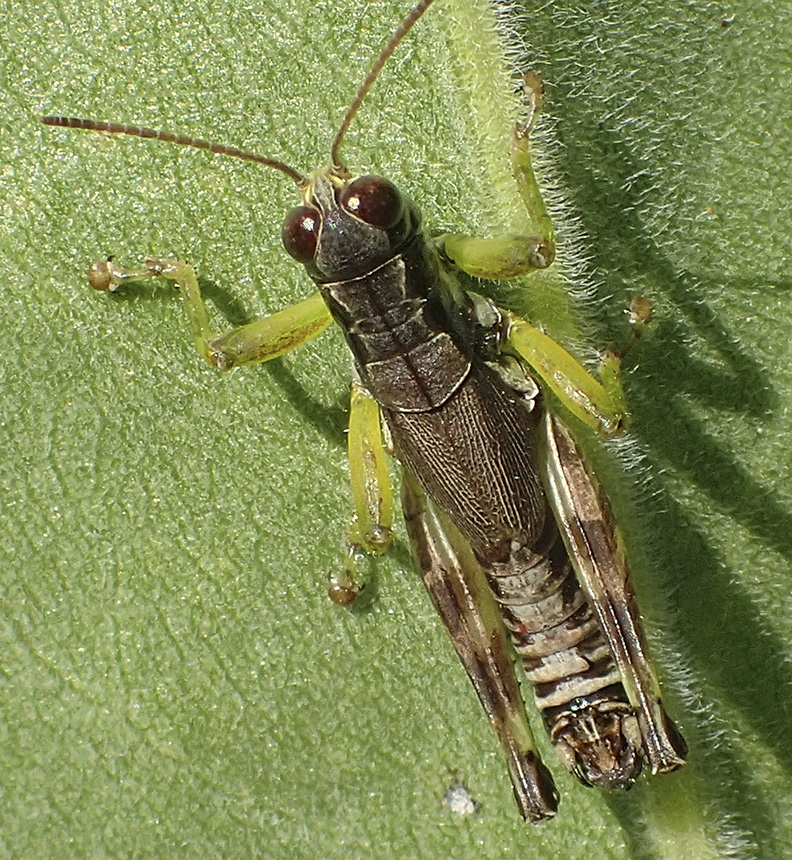
Green-legged grasshoppers are small. Adults are just 11⁄16″ to 1″ (17.5 to 25.5 mm) in length. Males are smaller than females.
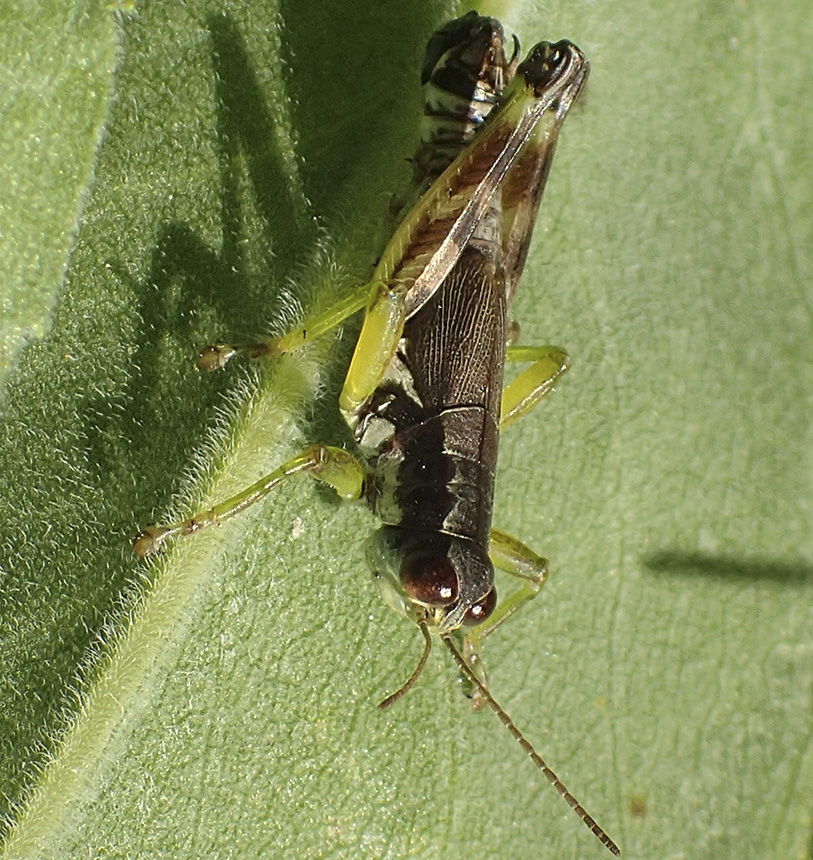
On some individuals, the body has highly contrasting black, white, and green markings. On others, it is brownish above and yellowish below. The sides of the plate on the thorax (pronotum) are white on the lower half. A black band extends from behind the eye, across the upper half of the pronotum, and onto the abdomen. The wings (tegmina) are short, elliptical, and slightly overlapping. They cover less than half of the abdomen. The front and middle legs are green. The third segment (femur) on the hind legs is usually distinctly banded, sometimes moderately or only slightly banded. On the male, the appendages at the tip of the abdomen (cerci) are slightly curved downward at the tip.
Distribution
Sources
Haarstad, J. 1990. The Acrididae of Minnesota. Final report submitted to the Minnesota Department of Natural Resources. 28 pp.
Hebard, Morgan. (1932). The Orthoptera of Minnesota. University of Minnesota. Minnesota Agricultural Experiment Station. Retrieved from the University of Minnesota Digital Conservancy, https://hdl.handle.net/11299/204015.
Taxonomy
Order
Orthoptera (Grasshoppers, Crickets, and Katydids)
Suborder
Caelifera (Grasshoppers, Locusts, and Allies)
Infraorder
Acrididea (Grasshoppers)
Nanorder
Acridomorpha
Superfamily
Acridoidea (Short-horned Grasshoppers and Locusts)
Family
Acrididae (Short-horned Grasshoppers)
Subfamily
Melanoplinae (Spur-throated Grasshoppers)
Tribe
Melanoplini
Genus
Subordinate Taxa
Melanoplus acrophilus
Melanoplus beameri
Melanoplus benni
Melanoplus cherokee (Cherokee melanoplus)
Melanoplus deceptus (deceptive melanoplus)
Melanoplus eurycercus (Hebard’s green-legged locust)
Melanoplus hubbelli (Hubbell’s melanoplus)
Melanoplus lilianae
Melanoplus longicornis
Melanoplus pachycercus
Melanoplus similis
Melanoplus sylvaticus
Melanoplus viridipes (green-legged spur-throat grasshopper) 
Synonyms
Common Names
green-legged grasshoppers
Photos
Visitor Photos
Share your photo of this insect.
This button not working for you?
Simply email us at info@MinnesotaSeasons.com.
Attach one or more photos and, if you like, a caption.
Babette Kis
Green-legged Grasshopper (Melanoplus viridipes-species-group)
Melanoplus viridipes-species-group, Green-legged Grasshopper photos taken on July 8, 2021 at Barnes Prairie, Racine Co., WI.
Minnesota Seasons Photos
Slideshows
Slideshows
Videos
Visitor Videos
Share your video of this insect.
This button not working for you?
Simply email us at info@MinnesotaSeasons.com.
Attach a video, a YouTube link, or a cloud storage link.
Other Videos
Sightings
Visitor Sightings
Report a sighting of this insect.
This button not working for you?
Simply email us at info@MinnesotaSeasons.com.
Be sure to include a location.
Babette Kis
7/8/2021
Location: Barnes Prairie, Racine Co., WI
Melanoplus viridipes-species-group, Green-legged Grasshopper photos taken on July 8, 2021 at Barnes Prairie, Racine Co., WI.
Minnesota Seasons Sightings