



Little Wood Satyr
(Megisto cymela)
Conservation • Description • Habitat • Ecology • Distribution • Taxonomy
|
|
|||||||||||||
Description |
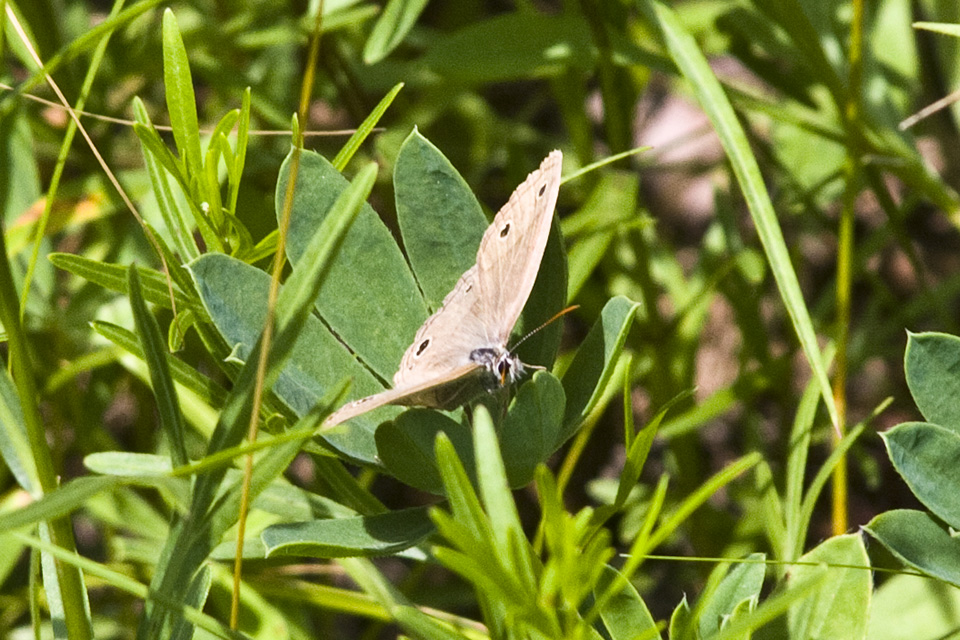
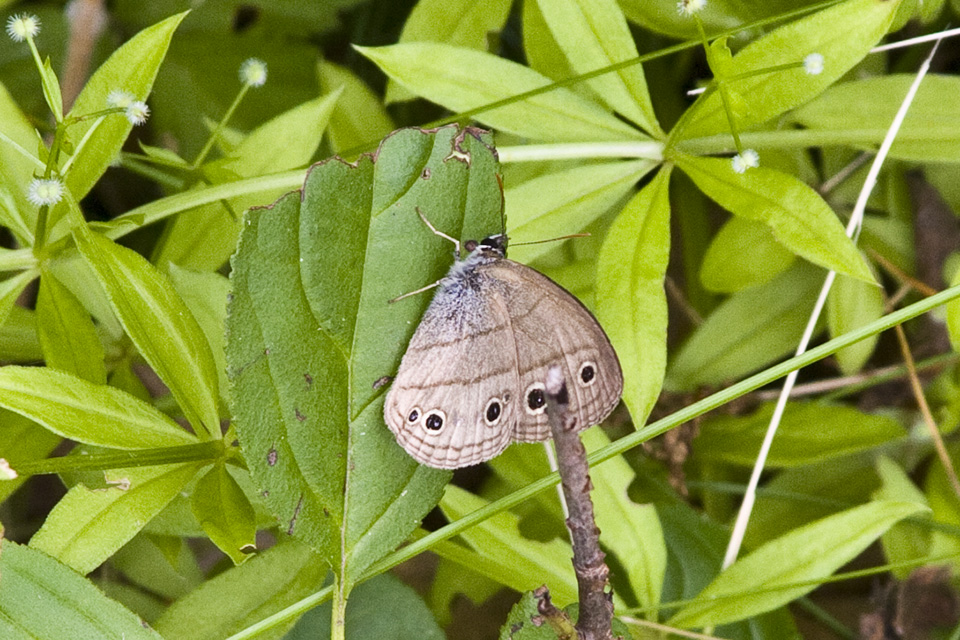
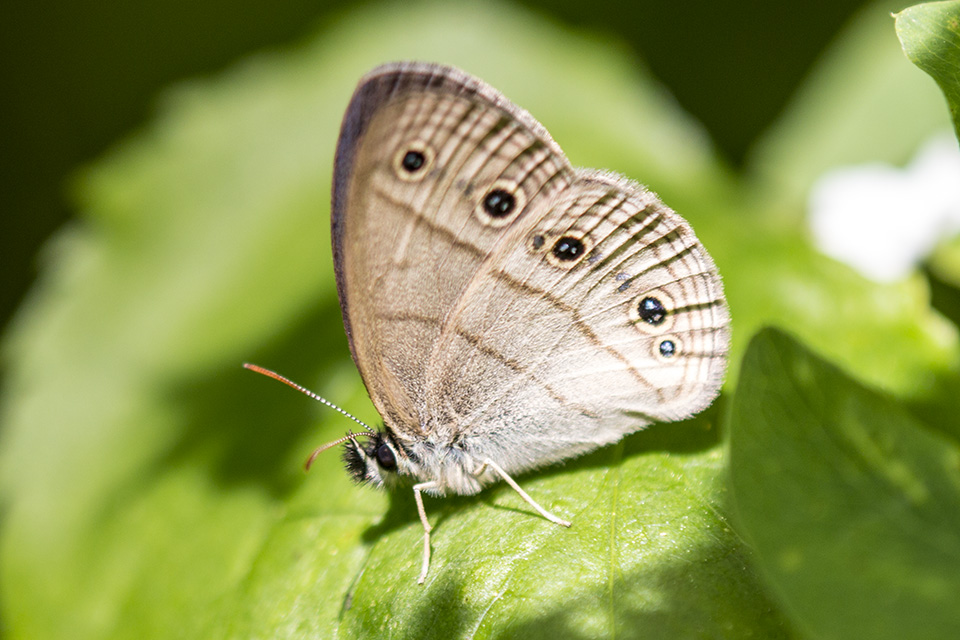
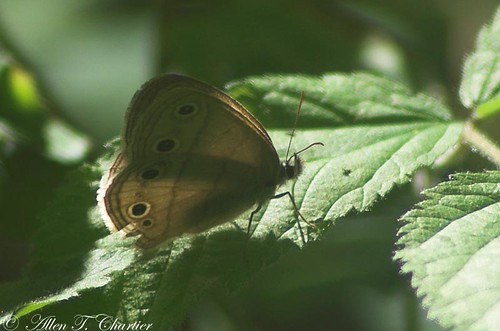
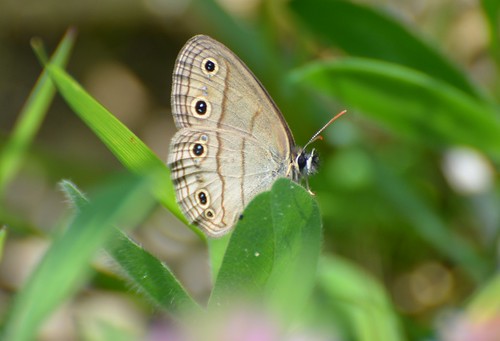
Little wood satyr is a medium-sized butterfly with rounded wings and a slow, bouncy flight. The upper wing surface is light brown to medium brown. All individuals have dark eyespots on the upper and lower sides of both wings. The eyespots are rimmed with yellow and most have two metallic gray “pupils”. Both males and females have two eyespots on the upperside of the forewing. The male has one or two large eyespots on the hindwing. The female has two large eyespots on the hindwing and may also have an additional, smaller spot between the lower eyespot and the margin. The lower wing surface is lighter than the upper surface. Both males and females have two large, prominent eyespots and a few smaller, less prominent spots on each wing. There are two distinct, parallel, relatively straight, dark brown stripes that cross both wings. |
Size |
1⅝″ to 1⅞″ wingspan |
Similar Species |
Northern pearly eye (Lethe anthedon) is larger, with a wingspan up to 2⅝″. It has 4 spots on the upper forewing and 5 on the upper hindwing, none of which have white “pupils”. The line nearest to the center of the lower hindwing is jagged, not straight. |
Habitat |
Edges between grassland and woodland |
Ecology |
Season |
One brood, late May to early August. |
Behavior |
|
Life Cycle |
The female lays eggs throughout her lifetime in the spring and summer. The eggs are placed singly on or near grass plants. Larvae feed at night. The offspring overwinter in leaf litter, pupate in the spring, and emerge as adults in late May. There is a second, smaller emergence of adults three weeks after the first. |
Larva Hosts |
Orchard grass (Dactylis glomerata glomerata), Kentucky bluegrass (Poa pratensis pratensis), and possibly other grasses. |
Adult Food |
Tree sap, aphid honeydew, fluids from decaying mushrooms, and, occasionally, flower nectar. |
Distribution |
||
|
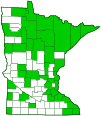
Sources 7, 21, 27, 29, 30, 71, 75, 82, 83. Biodiversity occurrence data published by: Minnesota Biodiversity Atlas (accessed through the Minnesota Biodiversity Atlas Portal, bellatlas.umn.edu, 7/12/2025). |
|
| 7/12/2025 | ||
Occurrence |
||
Common to abundant, widespread |
||
Taxonomy |
|
Order |
|
Superfamily |
Papilionoidea (Butterflies) |
Family |
|
Subfamily |
Satyriinae (satyrs, morphos, and allies) |
Tribe |
Satyrini (alpines, arctics, nymphs, and satyrs) |
Subtribe |
Euptychiina |
Genus |
Megisto |
Subordinate Taxa |
|
Little Wood Satyr (Megisto cymela cymela) Viola’s wood-satyr (Megisto cymela viola) |
|
Synonyms |
|
|
|
Common Names |
|
Little Wood Satyr |
|


Visitor Photos |
||
Share your photo of this insect. |
||
This button not working for you? |
||
|
||
|
||
MinnesotaSeasons.com Photos |
||
 |
 |
|
 |
 |
|
 |

Slideshows |
Little Wood Satyr (Megisto cymela) |
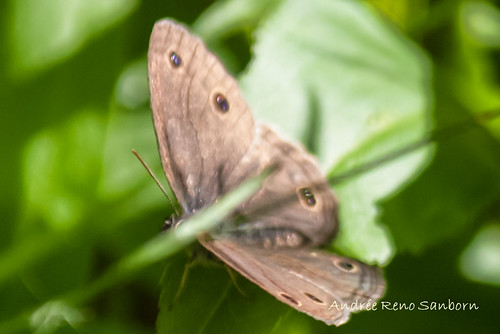
|
Megisto cymela (Little Wood Satyr) |
|
Little Wood Satyr butterfly |
|

Visitor Videos |
||
Share your video of this insect. |
||
This button not working for you? |
||
|
Other Videos |
||
Little Wood Satyr Butterfly (Nymphalidae: Megisto cymela) Sunning |
About
Published on Jun 13, 2012 Photographed at the Turtle River State Park, North Dakota (12 June 2012). Thank you to Kelly Fiegle (@Bugguide.net) for confirming the i9dentity of this specimen! |
Little Wood Satyr (Nymphalidae: Megisto cymela) on Leaf |
About
Uploaded on Jun 17, 2010 Photographed at the Rydell NWR, Minnesota (16 June 2010). |
Little Wood-Satyr |
About
Uploaded on Jul 6, 2010 |

Visitor Sightings |
||
Report a sighting of this insect. |
||
This button not working for you? |
||
|
|
MinnesotaSeasons.com Sightings |
||

Created: 6/24/2006 Last Updated: © MinnesotaSeasons.com. All rights reserved. |