



Melissa Blue
(Plebejus melissa melissa)
Conservation • Description • Habitat • Ecology • Distribution • Taxonomy
|
|
|||||||||||||

Description |
The upper side of the female is brown with light blue scales and a white margin. There is a submarginal row of reddish-orange spots on both the hindwing and the forewing. |
Size |
Wing span: ⅞″ to 1⅜″ |
Similar Species |
Karner blue (Plebejus melissa samuelis) female has no submarginal spots on the upper side of the forewing. Northern blue (Plebejus idas) female has less blue on the upper side. |
Habitat |
Open, weedy areas, meadows, and prairies. |
Ecology |
Season |
Two broods: late May to June; and August. |
Behavior |
|
Life Cycle |
|
Larva Hosts |
Various legumes of the pea family including Canadian milkvetch, Cooper’s milkvetch, ground plum, wild licorice, bird’s-foot trefoil, alfalfa, black medick, and, rarely, sundial lupine and bigleaf lupine. Caterpillars eat young leaves and are tended by ants who feed on the caterpillars’ sugary secretions. |
Adult Food |
|
Distribution |
||
|
Sources |
|
| 7/22/2025 | ||
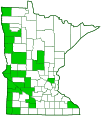
Occurrence |
||
|
||
Taxonomy |
|
Order |
|
Superfamily |
Papilionoidea (Butterflies) |
Family |
Lycaenidae (Gossamer-winged Butterflies) |
Subfamily |
Polyommatinae (blues) |
Tribe |
Polyommatini (typical blues) |
Subtribe |
Polyommatina |
Genus |
Plebejus |
Subgenus |
Lycaeides |
Subordinate Taxa |
|
|
|
Synonyms |
|
Lycaeides melissa melissa Lycaena melissa |
|
Common Names |
|
Melissa Blue orange-bordered blue |
|
Visitor Photos |
||
Share your photo of this insect. |
||
This button not working for you? |
||
|
||
|
||
MinnesotaSeasons.com Photos |
||
|

Slideshows |
|
Visitor Videos |
||
Share your video of this insect. |
||
This button not working for you? |
||
|
Other Videos |
||
|

Visitor Sightings |
||
Report a sighting of this insect. |
||
This button not working for you? |
||
|
|
MinnesotaSeasons.com Sightings |
||

Created: 10/4/2004 Last Updated: © MinnesotaSeasons.com. All rights reserved. |